
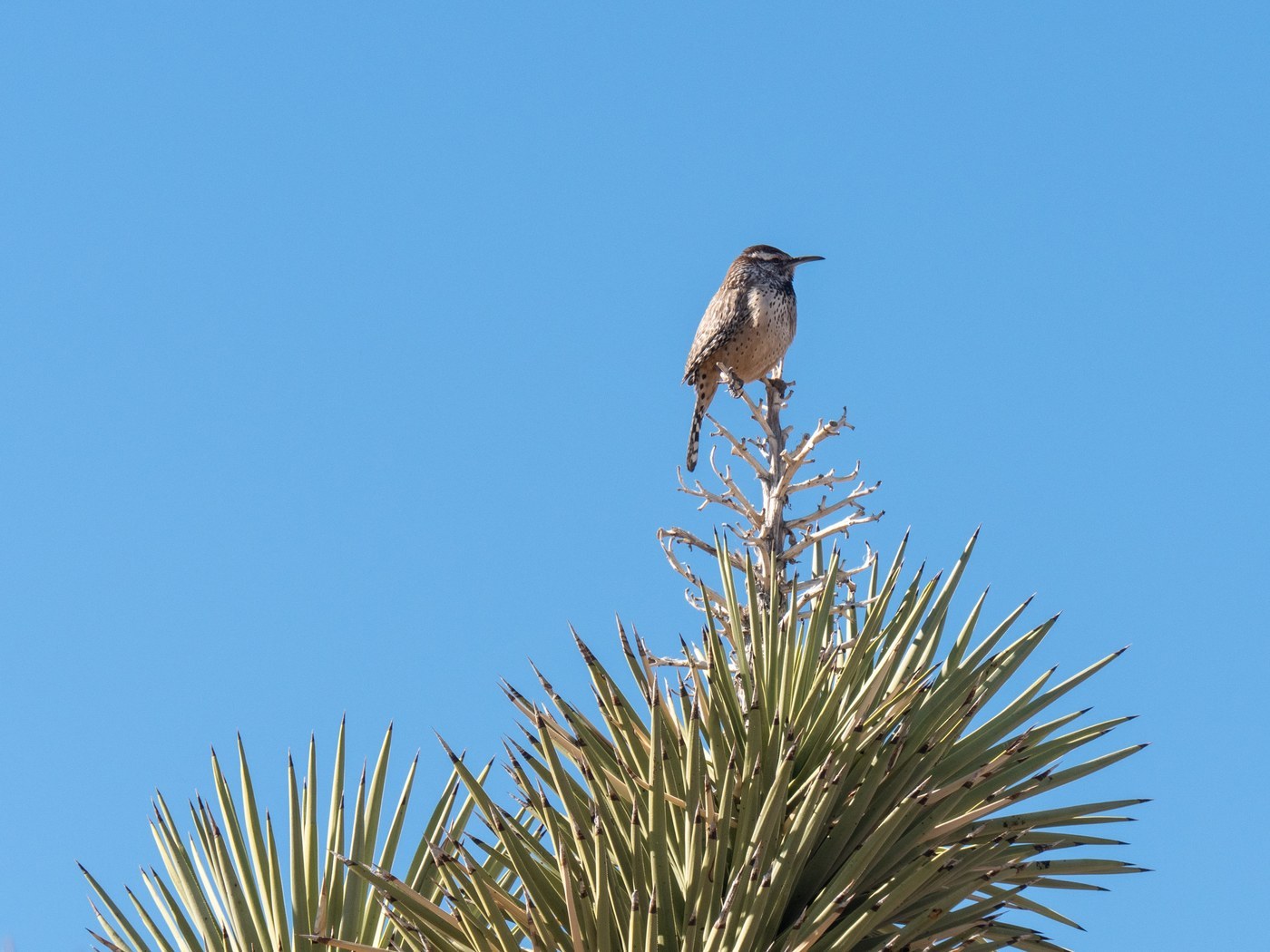
Cactus Wren
Campylorhynchus brunneicapillus
The largest North American wren, a bold, heavily spotted desert bird that nests within the spiny protection of cholla and cactus.
- Size
- 18-23 cm (7-9 in) long, 28-32 cm wingspan
- Habitat
- arid desert scrub, cactus stands, and thorny thickets in the American Southwest
- Type
- songbird
Spotted a bird like this?
Identify any bird from a photo, free.
Overview
The Cactus Wren is a large, boldly patterned wren and the state bird of Arizona, thriving in the harsh desert landscapes of the American Southwest. It has a brown crown, a prominent white eyebrow stripe, and heavily barred wings and tail, while its underparts are white to buffy and covered in dense dark spotting across the breast.
Unlike most small, secretive wrens, the Cactus Wren is conspicuous and unafraid, often seen perched atop cacti or fence posts belting out its harsh, chugging song. It is intimately tied to spiny desert plants, particularly cholla and other cacti, which provide protected nest sites from predators.
How to identify it
Key Field Marks
- Large size for a wren, with a long, slightly downcurved bill
- Bold white eyebrow stripe over a dark brown crown
- Heavy dark spotting across a whitish to buffy breast
- Strongly barred wings and a black-and-white banded tail, most visible from below
- Brown back streaked with white
Similar Species
No other North American wren approaches the Cactus Wren's large size and heavy spotting. Curve-billed Thrasher shares similar desert habitat and has a downcurved bill but is uniformly grayish-brown without bold spotting or a white eyebrow, and has orange eyes. Cactus Wren's harsh, mechanical song and habit of nesting in cactus further distinguish it.
Habitat & range
Habitat
Cactus Wrens inhabit arid desert scrub and thorn scrub, especially areas with abundant cholla, prickly pear, or other spiny cacti and desert shrubs that offer protected nest sites.
Range
This species is resident across the southwestern United States, including Arizona, southern California, New Mexico, and Texas, extending south through much of Mexico.
Migration
Cactus Wrens are non-migratory, remaining on their desert territories throughout the year regardless of season.
Behavior & voice
Behavior
Bold and gregarious for a wren, Cactus Wrens forage on the ground and in shrubs in small family groups, flicking their tails and often perching conspicuously in the open, including atop cacti.
Voice
The song is a harsh, low, rhythmic 'chug-chug-chug-chug,' often likened to a car engine struggling to start, and is one of the characteristic sounds of the desert Southwest. Calls include harsh churrs and chatters.
Feeding
It forages mostly on the ground, flipping leaves and debris to find insects and spiders, and also eats seeds, fruit, and occasionally small lizards.
Nesting & Breeding
Cactus Wrens build large, football-shaped nests of grass and plant fibers with a side entrance, typically wedged deep within the protective spines of cholla or other cactus. Pairs often build multiple nests year-round for roosting as well as breeding, and raise 2-3 broods of 3-5 eggs per season.
Frequently asked questions
Why does the Cactus Wren build its nest in cacti?
Nesting deep within spiny cholla or other cactus protects the eggs and young from most ground and avian predators, which cannot easily reach through the thorns.
What does a Cactus Wren sound like?
It gives a harsh, low, chugging song often compared to a car engine trying to start, repeated in a steady rhythm.
How big is a Cactus Wren?
It is the largest wren in North America, roughly 18-23 cm (7-9 in) long, noticeably bigger and bulkier than other wren species.
What does a Cactus Wren eat?
It mainly eats insects and spiders, along with some seeds, fruit, and occasionally small lizards.
Where does the Cactus Wren live?
It is a year-round resident of arid desert scrub across the southwestern United States and much of Mexico, wherever cacti and thorny shrubs are common.
Cactus Wren guides
In-depth guides for identifying, finding, and understanding Cactus Wren.
Other birds you may enjoy

Black Redstart
13-14.5 cm (5.1-5.7 in) long, 23-26 cm wingspan

Black-throated Sparrow
12-14 cm (4.7-5.5 in) long, about 19-20 cm (7.5-8 in) wingspan

Greater Bird-of-paradise
Body about 43 cm; males with additional flank plumes up to 50 cm and long tail wires

Blue Tit
11-12 cm (4.3-4.7 in) long, 17-20 cm wingspan

Red-billed Quelea
11.5–13 cm long, wingspan about 20–22 cm
White-plumed Antbird
13-14 cm (5-5.5 in) long

Pyrrhuloxia
19-22 cm (7.5-8.7 in) long, 30 cm wingspan

Blue-gray Tanager
16-18 cm (6-7 in) long

Blackburnian Warbler
11-13 cm (4.3-5.1 in) long, 20-22 cm wingspan

Bluethroat
13-14 cm (5.1-5.5 in) long, 20-22 cm wingspan

Eurasian Nuthatch
12-14.5 cm (4.7-5.7 in) long, 22.5-27 cm wingspan

Wood Thrush
19-21 cm (7.5-8.3 in) long, about 33 cm (13 in) wingspan