
Cactus Wren Identification Guide
North America's largest wren, a chunky desert bird with a heavily spotted breast and a raspy, chugging call, closely tied to cholla and other spiny desert vegetation.
Read the full Cactus Wren encyclopedia entry →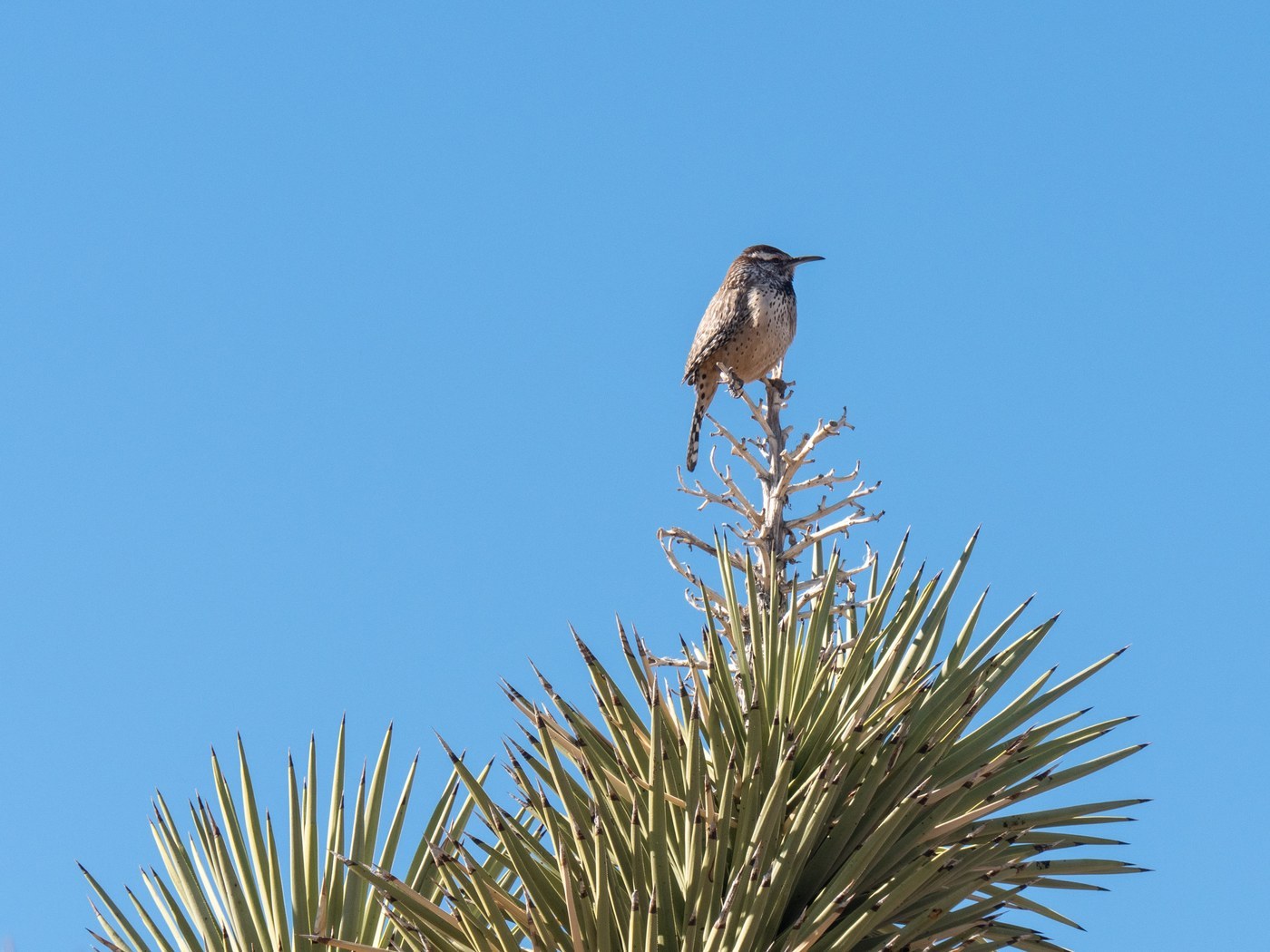
Key Field Marks
- Size & shape: Notably larger and bulkier than other wrens (about 8-9 inches long), with a long, slightly downcurved bill and a long tail often held cocked or flat, not sharply upturned like smaller wrens.
- Plumage: Heavily streaked brown back; the underparts are whitish to buffy and covered in bold, dark spots (not fine streaking), giving a "necklace" effect across the throat and chest.
- Head pattern: Broad white eyebrow (supercilium) contrasting with a dark brown cap and a dark line through the eye.
- Tail: Barred black-and-white outer tail feathers, visible in flight or when the tail is fanned.
- Bill and legs: Bill is thin, slightly curved, and dark; legs are sturdy and grayish, suited to hopping between cactus branches.
Separating from Similar Species
- Compared to other wrens (Bewick's, House, Canyon): Cactus Wren is much larger and heavier-bodied, with a spotted rather than plain or barred breast; other North American wrens lack the bold chest spotting.
- Compared to thrashers: Thrashers are slimmer, longer-tailed, and have a more sharply curved bill with streaked (not spotted) underparts; Cactus Wren looks stockier and shorter-tailed by comparison.
- Juveniles: Young birds show duller, less crisp spotting but retain the same overall shape and bold white eyebrow.
Where & When to See It
- Habitat: Sonoran, Mojave, and Chihuahuan desert scrub, especially areas with cholla, saguaro, and other cacti used for nesting and cover.
- Range: Resident (non-migratory) across the desert Southwest, including Arizona, southern California, Nevada, New Mexico, Texas, and northern Mexico.
- Season: Present year-round; most easily seen and heard during the breeding season (spring) when pairs are actively defending territory and building their football-shaped nests in cholla.
Voice & Song Cues
- Song is a harsh, low, mechanical cha-cha-cha-cha-cha, often described as sounding like a car engine struggling to start.
- Calls are frequent and raspy, given year-round by both sexes, and often the first clue to the bird's presence before it's seen.
- Pairs and family groups call back and forth, making Cactus Wrens one of the most vocal residents of the desert.
Frequently asked questions
What is the easiest way to identify a Cactus Wren?
Look for a large, chunky wren with a spotted (not streaked) breast, a bold white eyebrow, and a habit of perching conspicuously on cholla or saguaro while giving a harsh, chugging call.
How is Cactus Wren different from a thrasher?
Cactus Wren is shorter-tailed and stockier with spotted underparts, while desert thrashers are slimmer, longer-tailed, and more streaked, with a more strongly curved bill.
Where do Cactus Wrens nest?
They build large, football-shaped grass nests tucked deep inside spiny cholla cactus or other thorny desert shrubs, which protects eggs and young from predators.
Do Cactus Wrens migrate?
No, they are non-migratory residents that stay on their desert territory year-round, which is why they can be found in the same washes and cactus stands in any season.
What does a Cactus Wren sound like?
Its song is a low, harsh, repetitive chug-chug-chug, often compared to a car that won't start; it is one of the most distinctive sounds of the Sonoran Desert.