
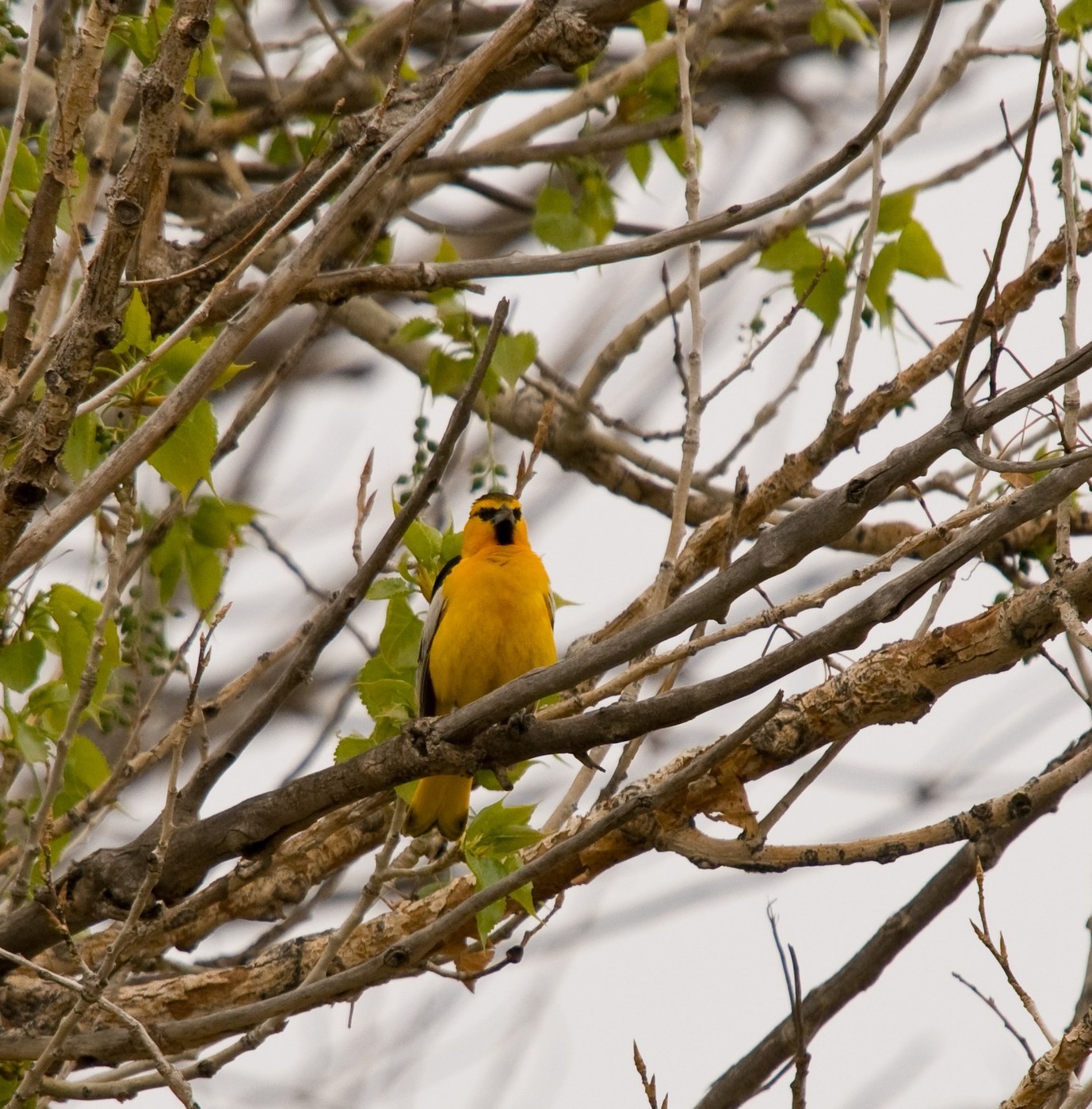
Bullock's Oriole
Icterus bullockii
The common western oriole, with males showing brilliant orange plumage, a bold black eyeline, and a large white wing patch.
- Size
- 17-19 cm (6.7-7.5 in) long, 30-33 cm wingspan
- Habitat
- open woodlands, riparian groves, orchards, and shade trees in the west
- Type
- songbird
Spotted a bird like this?
Identify any bird from a photo, free.
Overview
Bullock's Oriole is the western counterpart to the Baltimore Oriole, and the two were once considered a single species known as the Northern Oriole due to occasional hybridization where their ranges meet on the Great Plains. Adult males are vivid orange with a black crown, eyeline, throat, and back, and a large white patch on the black wing. Females and immatures are grayish-olive above with yellow-orange on the face, throat, and breast, fading to whitish on the belly.
Common throughout much of the western United States in summer, Bullock's Oriole is a familiar sight at hummingbird and oriole feeders, and its striking coloration and cheerful song make it a favorite among birders in riparian and suburban settings.
How to identify it
Key Field Marks
- Adult male: bright orange face and underparts, black crown, eyeline, throat stripe, and back, large white wing patch
- Female/immature: gray-olive back, yellow-orange head, throat and breast, whitish belly
- Fairly long, straight, pointed bill
- Large white wing patch is diagnostic for males, distinguishing from Baltimore Oriole
Similar Species
- Baltimore Oriole males have a solid black hood (not just an eyeline) and lack the large white wing patch; the two species hybridize where ranges meet in the central Great Plains.
- Hooded Oriole males have a black face/bib but orange-yellow crown, and a thinner, more strongly downcurved bill.
- Scott's Oriole males are yellow, not orange, with a black head and back.
Habitat & range
Habitat
Bullock's Oriole favors open woodlands, riparian corridors with cottonwoods and willows, orchards, and shade trees in parks and suburban yards.
Range
Breeds throughout the western United States and southwestern Canada, east to the Great Plains where it meets and occasionally hybridizes with the Baltimore Oriole. Winters mainly in Mexico and Central America.
Migration
A long-distance neotropical migrant, arriving on breeding grounds in spring and departing by late summer for wintering areas farther south.
Behavior & voice
Behavior
Bullock's Orioles forage actively in tree canopies, gleaning insects and probing flowers for nectar, and readily visit sugar-water and orange-slice feeders.
Voice
The song is a series of rich, chattering whistles and harsh notes, less flute-like and more varied than the Baltimore Oriole's song; the call is a sharp, dry chatter.
Feeding
Diet includes caterpillars, beetles, and other insects, along with fruit and nectar, particularly important during migration when they seek high-energy food sources.
Nesting & Breeding
The female weaves an intricate, pouch-like hanging nest from plant fibers, hair, and grass, usually suspended near the end of a tree branch. She incubates 3-6 eggs alone while the male helps feed the young after hatching.
Frequently asked questions
How is Bullock's Oriole different from the Baltimore Oriole?
Bullock's Oriole males have a black eyeline (not a full black hood), an orange face, and a large white wing patch, while Baltimore Oriole males have a solid black head and smaller white wingbars; their ranges meet and occasionally overlap on the Great Plains.
Were Bullock's and Baltimore Orioles once considered the same species?
Yes, because they hybridize where their ranges overlap, they were lumped as a single species called the Northern Oriole for several decades before being split back into two species based on further study.
What attracts Bullock's Orioles to a backyard?
Offering sugar-water nectar feeders, orange halves, and grape jelly, along with mature shade trees, can attract Bullock's Orioles to gardens within their western range.
Where does Bullock's Oriole build its nest?
It weaves a hanging, pouch-shaped nest from plant fibers and hair, typically suspended from the outer branches of a tall tree such as a cottonwood or sycamore.
Bullock's Oriole guides
In-depth guides for identifying, finding, and understanding Bullock's Oriole.
Other birds you may enjoy

Black Redstart
13-14.5 cm (5.1-5.7 in) long, 23-26 cm wingspan

Black-throated Sparrow
12-14 cm (4.7-5.5 in) long, about 19-20 cm (7.5-8 in) wingspan

Greater Bird-of-paradise
Body about 43 cm; males with additional flank plumes up to 50 cm and long tail wires

Blue Tit
11-12 cm (4.3-4.7 in) long, 17-20 cm wingspan

Red-billed Quelea
11.5–13 cm long, wingspan about 20–22 cm
White-plumed Antbird
13-14 cm (5-5.5 in) long

Pyrrhuloxia
19-22 cm (7.5-8.7 in) long, 30 cm wingspan

Blue-gray Tanager
16-18 cm (6-7 in) long

Blackburnian Warbler
11-13 cm (4.3-5.1 in) long, 20-22 cm wingspan

Bluethroat
13-14 cm (5.1-5.5 in) long, 20-22 cm wingspan

Eurasian Nuthatch
12-14.5 cm (4.7-5.7 in) long, 22.5-27 cm wingspan

Wood Thrush
19-21 cm (7.5-8.3 in) long, about 33 cm (13 in) wingspan