
Bullock's Oriole Identification Guide
The common western oriole, with males showing a bright orange face broken only by a black crown, eye-line, and throat, plus a bold white wing patch.
Read the full Bullock's Oriole encyclopedia entry →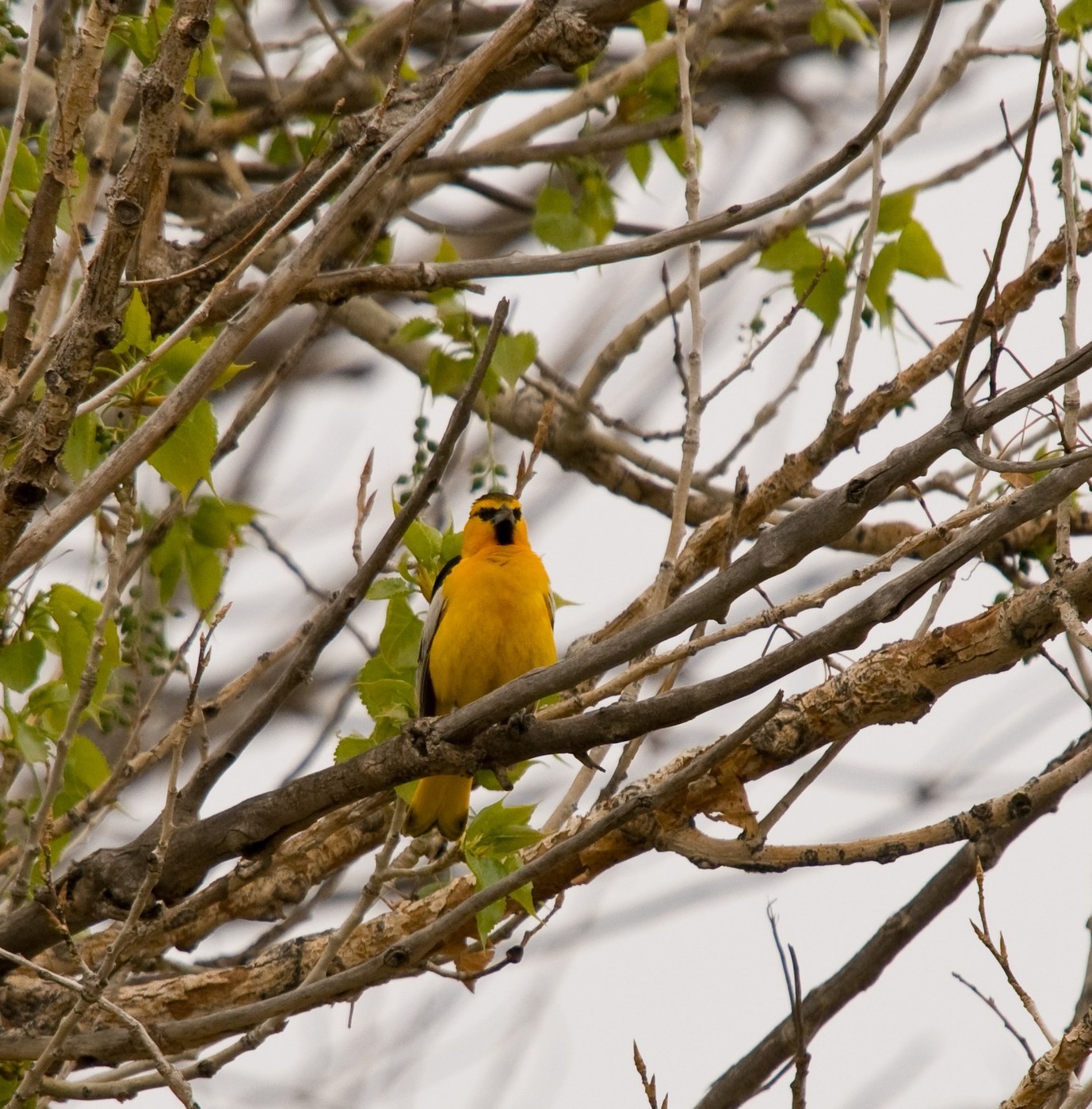
Key Field Marks
- Medium-sized oriole, about 18–19 cm (7–7.5 in), with a fairly long, pointed grayish bill.
- Adult male: bright orange face, underparts, and rump, with a black crown, black line through the eye, black throat patch, and black back; wings are black with a large, solid white patch (not just bars).
- Tail is mostly black with orange corners visible in flight or when spread.
- Adult female and immature male: grayish-olive back, yellowish-orange head, throat, and breast fading to whitish-gray on the belly, with two white wing bars rather than a solid patch.
- Overall a slimmer, longer-billed, longer-tailed shape than most other backyard songbirds.
Separating It From Similar Species
- Baltimore Oriole: male has an entirely solid black head/hood (not just a crown, eye-line, and throat patch), giving a more "hooded" look versus Bullock's more orange face; the two species hybridize in a narrow zone across the Great Plains where their ranges meet, and hybrids can show intermediate patterns.
- Female Bullock's vs. female Baltimore: female Baltimore tends to be more uniformly orange below with a darker olive-brown back, while female Bullock's shows a paler, grayer belly and a more contrasting yellowish throat/breast.
- Hooded Oriole: male is more solidly orange/yellow with less black on the face and a noticeably longer, more strongly downcurved bill.
- The white wing patch (solid block, not two thin bars) on adult male Bullock's is a quick, reliable mark versus many other orioles.
Habitat, Range & Season
- Breeds across the western United States and southwestern Canada, from the Great Plains to the Pacific coast.
- Favors open woodlands, riparian corridors with cottonwoods and willows, orchards, parks, and suburban shade trees.
- A summer breeder in most of its range, arriving in spring and departing by early fall; winters mainly in Mexico and Central America.
- Regularly visits nectar and fruit (orange halves, jelly) feeders during migration and breeding season.
Voice
- Song is a series of rich, chattering whistled phrases, harsher and more broken/chattery overall than the fluty, more musical song of Baltimore Oriole.
- Common call is a sharp, dry chattering rattle, plus a clear whistled "wheet" note.
Frequently asked questions
How do you tell a Bullock's Oriole from a Baltimore Oriole?
Male Bullock's Oriole has an orange face broken by a black crown, eye-line, and throat patch, while male Baltimore Oriole has an entirely solid black hood covering the whole head; the two also hybridize where their ranges meet on the Great Plains.
What does a female Bullock's Oriole look like?
Females are grayish-olive above with a yellowish-orange head, throat, and breast that fades to a paler grayish belly, and show two white wing bars rather than the male's solid white wing patch.
Where do Bullock's Orioles breed?
They breed across the western United States and southwestern Canada in open woodlands, riparian cottonwood groves, orchards, and shade trees, wintering mainly in Mexico and Central America.
Do Bullock's and Baltimore Orioles interbreed?
Yes, they hybridize in a contact zone across the Great Plains where their breeding ranges overlap, and hybrid individuals can show mixed head patterns.