
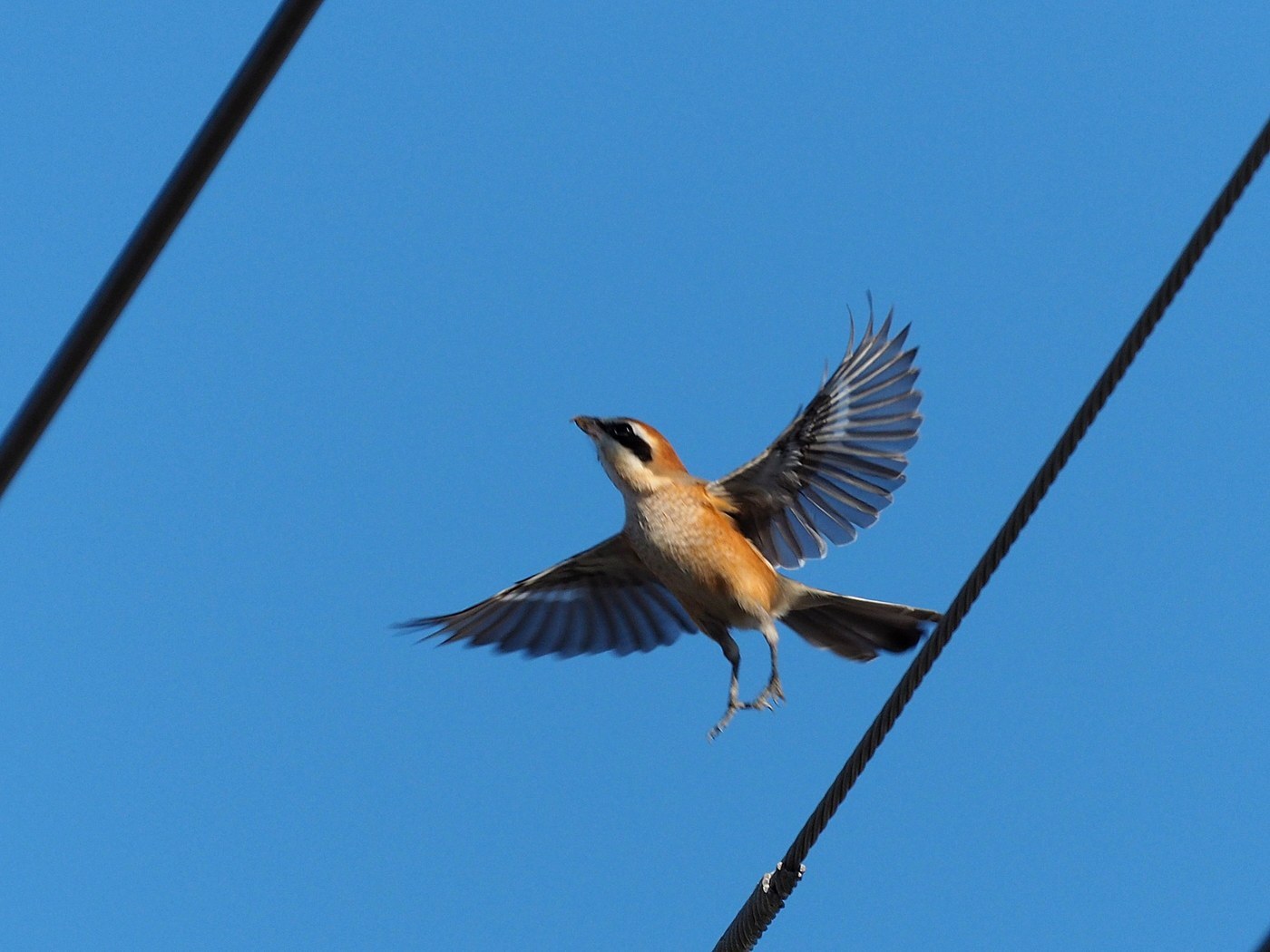
Bull-headed Shrike
Lanius bucephalus
A compact, big-headed predatory songbird with a rufous crown, black mask, and hooked bill, known for impaling prey on thorns.
- Size
- 19-20 cm (7.5-8 in) long
- Habitat
- open woodland edges, farmland, orchards, and scrubby fields
- Type
- songbird
Spotted a bird like this?
Identify any bird from a photo, free.
Overview
The Bull-headed Shrike is a stocky, large-headed songbird belonging to the predatory shrike family. Adults show a warm rufous-brown crown and nape, a bold black mask through the eye, a grey-brown back, and a strongly hooked bill used for subduing prey. Underparts are pale with fine barring, more pronounced in females and immatures, giving them a scaled appearance.
Like other shrikes, it hunts from an exposed perch, dropping onto prey on the ground, and is well known for its habit of impaling captured insects and small animals on thorns or barbed wire as a way of storing food or displaying territorial fitness, a behavior sometimes called a "larder."
How to identify it
Key field marks
- Rufous-brown crown and nape contrasting with a grey-brown back
- Broad black mask through the eye, more extensive and blacker in males
- Strongly hooked, shrike-typical bill
- Pale underparts with fine barring, especially on females and young birds
- Habit of perching prominently on wires, fences, or exposed branches
Similar species
- Brown Shrike is more uniformly rufous-brown overall without as strong a contrast between crown and back, and typically has a shorter, less hooked-looking bill impression.
- Great Grey Shrike and other larger shrikes are bigger with more grey plumage overall.
Habitat & range
Habitat
Prefers open country with scattered trees and shrubs, including farmland, orchards, forest edges, hedgerows, and scrubby grassland.
Range
Breeds across Japan, the Korean Peninsula, and northeastern China; northern populations winter further south within the same general region.
Migration
Partially migratory; birds from colder northern areas move to milder lowland or southern areas for winter, while southern populations tend to be resident.
Behavior & voice
Behavior
Hunts from an exposed perch, watching for movement before dropping onto prey on the ground; frequently caches surplus prey by impaling it on thorns, twigs, or barbed wire.
Voice
A harsh, chattering "gee-gee-gee" or scolding rattle; males also give a more varied, mimicking song during the breeding season.
Feeding
Takes large insects such as grasshoppers and beetles, along with small lizards, frogs, and occasionally small birds or rodents, using its hooked bill to kill and dismember prey.
Nesting
Builds a bulky cup nest of twigs and grass in a dense shrub or low tree; lays 4-6 pale eggs with darker speckling.
Frequently asked questions
Why does the Bull-headed Shrike impale prey on thorns?
It caches surplus prey by impaling insects, lizards, and other small animals on thorns or barbed wire, likely both to store food for later and as a signal of hunting prowess to potential mates.
What does a Bull-headed Shrike eat?
Mainly large insects such as grasshoppers and beetles, along with small lizards, frogs, and occasionally small birds or rodents.
How can you identify a Bull-headed Shrike?
Look for a rufous-brown crown and nape, a bold black mask through the eye, and a hooked bill, often seen perched prominently on wires or exposed branches.
Where does the Bull-headed Shrike live?
In open country with scattered trees, including farmland, orchards, and woodland edges across Japan, Korea, and northeastern China.
Bull-headed Shrike guides
In-depth guides for identifying, finding, and understanding Bull-headed Shrike.
Other birds you may enjoy

Black Redstart
13-14.5 cm (5.1-5.7 in) long, 23-26 cm wingspan

Black-throated Sparrow
12-14 cm (4.7-5.5 in) long, about 19-20 cm (7.5-8 in) wingspan

Greater Bird-of-paradise
Body about 43 cm; males with additional flank plumes up to 50 cm and long tail wires

Blue Tit
11-12 cm (4.3-4.7 in) long, 17-20 cm wingspan

Red-billed Quelea
11.5–13 cm long, wingspan about 20–22 cm
White-plumed Antbird
13-14 cm (5-5.5 in) long

Pyrrhuloxia
19-22 cm (7.5-8.7 in) long, 30 cm wingspan

Blue-gray Tanager
16-18 cm (6-7 in) long

Blackburnian Warbler
11-13 cm (4.3-5.1 in) long, 20-22 cm wingspan

Bluethroat
13-14 cm (5.1-5.5 in) long, 20-22 cm wingspan

Eurasian Nuthatch
12-14.5 cm (4.7-5.7 in) long, 22.5-27 cm wingspan

Wood Thrush
19-21 cm (7.5-8.3 in) long, about 33 cm (13 in) wingspan