
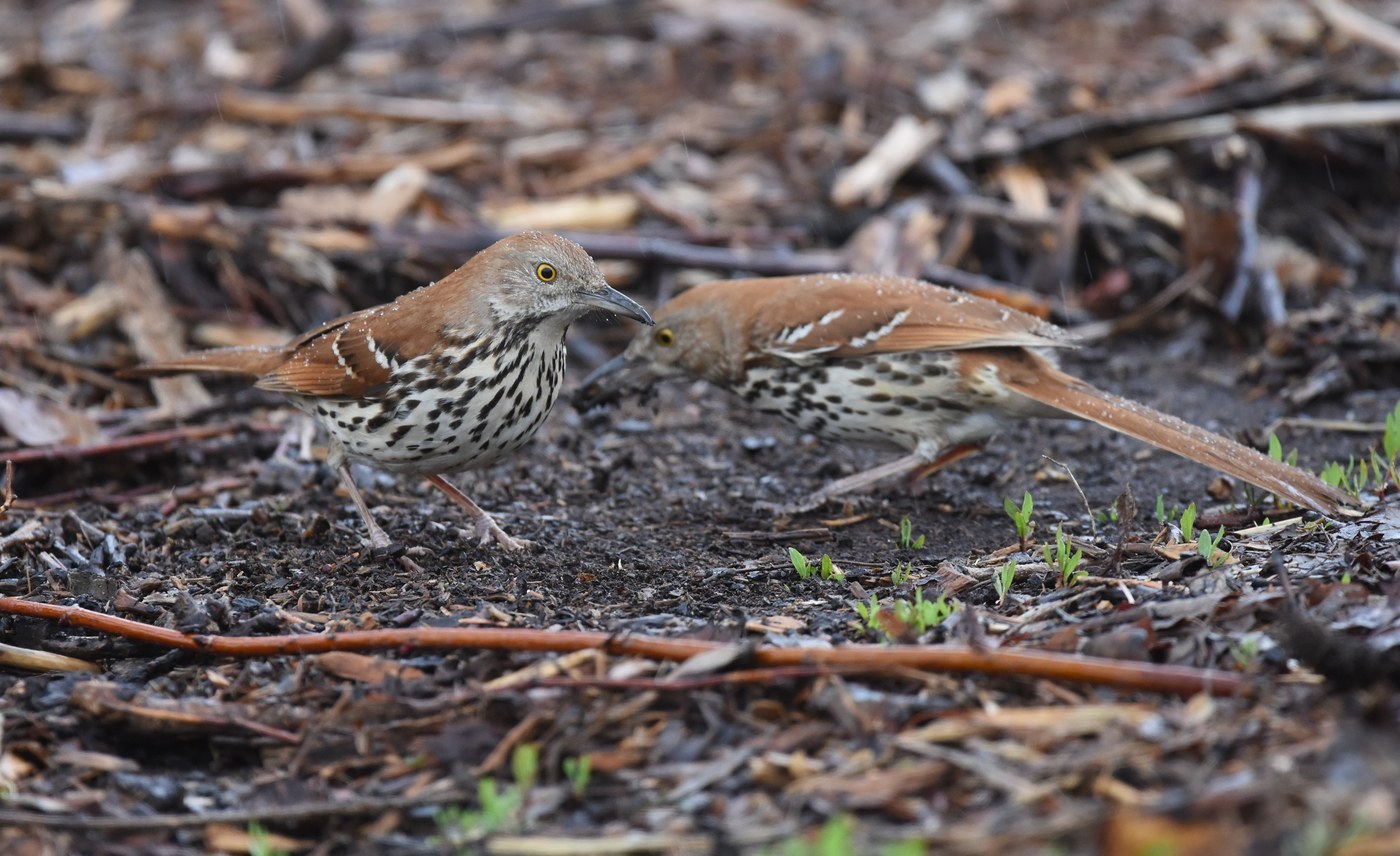
Brown Thrasher
Toxostoma rufum
A large, rich reddish-brown songbird with heavy dark streaking below and bright yellow eyes, known for an extensive repertoire of paired song phrases.
- Size
- 23-30.5 cm (9-12 in) long, 29-33 cm (11.5-13 in) wingspan
- Habitat
- dense thickets, hedgerows, woodland edges, and shrubby gardens
- Type
- songbird
Spotted a bird like this?
Identify any bird from a photo, free.
Overview
The Brown Thrasher is a large, long-tailed songbird, warm reddish-brown to rufous above with bold, heavy dark streaking on a whitish to buffy breast and belly. It has two white wing bars, a fairly long, slightly downcurved bill, and striking bright yellow eyes that stand out against its face. The tail is notably long, often held at an angle as the bird moves through dense cover.
A relative of mockingbirds and catbirds, the Brown Thrasher is renowned for having one of the largest song repertoires of any North American bird, often singing long strings of phrases, each typically repeated twice, from a high, exposed perch.
How to identify it
Key Field Marks
- Rich reddish-brown to rufous upperparts
- Heavy dark streaking on a whitish or buffy breast and belly
- Two white wing bars
- Long tail and slightly downcurved bill; bright yellow eyes
Similar Species
- Wood Thrush: much smaller, with rounder spotting (not streaking) on the breast and a shorter tail, and dark (not yellow) eyes.
- Fox Sparrow: smaller, with a shorter tail and stubbier bill, lacking the thrasher's slender downcurved bill and bright yellow eye.
- Long-billed Thrasher (south Texas): very similar but has a longer, more sharply curved bill and grayer face; ranges overlap only in a small area of south Texas.
Habitat & range
Habitat
Brown Thrashers favor dense thickets, hedgerows, shrubby fields, woodland edges, and overgrown gardens, staying close to heavy cover.
Range
They breed across most of the central and eastern United States and southern Canada, and winter mainly in the southeastern United States.
Migration
Northern and interior populations are migratory, moving south for winter, while many populations in the southeastern U.S. are year-round residents.
Behavior & voice
Behavior
Brown Thrashers are often secretive, foraging on the ground in leaf litter and dense cover, using their bill to vigorously toss aside leaves in search of food (the sweeping, "thrashing" motion that gives the family its name), but males sing conspicuously from high, exposed perches.
Voice
The song consists of a long series of varied musical phrases, most notably delivered in pairs (each phrase typically sung twice before moving to the next), and the species is estimated to have one of the largest song repertoires of any North American bird, with over a thousand distinct phrase types documented.
Feeding
They eat a wide variety of insects and other invertebrates gleaned or dug from leaf litter, along with berries and fruit, especially in fall and winter.
Nesting & Breeding
Brown Thrashers build a bulky cup nest low in dense shrubs, tangles, or occasionally on the ground, typically laying 2-6 eggs. They can be aggressive in defending the nest against intruders, including larger animals.
Frequently asked questions
Why is the Brown Thrasher's song repertoire so large?
Brown Thrashers are estimated to have one of the largest song repertoires of any North American bird, with researchers documenting over a thousand distinct song phrase types, which the bird typically sings in pairs.
How can I tell a Brown Thrasher from a Wood Thrush?
Brown Thrashers are larger with a longer tail, a slender downcurved bill, bright yellow eyes, and streaking (not rounded spots) on the underparts, unlike the smaller, dark-eyed Wood Thrush.
Where does the name 'thrasher' come from?
It refers to the bird's vigorous, sweeping motion of tossing aside leaf litter with its bill while foraging on the ground for insects.
Do Brown Thrashers migrate?
Populations in the northern and interior parts of the range migrate south for winter, while thrashers in much of the southeastern United States remain year-round.
What do Brown Thrashers eat?
They eat a wide range of insects and invertebrates found in leaf litter, along with berries and fruit, particularly outside the breeding season.
Brown Thrasher guides
In-depth guides for identifying, finding, and understanding Brown Thrasher.
Brown Thrasher identified by the community
Real birds identified with Bird Identifier.
Other birds you may enjoy

Black Redstart
13-14.5 cm (5.1-5.7 in) long, 23-26 cm wingspan

Black-throated Sparrow
12-14 cm (4.7-5.5 in) long, about 19-20 cm (7.5-8 in) wingspan

Greater Bird-of-paradise
Body about 43 cm; males with additional flank plumes up to 50 cm and long tail wires

Blue Tit
11-12 cm (4.3-4.7 in) long, 17-20 cm wingspan

Red-billed Quelea
11.5–13 cm long, wingspan about 20–22 cm
White-plumed Antbird
13-14 cm (5-5.5 in) long

Pyrrhuloxia
19-22 cm (7.5-8.7 in) long, 30 cm wingspan

Blue-gray Tanager
16-18 cm (6-7 in) long

Blackburnian Warbler
11-13 cm (4.3-5.1 in) long, 20-22 cm wingspan

Bluethroat
13-14 cm (5.1-5.5 in) long, 20-22 cm wingspan

Eurasian Nuthatch
12-14.5 cm (4.7-5.7 in) long, 22.5-27 cm wingspan

Wood Thrush
19-21 cm (7.5-8.3 in) long, about 33 cm (13 in) wingspan