Brown Thrasher Identification Guide
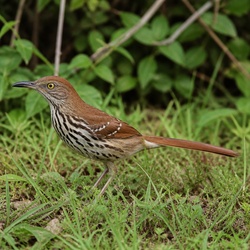
A large, long-tailed songbird of eastern thickets with warm rufous upperparts, heavy breast streaking, and a habit of repeating each song phrase exactly twice.
Read the full Brown Thrasher encyclopedia entry →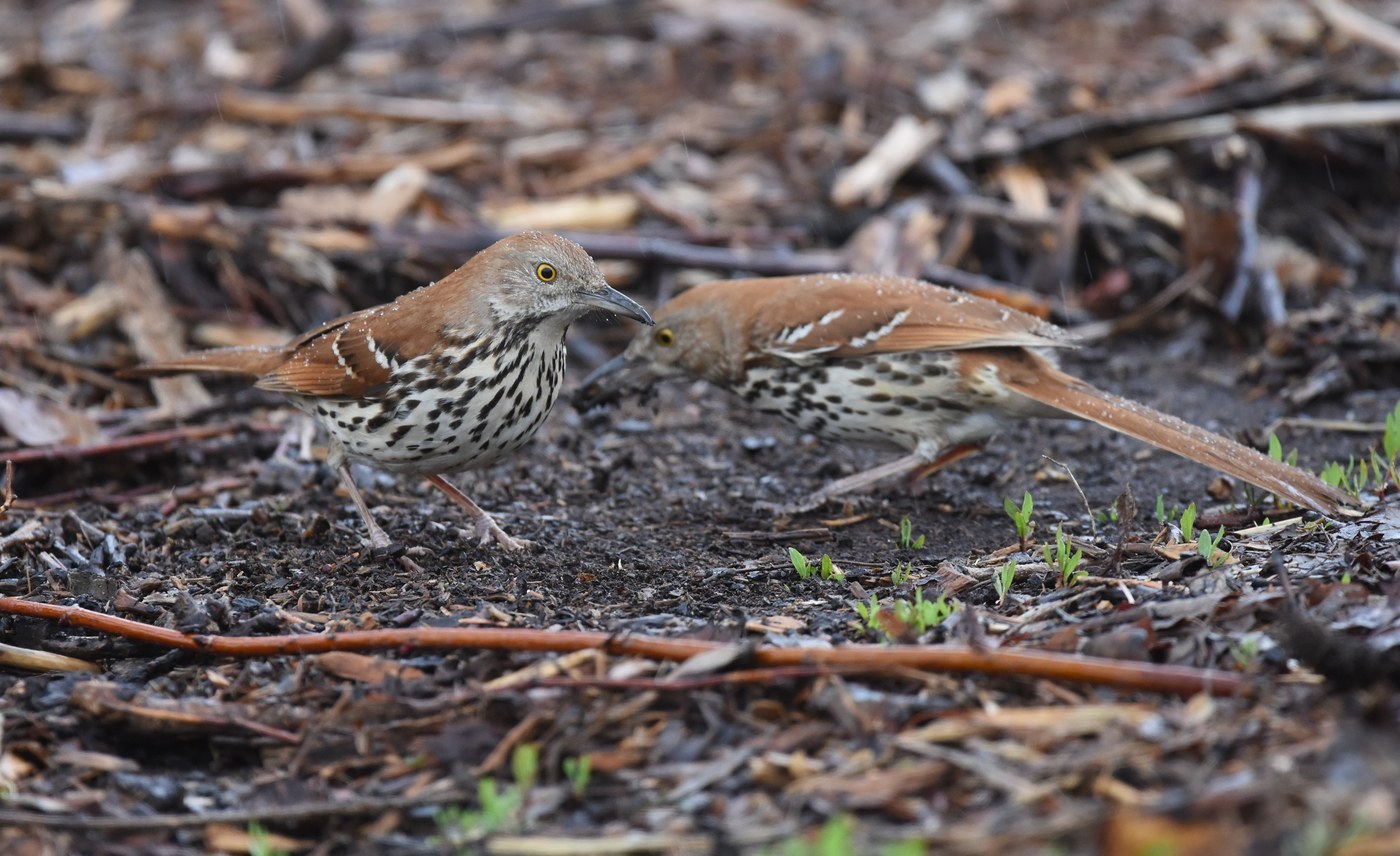
Key Field Marks
- Large mimid, about 29 cm (11.5 in) long, noticeably bigger and longer-tailed than a robin.
- Warm rufous-brown upperparts and long rufous tail.
- Whitish-to-buff underparts marked with bold, dark brown streaking (not spots) from throat to belly.
- Long, slightly downcurved black bill and bright yellow (sometimes orange) eyes.
- Two thin white wing bars cross each folded wing.
- Legs are pale pinkish-gray; the bird often forages by sweeping leaf litter aside with the bill.
Separating It From Similar Species
- Wood Thrush: much shorter tail, bold round black spots (not streaks) on a whiter breast, and a shorter, straight bill; Wood Thrush also has a rounder, more compact shape.
- Long-billed Thrasher (south Texas): very similar but has a longer, more sharply curved bill, grayer face, and darker, more saturated streaking; ranges barely overlap.
- Hermit Thrush: much smaller, spotted (not streaked) breast, and lacks the long tail and curved bill.
- Northern Mockingbird: gray overall, not rufous, with white wing patches that flash in flight; a completely different color pattern.
- Overall shape — a lanky, long-tailed skulker with a curved bill — combined with the rufous back and heavy streaking is distinctive once learned.
Habitat, Range & Season
- Found across the eastern and central United States, from the Great Plains to the Atlantic coast, and southern Canada in summer.
- Prefers dense shrubby thickets, overgrown fields, hedgerows, forest edges, and suburban tangles with heavy understory cover.
- Present year-round across much of its southern and mid-latitude range; northern populations migrate south for winter.
- Usually stays low and skulks in cover, though singing males will perch conspicuously atop a shrub or small tree.
Voice
- Song is a long series of varied musical phrases, but the key diagnostic is that each phrase is typically repeated exactly twice before moving to the next — unlike the Northern Mockingbird, which repeats phrases three or more times, and the Gray Catbird, which usually sings each phrase only once.
- Call is a sharp, loud "smack" or "chack" note, plus a low whistled "sssee" note.
Frequently asked questions
How do you tell a Brown Thrasher from a Wood Thrush?
Brown Thrasher is larger with a long rufous tail, a curved bill, and bold streaking on the breast, while Wood Thrush is smaller, short-tailed, straight-billed, and shows round black spots rather than streaks.
What is the easiest way to identify a Brown Thrasher by song?
Listen for phrases that are each repeated exactly twice in a row; mockingbirds repeat phrases three-plus times and catbirds usually sing each phrase only once.
Where do Brown Thrashers live?
They favor dense shrubby thickets, hedgerows, and brushy edges across the eastern and central United States, staying low in cover much of the time.
Are Brown Thrashers and thrushes related?
No — despite the similar name, Brown Thrasher is a mimid (related to mockingbirds and catbirds), not a true thrush.
Brown Thrasher identified by the community
Recent Brown Thrasher sightings identified with Bird Identifier.