
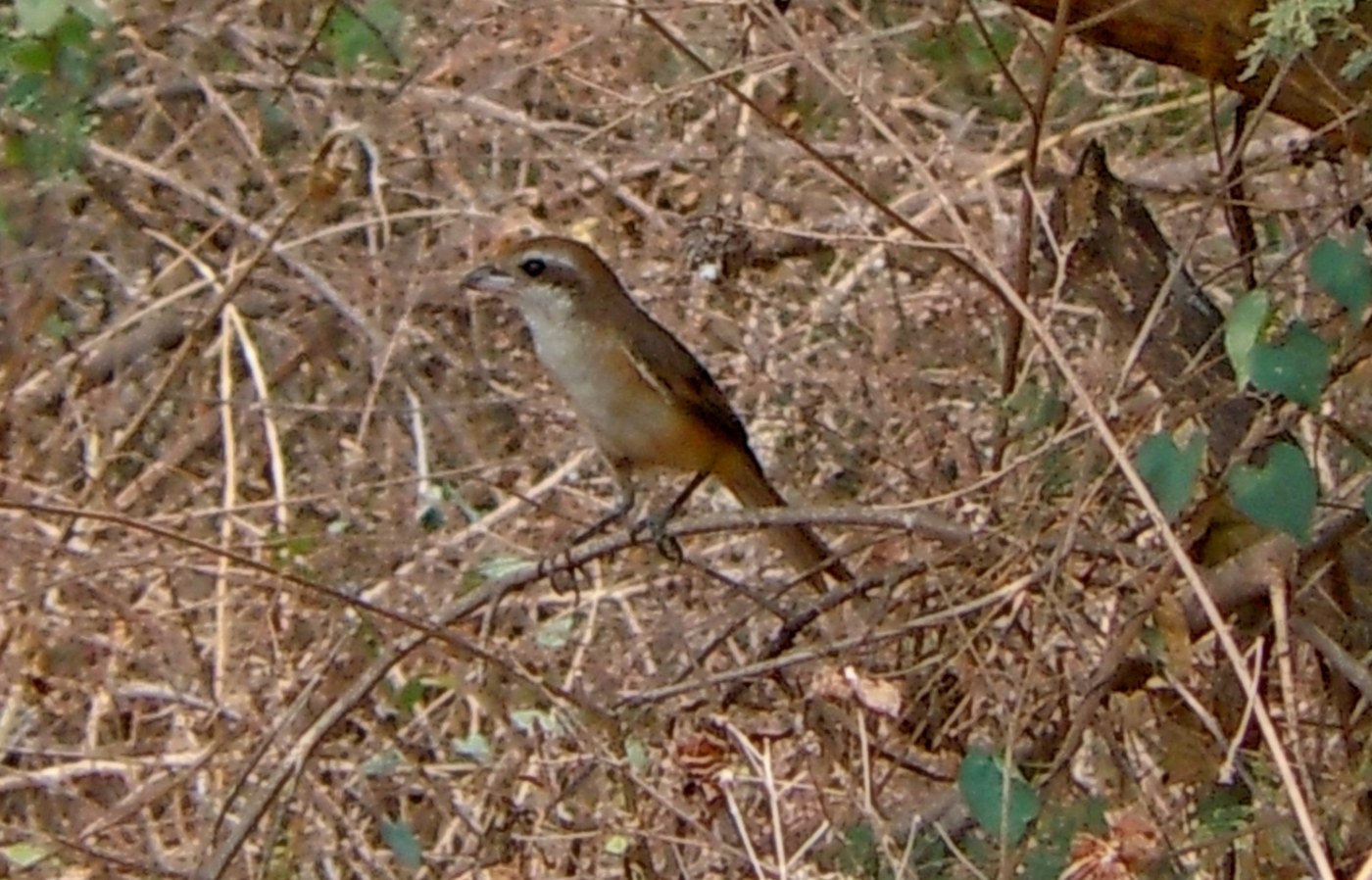
Brown Shrike
Lanius cristatus
A migratory rufous-brown shrike with a black mask, commonly seen perched on low bushes and wires during the non-breeding season.
- Size
- 19-20 cm (7.5-8 in) long
- Habitat
- open scrub, grassland, and farmland edges across Asia, wintering in South and Southeast Asia
- Type
- songbird
Spotted a bird like this?
Identify any bird from a photo, free.
Overview
The Brown Shrike is a medium-small, predominantly rufous-brown shrike, lacking the strong grey-and-chestnut contrast of its larger relative the Long-tailed Shrike. It shows warm brown upperparts, a paler buffy-white underside, and a bold black mask through the eye bordered above by a whitish supercilium (eyebrow stripe).
As a long-distance migrant, the Brown Shrike breeds across a broad swath of northern and central Asia and spends the non-breeding season across South and Southeast Asia, where it is a common sight perched on low bushes, fences, and wires in open country.
How to identify it
Key field marks
- Uniform warm rufous-brown upperparts (no contrasting grey head)
- Black mask through the eye, bordered by a pale whitish eyebrow stripe
- Buffy-whitish underparts, sometimes with faint barring on the flanks
- Stout, hook-tipped bill; often perches low and alert on bushes or wires
Similar species
The Long-tailed Shrike shows a grey head and mantle contrasting with a chestnut rump and flanks, a combination the more uniformly brown Brown Shrike lacks. Other migratory shrikes in the region can show subtle differences in mask shape and upperpart tone, best distinguished with care during migration seasons.
Habitat & range
Brown Shrikes breed across a wide swath of Siberia, Mongolia, northern China, and parts of Japan, and migrate to winter across South and Southeast Asia, including India, Sri Lanka, and further into Indonesia and the Philippines. During the non-breeding season they favor open scrub, grassland, farmland edges, and gardens with scattered bushes.
The species is a long-distance migrant, passing through many areas on passage in spring and autumn in addition to wintering populations.
Behavior & voice
Voice
A harsh, chattering scold, generally quieter and less musical than some other shrikes, mostly heard on the wintering grounds rather than in extended song.
Feeding
Brown Shrikes hunt from low perches, dropping onto large insects such as grasshoppers and beetles, along with small reptiles and occasionally small birds, sometimes caching surplus prey by impaling it on thorns.
Nesting and breeding
Breeding occurs on the species' northern breeding grounds, where it builds a cup nest of twigs and grass in a low bush or small tree; birds seen in South Asia during winter are non-breeding visitors defending temporary feeding territories rather than nesting.
Frequently asked questions
Is the Brown Shrike a migratory bird?
Yes, it breeds in northern and central Asia and migrates long distances to winter across South and Southeast Asia.
How do you tell a Brown Shrike from a Long-tailed Shrike?
Brown Shrike is uniformly rufous-brown above without a contrasting grey head, while Long-tailed Shrike shows a grey head and mantle against chestnut rump and flanks.
What does a Brown Shrike eat?
Mainly large insects like grasshoppers and beetles, along with small reptiles and occasionally small birds.
Where can you see Brown Shrikes in winter?
They are common non-breeding visitors to open scrub, farmland, and gardens across South and Southeast Asia during the northern winter.
Brown Shrike guides
In-depth guides for identifying, finding, and understanding Brown Shrike.
Other birds you may enjoy

Black Redstart
13-14.5 cm (5.1-5.7 in) long, 23-26 cm wingspan

Black-throated Sparrow
12-14 cm (4.7-5.5 in) long, about 19-20 cm (7.5-8 in) wingspan

Greater Bird-of-paradise
Body about 43 cm; males with additional flank plumes up to 50 cm and long tail wires

Blue Tit
11-12 cm (4.3-4.7 in) long, 17-20 cm wingspan

Red-billed Quelea
11.5–13 cm long, wingspan about 20–22 cm
White-plumed Antbird
13-14 cm (5-5.5 in) long

Pyrrhuloxia
19-22 cm (7.5-8.7 in) long, 30 cm wingspan

Blue-gray Tanager
16-18 cm (6-7 in) long

Blackburnian Warbler
11-13 cm (4.3-5.1 in) long, 20-22 cm wingspan

Bluethroat
13-14 cm (5.1-5.5 in) long, 20-22 cm wingspan

Eurasian Nuthatch
12-14.5 cm (4.7-5.7 in) long, 22.5-27 cm wingspan

Wood Thrush
19-21 cm (7.5-8.3 in) long, about 33 cm (13 in) wingspan