
Brown Shrike Identification Guide
A rufous-brown Asian shrike and rare North American vagrant, distinguished from the native Loggerhead Shrike by its warmer coloring and broader black mask.
Read the full Brown Shrike encyclopedia entry →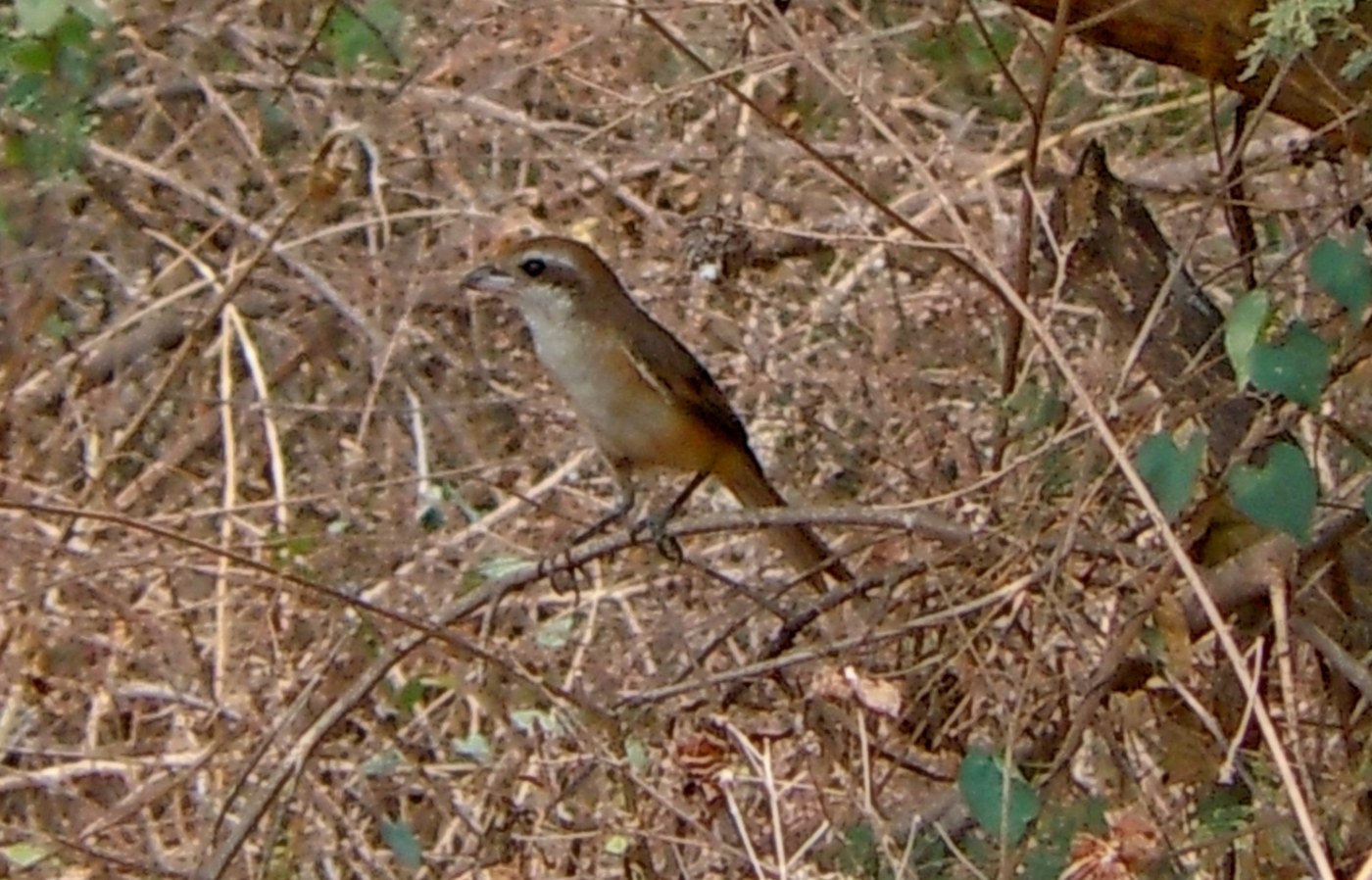
Key Field Marks
- Medium-sized shrike with a stout, hook-tipped bill typical of the family, used for gripping and dispatching insect and small vertebrate prey.
- Adult: warm rufous-brown crown, nape, and back (fairly uniform in tone), a broad black facial mask bordered above by a pale supercilium (eyebrow stripe), and buffy-white underparts with fine barring on the flanks.
- Overall coloring is noticeably warmer and more uniformly brown than related shrikes, from the crown right through to the tail.
Separating It From Similar Species
- Red-backed Shrike: shows a contrastingly gray crown and nape against a rufous back, unlike Brown Shrike's more uniform rufous-brown from crown to back.
- Loggerhead Shrike (the default shrike across much of North America): gray, not brown, above; narrower black mask; and clean white (not buffy) underparts without flank barring — a key distinction when Brown Shrike turns up as a vagrant.
- Northern Shrike: larger, paler gray overall, with a thinner mask that doesn't meet across the forehead, quite different from Brown Shrike's warm tones.
Habitat, Range & Season
- Breeds across a broad swath of Siberia, Mongolia, and northern China, and winters in South and Southeast Asia and the Indian subcontinent.
- A rare but regular vagrant to the westernmost Aleutian Islands and other parts of coastal Alaska, and casually recorded further south along the Pacific coast of North America.
- Favors open country, scrub, forest edges, and agricultural land with scattered perches, both on its native range and where it turns up as a vagrant.
Voice & Behavior
- Gives harsh, chattering, scolding calls typical of shrikes, and its song can include mimicry of other bird species.
- Like other shrikes, it hunts from an open perch, dropping onto insects, small reptiles, or rodents, and is known to impale surplus prey on thorns or barbed wire as a food cache — a hallmark shrike behavior useful for confirming identification to genus.
Frequently asked questions
How do you tell a Brown Shrike from a Loggerhead Shrike?
Brown Shrike is warm rufous-brown above with buffy, finely barred underparts, while Loggerhead Shrike is gray above with clean white underparts and no barring.
Where might a Brown Shrike be seen in North America?
It's a rare vagrant most often recorded in the western Aleutian Islands and occasionally elsewhere along the Alaska and Pacific coasts, far from its normal Asian range.
How do you tell a Brown Shrike from a Red-backed Shrike?
Red-backed Shrike shows a gray crown and nape contrasting with a rufous back, while Brown Shrike is more uniformly rufous-brown from the crown through the back.
Why do shrikes impale prey on thorns?
Shrikes, including Brown Shrike, cache surplus prey by impaling it on thorns or barbed wire, which helps them hold and store food since they lack strong grasping talons.