
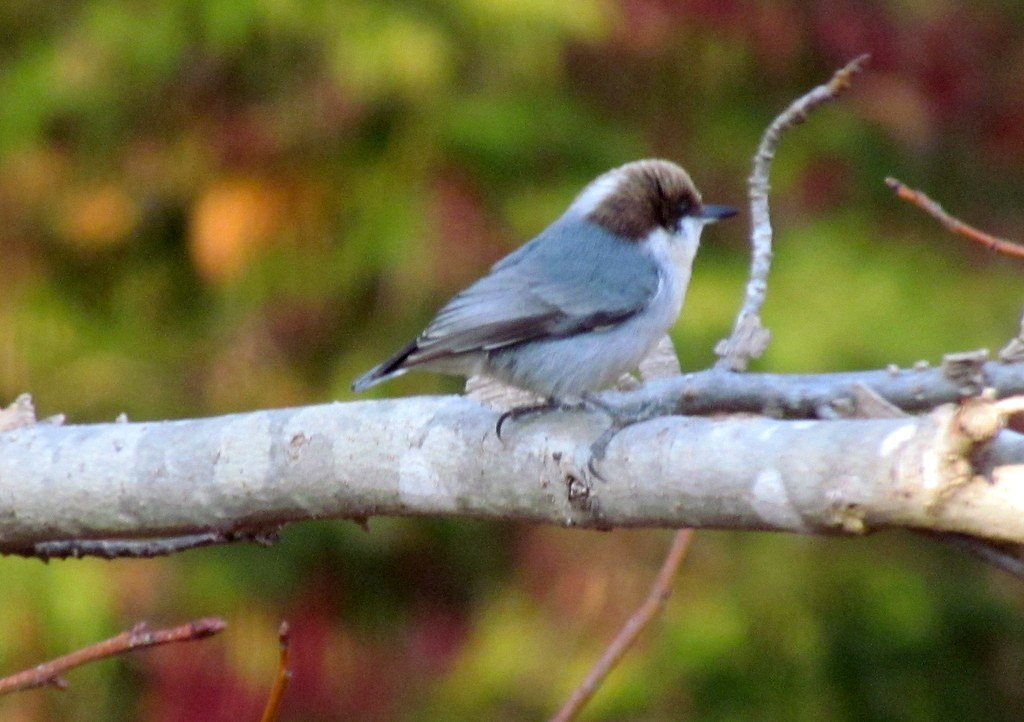
Brown-headed Nuthatch
Sitta pusilla
A tiny brown-capped nuthatch of southeastern pine forests, notable as one of the few birds known to use tools.
- Size
- 10-11.5 cm (3.9-4.5 in) long, 17-19 cm wingspan
- Habitat
- mature pine forests of the southeastern United States
- Type
- songbird
Spotted a bird like this?
Identify any bird from a photo, free.
Overview
The Brown-headed Nuthatch is a small, active nuthatch endemic to the pine forests of the southeastern United States, with a warm brown cap, blue-gray back, and pale grayish-white underparts. It shares the compact body and straight, chisel-like bill typical of nuthatches, and is closely tied to mature pine woodlands, particularly longleaf pine ecosystems that have declined significantly across its range.
This species is notable for being one of the very few North American birds documented to use tools: individuals have been observed holding a loose flake of bark in the bill and using it as a lever to pry up other bark scales in search of hidden insects.
How to identify it
Key Field Marks
- Small size, warm brown cap extending down to the eye
- Blue-gray back and wings
- Pale grayish-white underparts
- Small pale spot on the nape
- Short tail, straight thin bill
Similar Species
- Pygmy Nuthatch: very similar in size and structure but occurs in western pine forests with essentially no range overlap; slightly grayer-brown cap.
- Red-breasted Nuthatch: shows a bold black eye stripe and rusty underparts, quite different from the plain-faced Brown-headed Nuthatch.
- White-breasted Nuthatch: larger, with a solid black cap and bright white face.
Habitat & range
Habitat
Brown-headed Nuthatches are closely tied to mature pine forest, especially longleaf, loblolly, and shortleaf pine stands with open understory maintained historically by periodic fire.
Range
The species is found throughout the coastal plain and piedmont of the southeastern United States, from Virginia and Maryland south through Florida and west to eastern Texas and Oklahoma.
Migration
Brown-headed Nuthatches are non-migratory residents, remaining within pine forest habitat year-round and generally not wandering far from their home range.
Behavior & voice
Behavior
Active and social, Brown-headed Nuthatches forage in small flocks or family groups, moving rapidly over bark and pine needle clusters, often hanging upside down in typical nuthatch fashion.
Voice
The call is a distinctive, high-pitched, squeaky chatter often likened to a rubber duck or dog toy — a useful and memorable way to locate the species by ear.
Feeding
Diet includes insects and spiders gleaned from bark and pine needles, along with pine seeds, which are cached in bark crevices for later retrieval; the species is notable for using bark flakes as tools to pry off other bark in search of prey.
Nesting
Nests are built in cavities excavated in dead or decaying pine snags, sometimes assisted by helper birds at the nest, similar to the cooperative breeding seen in the closely related Pygmy Nuthatch. Clutches typically number 5-6 eggs.
Frequently asked questions
Is the Brown-headed Nuthatch really a tool user?
Yes, it is one of the few North American birds documented using tools, holding a loose bark flake in its bill to pry up other bark scales while searching for hidden insects.
What does the Brown-headed Nuthatch's call sound like?
A distinctive high, squeaky chatter often compared to the sound of a small rubber duck or dog toy.
Where does the Brown-headed Nuthatch live?
In mature pine forests, especially longleaf pine, across the coastal plain and piedmont of the southeastern United States.
Why has the Brown-headed Nuthatch declined in some areas?
Loss of mature, open pine forest habitat, particularly the decline of longleaf pine ecosystems historically maintained by fire, has reduced suitable habitat in parts of its range.
Does the Brown-headed Nuthatch practice cooperative breeding?
Yes, similar to the closely related Pygmy Nuthatch, breeding pairs are sometimes assisted by helper birds at the nest.
Brown-headed Nuthatch guides
In-depth guides for identifying, finding, and understanding Brown-headed Nuthatch.
Other birds you may enjoy

Black Redstart
13-14.5 cm (5.1-5.7 in) long, 23-26 cm wingspan

Black-throated Sparrow
12-14 cm (4.7-5.5 in) long, about 19-20 cm (7.5-8 in) wingspan

Greater Bird-of-paradise
Body about 43 cm; males with additional flank plumes up to 50 cm and long tail wires

Blue Tit
11-12 cm (4.3-4.7 in) long, 17-20 cm wingspan

Red-billed Quelea
11.5–13 cm long, wingspan about 20–22 cm
White-plumed Antbird
13-14 cm (5-5.5 in) long

Pyrrhuloxia
19-22 cm (7.5-8.7 in) long, 30 cm wingspan

Blue-gray Tanager
16-18 cm (6-7 in) long

Blackburnian Warbler
11-13 cm (4.3-5.1 in) long, 20-22 cm wingspan

Bluethroat
13-14 cm (5.1-5.5 in) long, 20-22 cm wingspan

Eurasian Nuthatch
12-14.5 cm (4.7-5.7 in) long, 22.5-27 cm wingspan

Wood Thrush
19-21 cm (7.5-8.3 in) long, about 33 cm (13 in) wingspan