
Brown-headed Nuthatch Identification Guide
A tiny, highly social nuthatch of southeastern pine forests, known for its squeaky rubber-duck call and cooperative breeding habits.
Read the full Brown-headed Nuthatch encyclopedia entry →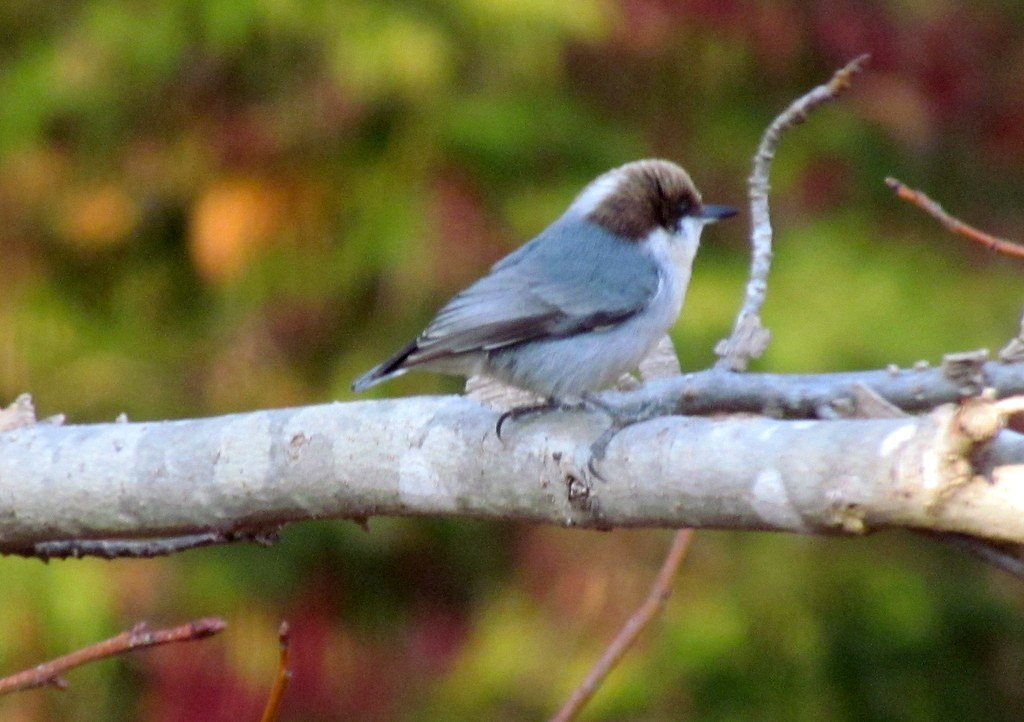
Key Field Marks
- Very small nuthatch, one of the smallest in North America, with a compact body, short tail, and thin, straight bill.
- Adult: brown cap extending from the forehead to the nape, blue-gray back and wings, whitish underparts, and a small white patch on the nape.
- No black eyeline or eyebrow stripe — the face is plain, with the brown cap being the main head pattern.
- Forages actively, often hanging upside-down or sideways on trunks and branches like other nuthatches.
Separating It From Similar Species
- Red-breasted Nuthatch: shows a bold black eyeline bordered by a white eyebrow stripe and rusty-orange underparts, quite different from the plain-faced, whitish-bellied Brown-headed Nuthatch.
- White-breasted Nuthatch: much larger, with a solid black cap (not brown) and an entirely white face, lacking any brown crown coloring.
- Pygmy Nuthatch (western, non-overlapping range): very similar in size and behavior with a brown-gray cap, but ranges don't overlap with Brown-headed Nuthatch, so range alone usually resolves any confusion.
- Voice is often the quickest giveaway — its squeaky call is unlike any other nuthatch.
Habitat, Range & Season
- A specialist of mature pine forests, especially longleaf pine, in the southeastern coastal plain from Virginia to Texas and Florida.
- Resident year-round within its range; rarely wanders far from pine woodlands.
- Highly social, living in small family groups; known to be a cooperative breeder, with previous offspring sometimes helping parents raise later broods.
- Occasionally uses a small flake of pine bark as a tool to pry up bark scales in search of insects — an unusual example of tool use in birds.
Voice
- Gives a distinctive, high-pitched, squeaky call often compared to a rubber duck or squeaky toy, rendered as a rapid "kee-dee-dee" chatter, frequently heard from foraging flocks moving through pine canopies.
Frequently asked questions
What does a Brown-headed Nuthatch sound like?
It gives a high, squeaky, rapid chattering call often compared to a rubber duck or squeaky toy — a very distinctive and reliable field mark.
How do you tell a Brown-headed Nuthatch from a Red-breasted Nuthatch?
Brown-headed Nuthatch has a plain face with a brown cap and whitish underparts, while Red-breasted Nuthatch has a bold black-and-white eyeline and rusty-orange underparts.
Where do Brown-headed Nuthatches live?
They are year-round residents of mature pine forests, especially longleaf pine, across the southeastern U.S. coastal plain.
Do Brown-headed Nuthatches use tools?
Yes, they are one of the few birds known to use a tool — holding a small flake of bark in the bill to pry up other bark scales while foraging for insects.