
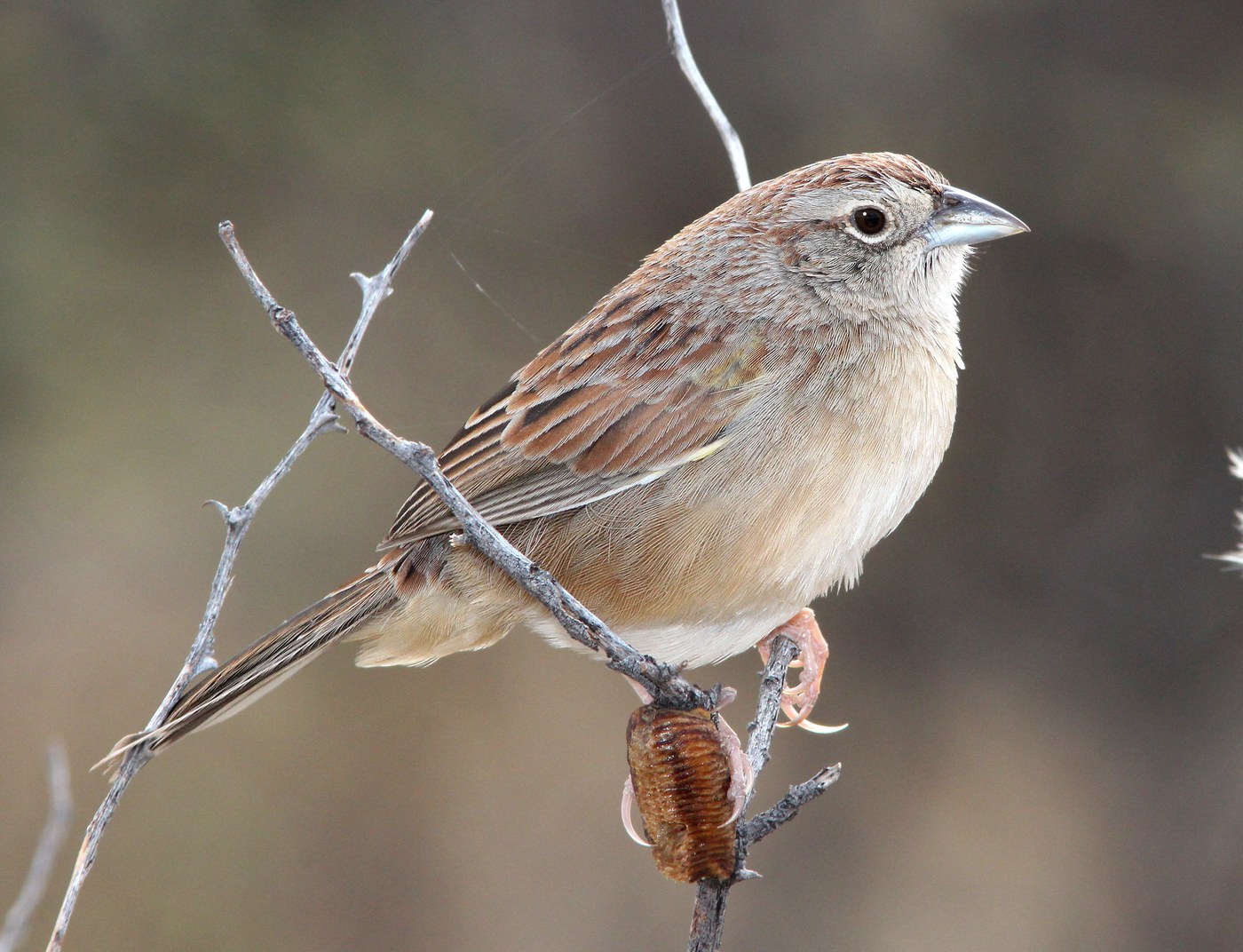
Botteri's Sparrow
Peucaea botterii
A large, plain-faced grassland sparrow known for a distinctive accelerating song likened to a bouncing ball coming to a stop.
- Size
- 14-16 cm (5.5-6.3 in) long, about 20-21 cm (8-8.3 in) wingspan
- Habitat
- dense grassland with scattered shrubs, including sacaton grassland and coastal prairie
- Type
- songbird
Spotted a bird like this?
Identify any bird from a photo, free.
Overview
The Botteri's Sparrow is a large, plain-plumaged sparrow of dense native grassland, occurring in the United States in two widely separated pockets: southeastern Arizona and the coastal prairies of southern Texas. It closely resembles the related Cassin's Sparrow but differs in structure, habitat preference, and especially voice.
Plumage is understated: brownish and streaked above, with plain, unstreaked buffy underparts. The bird has a notably large bill and a long, somewhat rounded tail, giving it a bulkier appearance than many grassland sparrows. Its plain face lacks strong markings, making the song the best tool for confident identification.
Botteri's Sparrow is closely tied to tall, dense grass, often with scattered shrubs, and can be difficult to see well as it tends to stay low and hidden except when singing from an elevated perch.
How to identify it
Key Field Marks
- Large size and bulky build for a grassland sparrow
- Large, heavy bill
- Plain, unstreaked buffy underparts
- Streaked brownish back
- Long, rounded tail
Similar Species
- Cassin's Sparrow: similar plain plumage but smaller-billed and plainer-faced, with a distinctive fluttering skylarking flight song rather than the accelerating trill of Botteri's Sparrow
The song is the most reliable identification feature: an accelerating series of chip notes that rolls into a rapid trill, often compared to the sound of a ball bouncing to a stop.
Habitat & range
In the United States, Botteri's Sparrow occurs in two disjunct areas: dense sacaton and other tall bunchgrass grasslands of southeastern Arizona, and coastal prairie grasslands of southern Texas. The species also occurs more broadly through Mexico and into Central America.
It favors relatively tall, dense native grass, sometimes with scattered mesquite or other shrubs, and is sensitive to overgrazing and conversion of native grassland, which can reduce the structural density it requires for nesting and singing perches.
Behavior & voice
Behavior
Botteri's Sparrow tends to stay low and hidden within dense grass, foraging on the ground, and becomes most visible when males sing from an exposed low perch such as a shrub or tall grass stem.
Voice
The song begins with a few slow chip notes that steadily accelerate into a rapid trill, often described as sounding like a bouncing ball coming to a stop.
Feeding
Diet consists of insects and seeds gathered from the ground and dense grass cover.
Nesting and Breeding
Nests are built on or near the ground within dense grass, well concealed from view. Clutches typically contain 3-4 pale, unmarked eggs.
Frequently asked questions
Where does the Botteri's Sparrow live in the United States?
It occurs in two separate areas: dense grassland in southeastern Arizona and coastal prairie in southern Texas.
What does the Botteri's Sparrow's song sound like?
It is an accelerating series of chip notes that rolls into a rapid trill, often compared to a bouncing ball coming to a stop.
How do you tell Botteri's Sparrow from Cassin's Sparrow?
Botteri's Sparrow is larger and heavier-billed with an accelerating trilled song, while Cassin's Sparrow has a distinctive fluttering flight display with whistled notes.
What habitat does the Botteri's Sparrow need?
It needs dense, relatively tall native grassland, sometimes with scattered shrubs, and is sensitive to overgrazing.
Is the Botteri's Sparrow found outside the United States?
Yes, it occurs more widely through Mexico and into Central America, with US populations at the northern edge of its range.
Botteri's Sparrow guides
In-depth guides for identifying, finding, and understanding Botteri's Sparrow.
Other birds you may enjoy

Black Redstart
13-14.5 cm (5.1-5.7 in) long, 23-26 cm wingspan

Black-throated Sparrow
12-14 cm (4.7-5.5 in) long, about 19-20 cm (7.5-8 in) wingspan

Greater Bird-of-paradise
Body about 43 cm; males with additional flank plumes up to 50 cm and long tail wires

Blue Tit
11-12 cm (4.3-4.7 in) long, 17-20 cm wingspan

Red-billed Quelea
11.5–13 cm long, wingspan about 20–22 cm
White-plumed Antbird
13-14 cm (5-5.5 in) long

Pyrrhuloxia
19-22 cm (7.5-8.7 in) long, 30 cm wingspan

Blue-gray Tanager
16-18 cm (6-7 in) long

Blackburnian Warbler
11-13 cm (4.3-5.1 in) long, 20-22 cm wingspan

Bluethroat
13-14 cm (5.1-5.5 in) long, 20-22 cm wingspan

Eurasian Nuthatch
12-14.5 cm (4.7-5.7 in) long, 22.5-27 cm wingspan

Wood Thrush
19-21 cm (7.5-8.3 in) long, about 33 cm (13 in) wingspan