
Botteri's Sparrow Identification Guide
A plain, large-billed grassland sparrow of southeastern Arizona and south Texas, best told from the similar Cassin's Sparrow by its ground-level, non-skylarking song.
Read the full Botteri's Sparrow encyclopedia entry →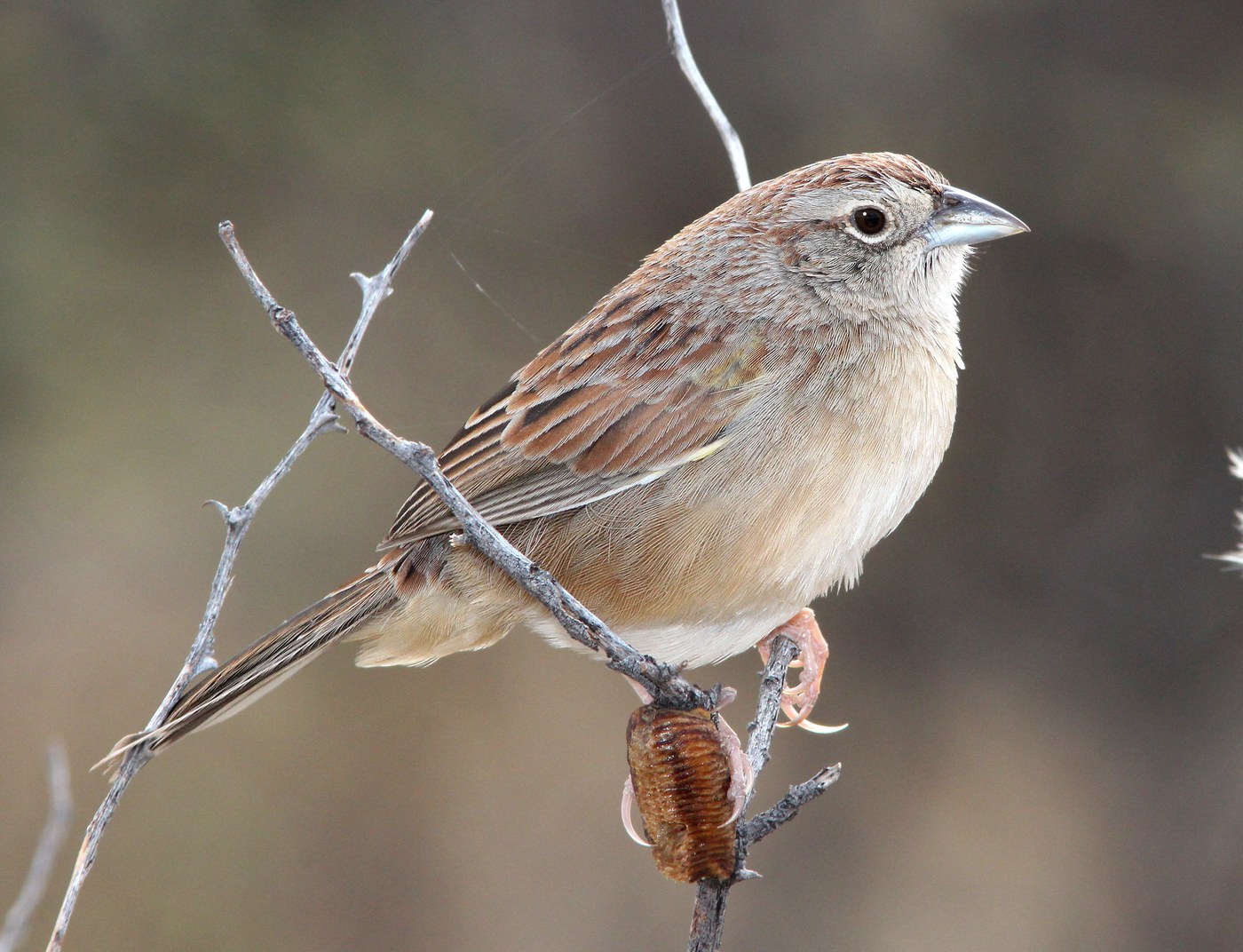
Key Field Marks
- Size & shape: A large, chunky sparrow (about 14–15 cm) with a flat-crowned head, long rounded tail, and a noticeably large, conical bill.
- Plumage: Warm brown to grayish-brown upperparts with fine dark streaking; underparts are plain buffy-gray with no breast streaking.
- Face: Fairly plain and unpatterned — a subtle pale eyering and faint mustache stripe, but no bold facial markings.
- Tail: Long, rounded, and often pumped or spread in flight, showing plain brown edges (no white in the tail).
Separating from Similar Species
- Cassin's Sparrow: The classic confusion species. Cassin's is grayer overall with more contrast on the tertials and a distinctive skylarking flight display (rising, then parachuting down while singing). Botteri's rarely performs an aerial display and sings from a grass stem or low shrub.
- Rufous-winged Sparrow: Shows a distinct rufous crown stripe and two dark whisker marks; Botteri's lacks these bold head markings.
- Cassin's vs. Botteri's calls: Cassin's flight song ends in a musical, bouncing-ball trill audible from a distance; Botteri's song is drier and more insect-like, delivered from a perch.
Habitat, Range & Season
- Breeds in tall sacaton grasslands with scattered mesquite in southeastern Arizona, and in coastal prairie grasslands of south Texas (a distinct subspecies group).
- A summer breeder, arriving in spring and departing by early fall; winters mainly in Mexico.
- Requires dense, relatively tall native grass structure — a good indicator of healthy grassland habitat.
Voice & Song
- Song begins with a few dry introductory chip notes that accelerate into a loose, bouncing trill, sometimes likened to a ball dropped on a hard floor slowing to a stop.
- Usually sung from a low perch within or just above the grass, not in flight — a key contrast with Cassin's Sparrow's aerial song flight.
- Calls are soft, dry chip notes, easily overlooked.
Frequently asked questions
What is the easiest way to tell Botteri's Sparrow from Cassin's Sparrow?
Focus on behavior: Cassin's Sparrow performs a distinctive skylarking flight display while singing, while Botteri's Sparrow sings from a grass stem or low perch and rarely takes to the air to sing.
Where is the best place to look for Botteri's Sparrow in the US?
Southeastern Arizona's sacaton grasslands (such as the San Rafael Valley) and the coastal prairies of south Texas are the most reliable US locations.
Does Botteri's Sparrow have any bold facial or breast markings?
No. It is one of the plainest sparrows, with an unstreaked buffy breast and a fairly featureless face, which is itself a useful clue against more patterned sparrows.
When is the best time to find Botteri's Sparrow?
Late spring through summer (roughly May–August), when males are actively singing on breeding territories; they are far quieter and harder to detect outside the breeding season.