
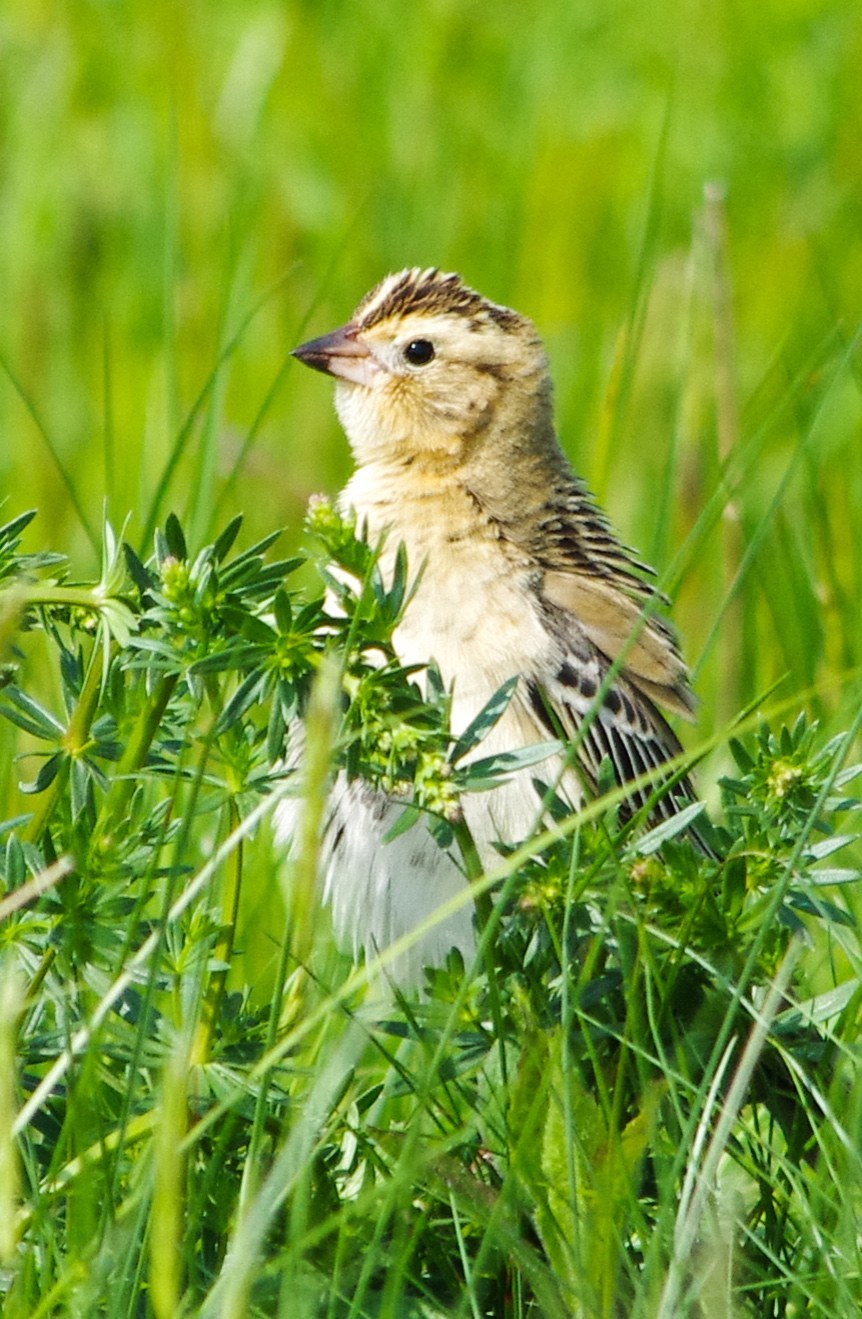
Bobolink
Dolichonyx oryzivorus
A grassland songbird famous for the breeding male's striking black-and-white "backward tuxedo" plumage and one of the longest migrations of any North American songbird.
- Size
- 16-18 cm (6.3-7.1 in) long, 26-30 cm wingspan
- Habitat
- hayfields, prairies, and grassy meadows
- Type
- songbird
Spotted a bird like this?
Identify any bird from a photo, free.
Overview
The Bobolink is a distinctive grassland songbird best known for the breeding male's bold, unusual plumage: entirely black underparts and face contrasted with a creamy-yellow nape patch and white patches on the back and rump, essentially a tuxedo worn backward. After breeding, males molt into a much plainer, sparrow-like buffy-brown plumage resembling the female, which is streaked brown and buff year-round and easily overlooked among grassland sparrows.
Bobolinks undertake one of the longest migrations of any songbird in the Americas, traveling roughly 20,000 km (12,000 miles) round-trip each year between North American breeding grounds and wintering areas in the grasslands of southern South America.
How to identify it
Key Field Marks
- Breeding male: black underparts and face, pale straw-yellow nape, white scapulars and rump patches
- Female and non-breeding male: streaky buff-brown, sparrow-like, with a bold buffy crown stripe
- Short, pointed tail feathers with spiky tips
- Conical, finch-like bill
- Distinctive bubbling flight song delivered while fluttering over fields
Similar Species
- Breeding male Bobolinks are unmistakable due to the unique reversed black-and-white/yellow pattern found in no other North American bird.
- Female and non-breeding Bobolinks can resemble sparrows but are larger, with a sharper bill and distinctive pointed tail feathers.
Habitat & range
Habitat
Bobolinks breed in open grasslands, especially hayfields, tallgrass prairie remnants, and weedy meadows with a mix of grasses and forbs.
Range
Breeds across the northern United States and southern Canada, from the Great Plains east to New England. Winters in grassland and marsh habitats of southern South America, including Argentina, Bolivia, and Paraguay.
Migration
An exceptionally long-distance migrant, the Bobolink makes an annual round-trip of roughly 20,000 km, one of the longest migrations of any songbird, passing through Central America and across open ocean stretches of the Caribbean and Gulf.
Behavior & voice
Behavior
Males perform a distinctive, bubbling flight display over territories, fluttering on shallow wingbeats while singing continuously. Bobolinks are highly social outside the breeding season, forming large flocks during migration and winter.
Voice
The song is a bubbly, tinkling, banjo-like cascade of notes, often rendered as "bob-o-link, bob-o-link, spink, spank, spink." The flight call is a distinctive metallic "pink" note.
Feeding
Feeds on insects, especially during the breeding season, and switches to seeds of grasses, weeds, and grain such as rice during migration and winter.
Nesting & Breeding
The female builds a well-concealed cup nest of grass directly on the ground within dense hayfield or prairie vegetation. Bobolinks are often polygynous, and females incubate 4-7 eggs alone; nests are highly vulnerable to hay mowing before fledging.
Frequently asked questions
Why does the male Bobolink look like it's wearing a backward tuxedo?
Breeding males are black below and pale above, the reverse of typical bird coloration (dark above, pale below), giving rise to the popular description of a backward tuxedo, unique among North American birds.
How far do Bobolinks migrate?
Bobolinks make one of the longest migrations of any songbird, traveling roughly 20,000 km (12,000 miles) round-trip each year between North American breeding grounds and wintering grounds in southern South America.
Why are Bobolink populations declining?
Earlier and more frequent hay mowing destroys ground nests before chicks fledge, and loss of grassland habitat on both breeding and wintering grounds has driven significant population declines.
What does a Bobolink eat?
It eats mainly insects during the breeding season and shifts to grass and weed seeds, and sometimes rice, during migration and winter.
Do male and female Bobolinks look different?
Yes, breeding males are strikingly black, white, and buff-yellow, while females and non-breeding males are streaky buff-brown and sparrow-like.
Bobolink guides
In-depth guides for identifying, finding, and understanding Bobolink.
Other birds you may enjoy

Black Redstart
13-14.5 cm (5.1-5.7 in) long, 23-26 cm wingspan

Black-throated Sparrow
12-14 cm (4.7-5.5 in) long, about 19-20 cm (7.5-8 in) wingspan

Greater Bird-of-paradise
Body about 43 cm; males with additional flank plumes up to 50 cm and long tail wires

Blue Tit
11-12 cm (4.3-4.7 in) long, 17-20 cm wingspan

Red-billed Quelea
11.5–13 cm long, wingspan about 20–22 cm
White-plumed Antbird
13-14 cm (5-5.5 in) long

Pyrrhuloxia
19-22 cm (7.5-8.7 in) long, 30 cm wingspan

Blue-gray Tanager
16-18 cm (6-7 in) long

Blackburnian Warbler
11-13 cm (4.3-5.1 in) long, 20-22 cm wingspan

Bluethroat
13-14 cm (5.1-5.5 in) long, 20-22 cm wingspan

Eurasian Nuthatch
12-14.5 cm (4.7-5.7 in) long, 22.5-27 cm wingspan

Wood Thrush
19-21 cm (7.5-8.3 in) long, about 33 cm (13 in) wingspan