
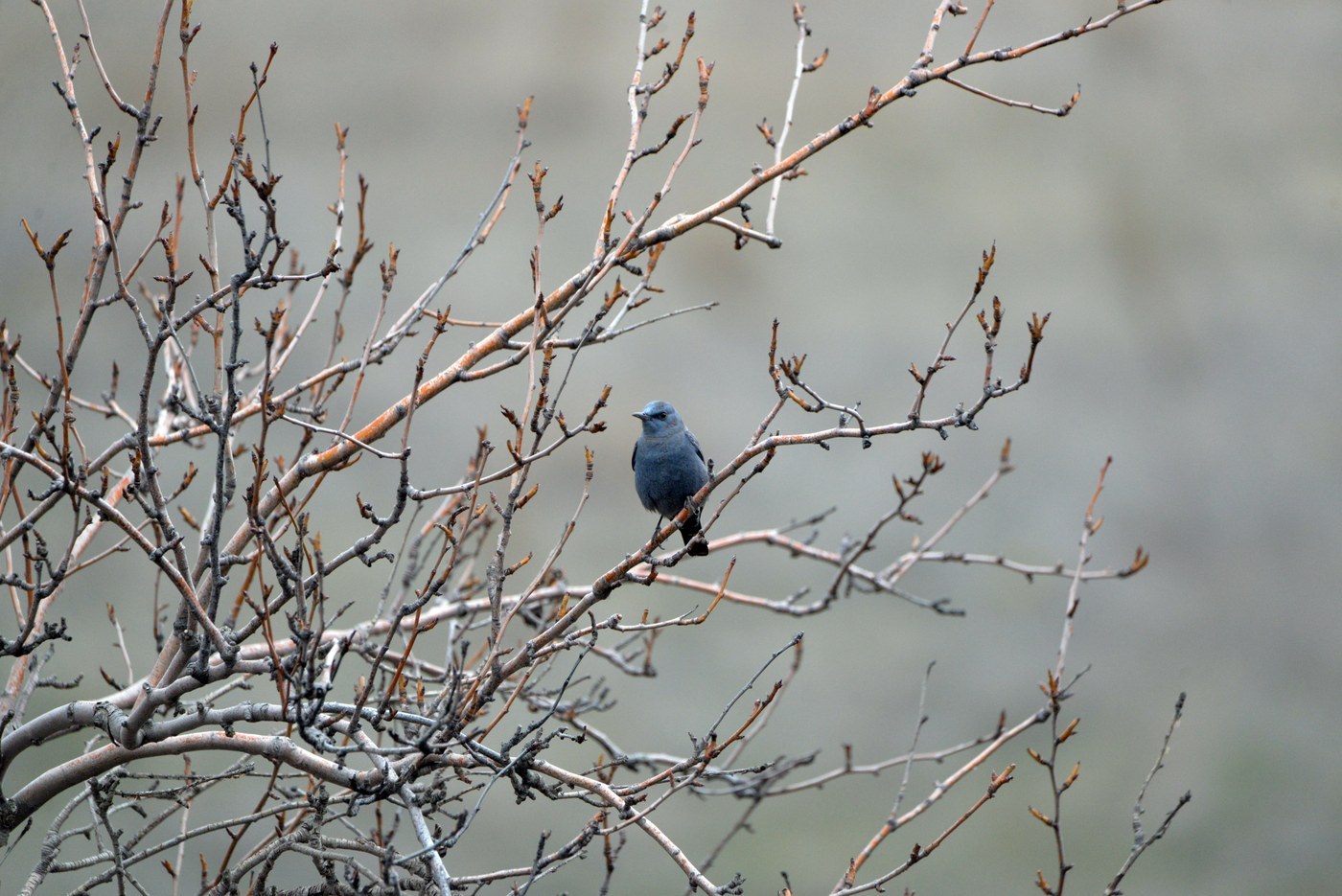
Blue Rock Thrush
Monticola solitarius
A stocky, solitary thrush of rocky habitats; the male is an overall slate-blue, while the female is grey-brown with fine scaly barring.
- Size
- 20-23 cm (8-9 in) long
- Habitat
- rocky cliffs, coastal crags, quarries, and old buildings or ruins
- Type
- songbird
Spotted a bird like this?
Identify any bird from a photo, free.
Overview
The Blue Rock Thrush is a stocky, upright bird of rocky and rugged terrain. Males are strikingly colored in deep slate-blue overall, sometimes with a darker, almost blackish tone to the wings and tail, and in some populations a chestnut belly. Females and immatures are much more subdued, showing grey-brown plumage finely barred and scaled with dark crescents across the underparts, offering excellent camouflage against rock.
True to its name, it is closely tied to rocky habitats, from natural cliffs and coastal crags to human structures like quarries, ruins, and old buildings, where it perches prominently and sings a rich, melodious song, particularly at dawn.
How to identify it
Key field marks
- Male: deep slate-blue overall plumage, sometimes with a chestnut belly in some populations
- Female: grey-brown with fine dark scaly barring across the underparts
- Stocky build with a fairly long, straight bill
- Upright posture on rocky perches
Similar species
- Common Blackbird male is glossier black with an orange bill, lacking the blue tone and rocky habitat preference.
- White-throated Rock Thrush and other rock thrushes differ in having orange underparts or a white throat patch; female Blue Rock Thrush is best told by its barred (not spotted) underparts.
Habitat & range
Habitat
Inhabits rocky cliffs, coastal crags, mountain slopes, quarries, and old stone buildings or ruins, generally favoring open, rugged terrain with little vegetation.
Range
Widespread from the Mediterranean region across the Middle East and central Asia to China, Korea, and Japan.
Migration
Some populations are resident, particularly in milder coastal areas, while northern and montane populations move to lower elevations or further south for winter.
Behavior & voice
Behavior
Usually solitary and territorial, perching prominently on rocks, ledges, or rooftops; sallies out to catch insects or drops onto prey on the ground.
Voice
A rich, melodious, flutey song, often delivered from a high rocky perch, along with a sharp "tack" call.
Feeding
Eats insects and other invertebrates, small lizards and other small vertebrates, and berries, especially in the non-breeding season.
Nesting
Builds a cup nest tucked into a rock crevice, cliff ledge, or hole in a wall or building; lays 3-5 pale blue eggs.
Frequently asked questions
How do you identify a male Blue Rock Thrush?
Males are an overall deep slate-blue, sometimes with a chestnut belly depending on the population, and are usually seen perched on rocky terrain.
What does a female Blue Rock Thrush look like?
Females are grey-brown with fine, dark, crescent-shaped barring across the underparts, quite different from the solid blue male.
Where does the Blue Rock Thrush live?
On rocky cliffs, coastal crags, quarries, and old buildings from the Mediterranean across the Middle East and Asia to China, Korea, and Japan.
What does a Blue Rock Thrush eat?
Insects and other invertebrates, small lizards and other small vertebrates, and berries.
Blue Rock Thrush guides
In-depth guides for identifying, finding, and understanding Blue Rock Thrush.
Other birds you may enjoy

Black Redstart
13-14.5 cm (5.1-5.7 in) long, 23-26 cm wingspan

Black-throated Sparrow
12-14 cm (4.7-5.5 in) long, about 19-20 cm (7.5-8 in) wingspan

Greater Bird-of-paradise
Body about 43 cm; males with additional flank plumes up to 50 cm and long tail wires

Blue Tit
11-12 cm (4.3-4.7 in) long, 17-20 cm wingspan

Red-billed Quelea
11.5–13 cm long, wingspan about 20–22 cm
White-plumed Antbird
13-14 cm (5-5.5 in) long

Pyrrhuloxia
19-22 cm (7.5-8.7 in) long, 30 cm wingspan

Blue-gray Tanager
16-18 cm (6-7 in) long

Blackburnian Warbler
11-13 cm (4.3-5.1 in) long, 20-22 cm wingspan

Bluethroat
13-14 cm (5.1-5.5 in) long, 20-22 cm wingspan

Eurasian Nuthatch
12-14.5 cm (4.7-5.7 in) long, 22.5-27 cm wingspan

Wood Thrush
19-21 cm (7.5-8.3 in) long, about 33 cm (13 in) wingspan