
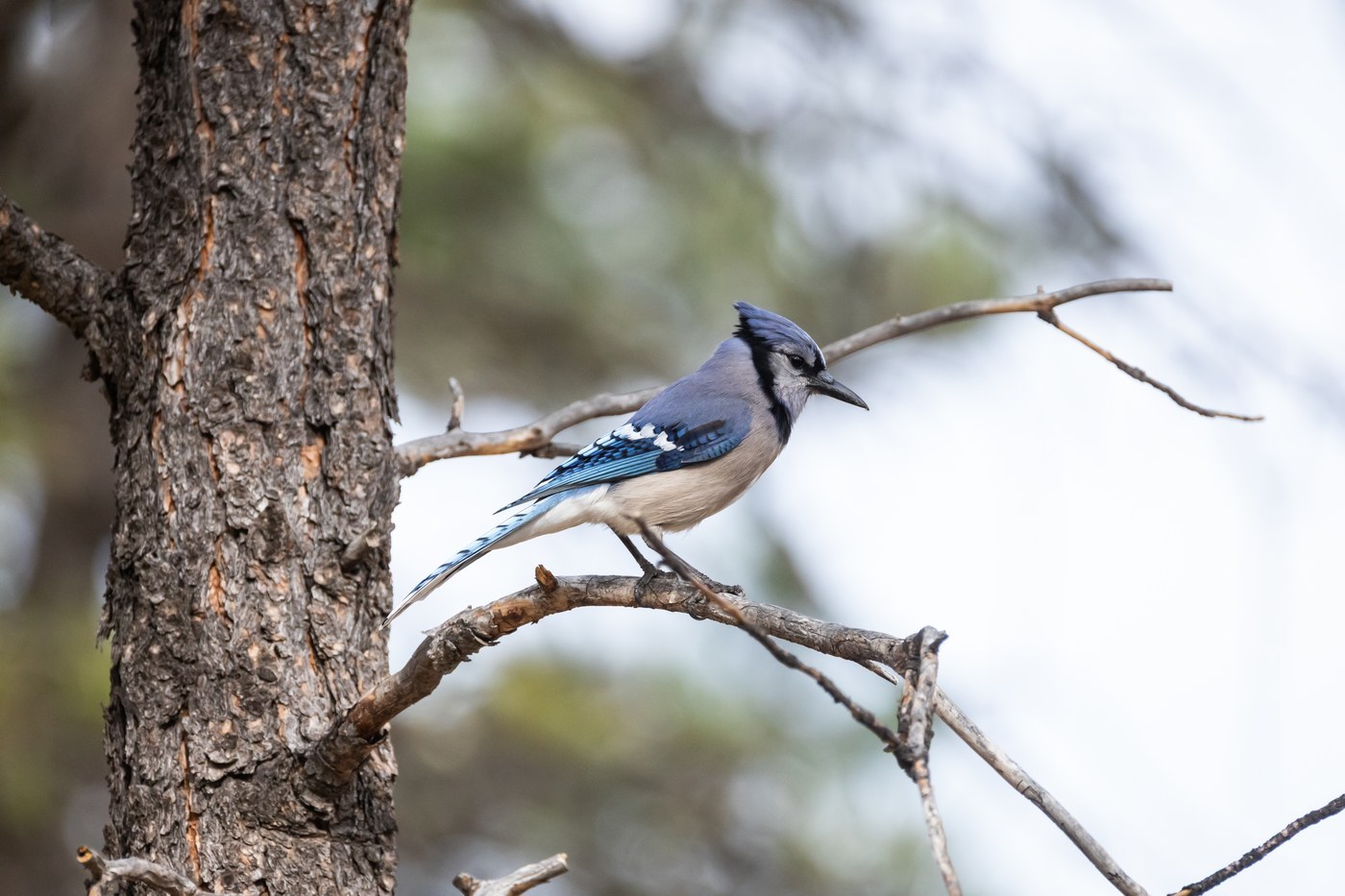
Blue Jay
Cyanocitta cristata
A bold, crested songbird in vivid blue, white, and black, known for its loud calls and habit of caching acorns.
- Size
- 22-30 cm (9-12 in) long, 34-43 cm (13-17 in) wingspan
- Habitat
- deciduous and mixed forests, forest edges, parks, and suburban yards with oak trees
- Type
- songbird
Spotted a bird like this?
Identify any bird from a photo, free.
Overview
The Blue Jay is a large, conspicuous songbird found throughout eastern and central North America, well known for its intelligence, boldness, and striking plumage. It has a blue crest, back, wings, and tail, contrasted with white underparts and a white face, and a black necklace-like band across the throat and around the neck. The wings and tail show bold black barring and white patches, especially visible in flight.
Blue Jays are members of the crow family (Corvidae) and share that family's intelligence, including complex social behavior, problem-solving, and the ability to mimic other birds' calls, most famously imitating the scream of a Red-shouldered Hawk.
How to identify it
Key Field Marks
- Bright blue upperparts with a prominent crest
- White face and underparts with a black necklace band
- Black-barred wings and tail with white wing bars and white tail corners
- Stout black bill
Similar Species
- Steller's Jay (western mountains): darker, with a blackish head and crest and no white face; ranges do not typically overlap.
- Belted Kingfisher: also blue and white but has a shaggy crest, a dagger-like bill, and is found near water, with very different shape and behavior.
- Eastern Bluebird: much smaller, uniformly blue above without a crest or black necklace.
Habitat & range
Habitat
Blue Jays inhabit deciduous and mixed forests, especially those with oaks, as well as forest edges, parks, and suburban and urban areas with mature trees and bird feeders.
Range
They are found year-round across most of the eastern and central United States and southern Canada, from the Great Plains to the Atlantic coast.
Migration
Most Blue Jays are permanent residents, but some individuals, especially in the northern part of the range, migrate south in variable numbers each year; the reasons for partial migration in this species are not fully understood.
Behavior & voice
Behavior
Blue Jays are intelligent, social, and often bold or aggressive, sometimes mobbing predators like hawks and owls in noisy groups. They are also known to cache thousands of acorns each fall, an activity that has helped disperse oak trees across the landscape.
Voice
Their most familiar call is a loud, harsh "jay jay jay," but they have a large vocal repertoire, including a musical "queedle-queedle" and remarkably accurate imitations of hawk calls.
Feeding
They eat a wide variety of foods including acorns, nuts, seeds, fruit, and insects, and will occasionally take eggs or nestlings of other birds, though this is a minor part of their diet.
Nesting & Breeding
Both members of a pair build a bulky twig nest in a tree fork or dense branch, typically laying 3-7 eggs. Young remain with parents for a couple of months after fledging, and family groups may stay loosely associated.
Frequently asked questions
Why do Blue Jays mimic hawk calls?
Blue Jays often imitate the calls of Red-shouldered and Red-tailed Hawks, which may help them clear other birds away from a feeder or food source, or serve as an alarm signal, though the exact function is debated.
Do Blue Jays migrate?
Some do and some don't; many Blue Jays are year-round residents, but variable numbers migrate south each fall, and the same individual may migrate in some years and not others.
Are Blue Jays aggressive toward other birds?
They can be assertive at feeders and will mob predators, but claims that they are major nest predators of songbirds are largely overstated; insects and plant material make up most of their diet.
How intelligent are Blue Jays?
As corvids, Blue Jays are highly intelligent, capable of problem-solving, tool use in captivity, and complex caching behavior that requires spatial memory.
Why is the Blue Jay's blue color unusual?
Blue Jay feathers contain no blue pigment; the blue color results from microscopic structures in the feather barbs that scatter light, a phenomenon called structural color.
Blue Jay guides
In-depth guides for identifying, finding, and understanding Blue Jay.
Other birds you may enjoy

Black Redstart
13-14.5 cm (5.1-5.7 in) long, 23-26 cm wingspan

Black-throated Sparrow
12-14 cm (4.7-5.5 in) long, about 19-20 cm (7.5-8 in) wingspan

Greater Bird-of-paradise
Body about 43 cm; males with additional flank plumes up to 50 cm and long tail wires

Blue Tit
11-12 cm (4.3-4.7 in) long, 17-20 cm wingspan

Red-billed Quelea
11.5–13 cm long, wingspan about 20–22 cm
White-plumed Antbird
13-14 cm (5-5.5 in) long

Pyrrhuloxia
19-22 cm (7.5-8.7 in) long, 30 cm wingspan

Blue-gray Tanager
16-18 cm (6-7 in) long

Blackburnian Warbler
11-13 cm (4.3-5.1 in) long, 20-22 cm wingspan

Bluethroat
13-14 cm (5.1-5.5 in) long, 20-22 cm wingspan

Eurasian Nuthatch
12-14.5 cm (4.7-5.7 in) long, 22.5-27 cm wingspan

Wood Thrush
19-21 cm (7.5-8.3 in) long, about 33 cm (13 in) wingspan