
Blue Jay Identification Guide
A large, boldly patterned blue, white, and black crested songbird, common and vocal across eastern and central North American woodlands and backyards.
Read the full Blue Jay encyclopedia entry →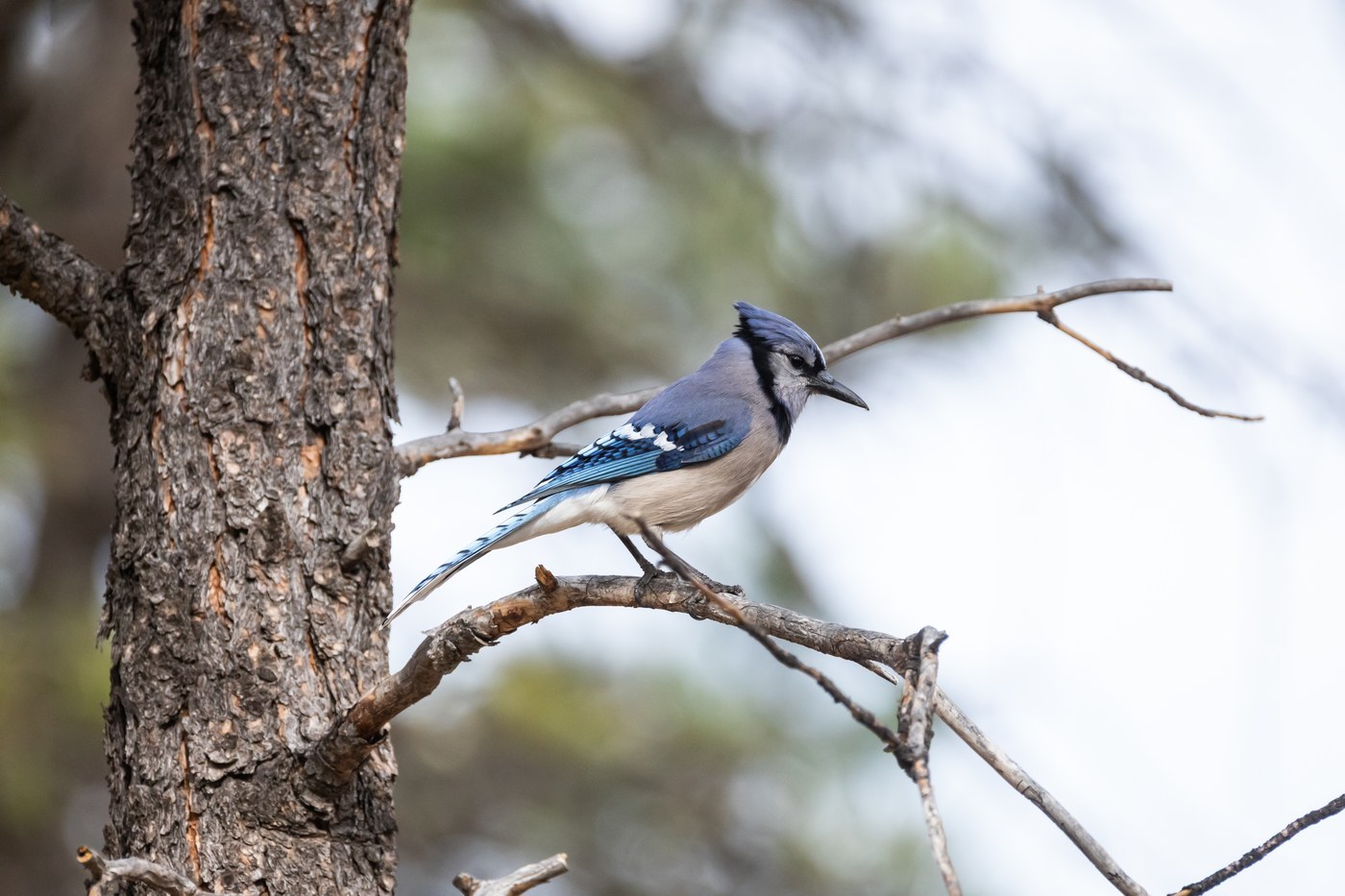
Key Field Marks
- Size & shape: A large songbird, 25-30 cm (10-12 in), with a prominent pointed crest, a fairly long tail, and a stout, straight, all-purpose bill.
- Plumage: Bright blue upperparts, crest, and tail, with a whitish face and underparts, a black necklace-like band across the throat/upper breast extending around the nape, and bold black barring plus white wing bars and tail-tip spots on the wings and tail.
- Behavior: Bold, noisy, and intelligent; often seen carrying and caching acorns and other food items, mobbing hawks and owls, and raising its crest when excited or aggressive (crest is flattened when relaxed or fleeing).
- Flight: Steady, somewhat labored-looking flight with the blue wings and tail flashing white wing bars and tail corners.
- Sexes: Sexes look alike; juveniles are similarly patterned but slightly duller/browner-blue.
Similar Species
- Steller's Jay: Western counterpart with a darker, mostly black head/crest and no white face pattern; ranges barely overlap, if at all, in the Rockies.
- Woodhouse's/California Scrub-Jay: Lacks a crest entirely and shows a plainer blue-and-gray pattern without the black necklace or white wing markings.
- Florida Scrub-Jay: Also crestless, paler blue-gray, and restricted to Florida scrub habitat.
- The prominent crest, black necklace, and white-spotted blue wings/tail make Blue Jay essentially unmistakable within its eastern/central range.
Where & When to See It
- Range: Resident and partially migratory across the eastern two-thirds of the United States and southern Canada, from the Great Plains east to the Atlantic, generally absent from the far West.
- Habitat: Highly adaptable — deciduous and mixed forest, forest edge, parks, suburban and urban yards, and areas with oak trees (a key food source via acorns).
- Season: Present year-round through most of its range; some northern populations migrate south in loose flocks during fall, visible as daytime movements along ridges and lakeshores, though many individuals also remain on territory through winter.
Voice & Song Cues
- Loud, harsh jay! jay! or jeeah calls are the classic sound, often given repeatedly and used to alert other birds to predators.
- Also gives a liquid, musical "pump-handle" or squeaky gate-like call, and is a skilled mimic of Red-shouldered and Red-tailed Hawk calls, sometimes to scare other birds from a feeder.
- A quieter, softer whisper song of clicks, whines, and warbles is given during courtship, rarely heard compared to the loud alarm calls.
Frequently asked questions
What makes the Blue Jay easy to identify?
Its prominent blue crest, white face, black necklace band, and white-spotted blue wings and tail make it distinctive and essentially unmistakable in its eastern North American range.
Do Blue Jays migrate?
Some northern populations migrate south in loose daytime flocks in fall, but many individuals, especially in the southern part of the range, remain on territory year-round.
Why does a Blue Jay's crest change shape?
The crest is raised when the bird is excited, agitated, or aggressive, and flattened when it is relaxed, feeding calmly, or fleeing a threat.
Can Blue Jays imitate hawks?
Yes, Blue Jays frequently mimic the calls of Red-shouldered and Red-tailed Hawks, which may help them clear other birds away from feeders or food sources.