
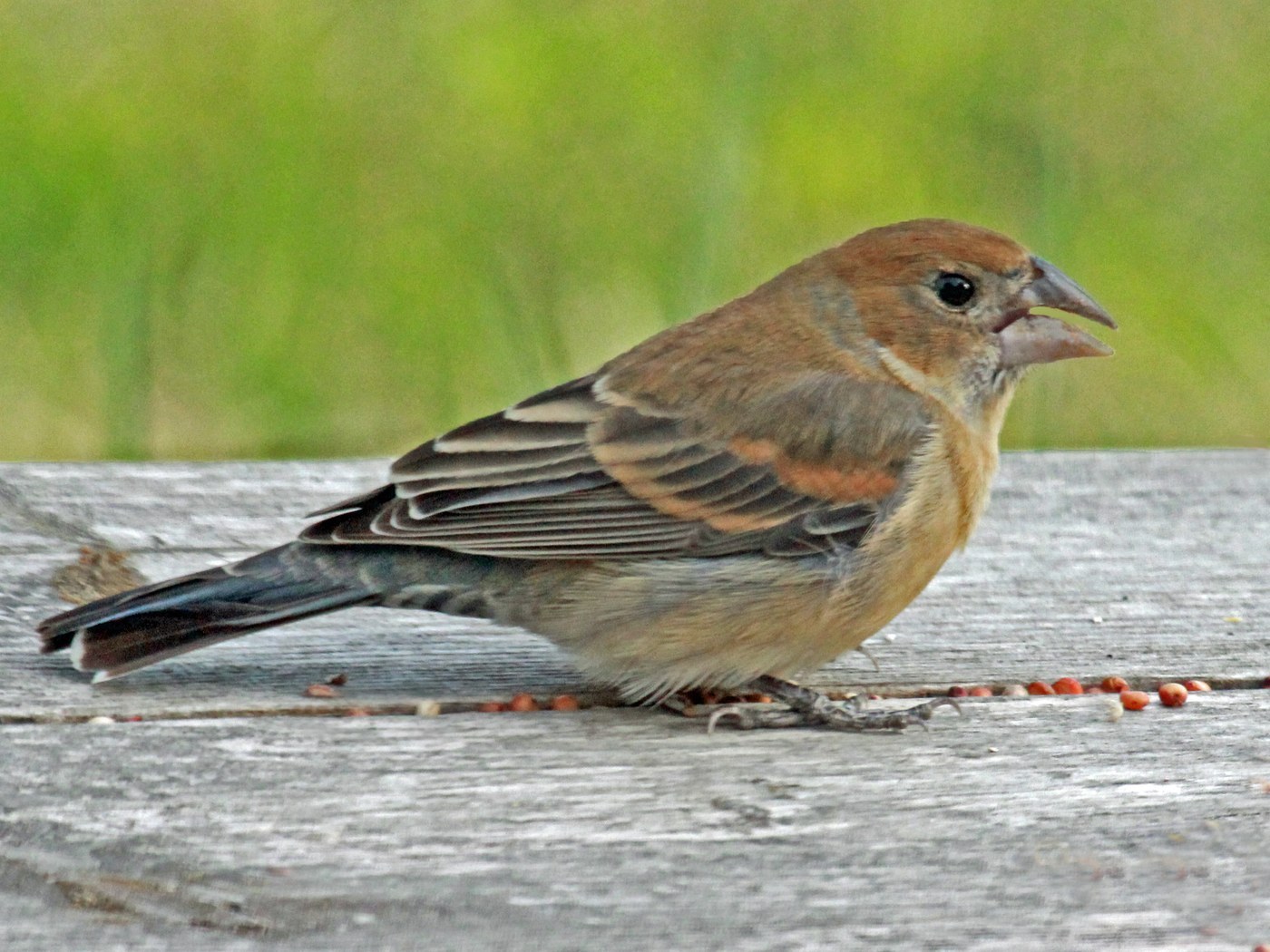
Blue Grosbeak
Passerina caerulea
A stocky, deep-blue finch-like bird with rich chestnut wingbars and a heavy silver bill, favoring brushy fields across the southern and central United States.
- Size
- 14-19 cm (5.5-7.5 in) long, 26-29 cm wingspan
- Habitat
- shrubby fields, brushy roadsides, riparian thickets, and hedgerows
- Type
- songbird
Spotted a bird like this?
Identify any bird from a photo, free.
Overview
The Blue Grosbeak is a chunky, deep-blue songbird related to the smaller buntings, distinguished by its notably heavier, silvery bill and two bold chestnut wingbars. Adult males are rich, deep blue overall, appearing almost black in poor light, with a small black mask around the bill. Females are warm cinnamon-brown overall with subtler buffy wingbars and a hint of blue on the wings, rump, or tail in some individuals.
Often confused with the smaller Indigo Bunting where ranges overlap, the Blue Grosbeak is larger and stockier with a much heavier bill and distinctive rusty wingbars, and it favors brushy, weedy field edges rather than more wooded habitat.
How to identify it
Key Field Marks
- Large, heavy, silvery-gray conical bill
- Adult male: deep blue body, black face mask, two rufous-chestnut wingbars
- Female: warm cinnamon-brown overall, buffy wingbars, occasional blue tinge on rump/tail
- Stocky build, often flicks and spreads its tail
Similar Species
- Indigo Bunting is smaller with a much smaller bill and lacks the rufous wingbars; male Indigo Buntings are also a brighter, more uniform blue.
- Eastern/Western Bluebird have a completely different, more upright thrush shape and thin bill, not a heavy conical grosbeak bill.
- Female Blue Grosbeaks can resemble female cowbirds but show wingbars and a heavier bill.
Habitat & range
Habitat
Favors brushy old fields, hedgerows, riparian thickets, roadside edges, and shrubby second growth, generally avoiding dense forest or wide-open grassland.
Range
Breeds across the southern and central United States, from California and the Southwest east to the mid-Atlantic, and south into Mexico and Central America.
Migration
A long-distance neotropical migrant, wintering from Mexico south to Panama.
Behavior & voice
Behavior
Blue Grosbeaks often perch low in shrubs or on wires, flicking and spreading their tail sideways in a distinctive habit. They can be somewhat secretive, staying low in brushy cover.
Voice
The song is a rich, warbling series of rising and falling notes, somewhat similar to a Purple Finch's song but slower and more deliberate; the call is a sharp "chink" or metallic "tink."
Feeding
Feeds heavily on insects, especially grasshoppers and other large invertebrates, along with seeds and grain, particularly outside the breeding season.
Nesting & Breeding
The female builds a bulky cup nest of twigs, bark strips, and rootlets in a low shrub or tree, sometimes incorporating unusual materials like snakeskin or paper. She incubates 3-4 eggs, and the species is a frequent host of Brown-headed Cowbird parasitism.
Frequently asked questions
How do you tell a Blue Grosbeak from an Indigo Bunting?
Blue Grosbeaks are larger with a much heavier bill and show two rusty-chestnut wingbars, while Indigo Buntings are smaller, more uniformly blue, and lack strong wingbars.
Why does the Blue Grosbeak flick its tail?
Blue Grosbeaks have a distinctive habit of flicking and spreading their tail sideways while perched, a behavior useful for identification even at a distance.
What does a female Blue Grosbeak look like?
Females are warm cinnamon-brown overall with buffy wingbars and sometimes a hint of blue on the rump or tail, quite different from the deep blue male.
What does the Blue Grosbeak eat?
It feeds mainly on insects, especially grasshoppers, along with seeds and grain, foraging low in brushy field edges.
Blue Grosbeak guides
In-depth guides for identifying, finding, and understanding Blue Grosbeak.
Other birds you may enjoy

Black Redstart
13-14.5 cm (5.1-5.7 in) long, 23-26 cm wingspan

Black-throated Sparrow
12-14 cm (4.7-5.5 in) long, about 19-20 cm (7.5-8 in) wingspan

Greater Bird-of-paradise
Body about 43 cm; males with additional flank plumes up to 50 cm and long tail wires

Blue Tit
11-12 cm (4.3-4.7 in) long, 17-20 cm wingspan

Red-billed Quelea
11.5–13 cm long, wingspan about 20–22 cm
White-plumed Antbird
13-14 cm (5-5.5 in) long

Pyrrhuloxia
19-22 cm (7.5-8.7 in) long, 30 cm wingspan

Blue-gray Tanager
16-18 cm (6-7 in) long

Blackburnian Warbler
11-13 cm (4.3-5.1 in) long, 20-22 cm wingspan

Bluethroat
13-14 cm (5.1-5.5 in) long, 20-22 cm wingspan

Eurasian Nuthatch
12-14.5 cm (4.7-5.7 in) long, 22.5-27 cm wingspan

Wood Thrush
19-21 cm (7.5-8.3 in) long, about 33 cm (13 in) wingspan