
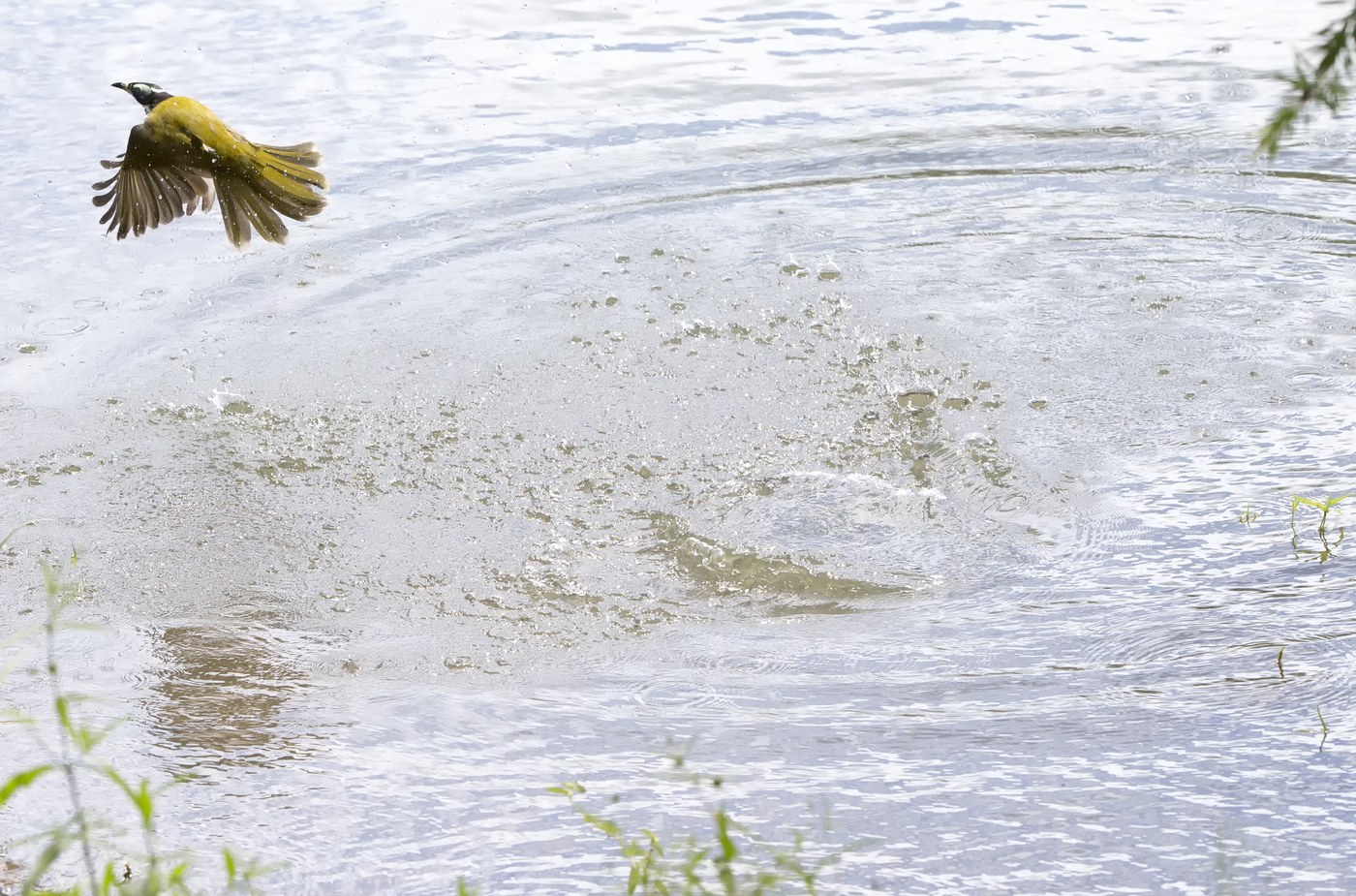
Blue-faced Honeyeater
Entomyzon cyanotis
A large, bold honeyeater with vivid turquoise-blue bare skin around the eye set against a black-and-white head and olive-green back.
- Size
- 26-32 cm (10-12.5 in) long, 35-45 cm wingspan
- Habitat
- open woodland, forest edges, parks, and gardens near water
- Type
- songbird
Spotted a bird like this?
Identify any bird from a photo, free.
Overview
The Blue-faced Honeyeater is one of the largest and most striking honeyeaters in Australia, easily identified by the patch of bare, vivid turquoise-blue skin surrounding the eye, set against a black crown, nape, and throat and a clean white underside. The back and wings are olive-green, and the overall effect is a bold, high-contrast bird sometimes nicknamed "bananabird" for its habit of raiding ripening bananas in gardens and orchards.
Juveniles show yellow-green facial skin rather than blue, gradually developing the adult's turquoise coloring as they mature, and family groups often forage together noisily through open woodland and garden trees.
How to identify it
Key field marks
- Bright turquoise-blue bare skin patch around the eye in adults
- Black head, nape, and throat contrasting with a clean white breast and belly
- Olive-green back and wings
- Large size for a honeyeater, with a heavy, slightly downcurved bill
Similar species
- Juveniles, which show yellow-green rather than blue facial skin, can be mistaken for other species but retain the same black-and-white head pattern and olive back.
- No other Australian honeyeater has this combination of bare blue facial skin and black-and-white head pattern.
Habitat & range
Habitat
Found in open eucalypt woodland, forest edges, mangroves, parks, gardens, and orchards, generally near water.
Range
Widespread across northern and eastern Australia, from the Kimberley region of Western Australia across the Top End and Cape York, down the east coast through Queensland and New South Wales to eastern Victoria.
Migration
Largely sedentary, though some local and seasonal movements occur in response to food availability.
Behavior & voice
Behavior
Usually seen in small, active family groups foraging together in trees and on the ground; bold and inquisitive, often visiting gardens and readily approaching people.
Voice
A loud, ringing, two- or three-note call often rendered as "queep-queep" or a sharp "yorrick," along with various chattering notes when in groups.
Feeding
Forages for insects among bark and foliage, drinks nectar from flowering trees, and eats soft fruit, sometimes raiding ripe fruit in orchards and gardens.
Nesting
Often uses old nests of other birds, particularly babblers or friarbirds, refurbishing them rather than always building from scratch; lays 2-3 pinkish eggs with reddish-brown spotting.
Frequently asked questions
How do you identify a Blue-faced Honeyeater?
Look for a large honeyeater with vivid turquoise-blue bare skin around the eye, a black head and throat, a white breast, and an olive-green back.
Why is the Blue-faced Honeyeater called a bananabird?
It has earned the nickname for its habit of visiting gardens and orchards to feed on ripening bananas and other soft fruit.
Do young Blue-faced Honeyeaters have blue faces?
No, juveniles have yellow-green facial skin that gradually changes to the adult's turquoise-blue as they mature.
What does a Blue-faced Honeyeater eat?
Insects gleaned from bark and foliage, nectar from flowering trees, and soft fruit.
Blue-faced Honeyeater guides
In-depth guides for identifying, finding, and understanding Blue-faced Honeyeater.
Other birds you may enjoy

Black Redstart
13-14.5 cm (5.1-5.7 in) long, 23-26 cm wingspan

Black-throated Sparrow
12-14 cm (4.7-5.5 in) long, about 19-20 cm (7.5-8 in) wingspan

Greater Bird-of-paradise
Body about 43 cm; males with additional flank plumes up to 50 cm and long tail wires

Blue Tit
11-12 cm (4.3-4.7 in) long, 17-20 cm wingspan

Red-billed Quelea
11.5–13 cm long, wingspan about 20–22 cm
White-plumed Antbird
13-14 cm (5-5.5 in) long

Pyrrhuloxia
19-22 cm (7.5-8.7 in) long, 30 cm wingspan

Blue-gray Tanager
16-18 cm (6-7 in) long

Blackburnian Warbler
11-13 cm (4.3-5.1 in) long, 20-22 cm wingspan

Bluethroat
13-14 cm (5.1-5.5 in) long, 20-22 cm wingspan

Eurasian Nuthatch
12-14.5 cm (4.7-5.7 in) long, 22.5-27 cm wingspan

Wood Thrush
19-21 cm (7.5-8.3 in) long, about 33 cm (13 in) wingspan