
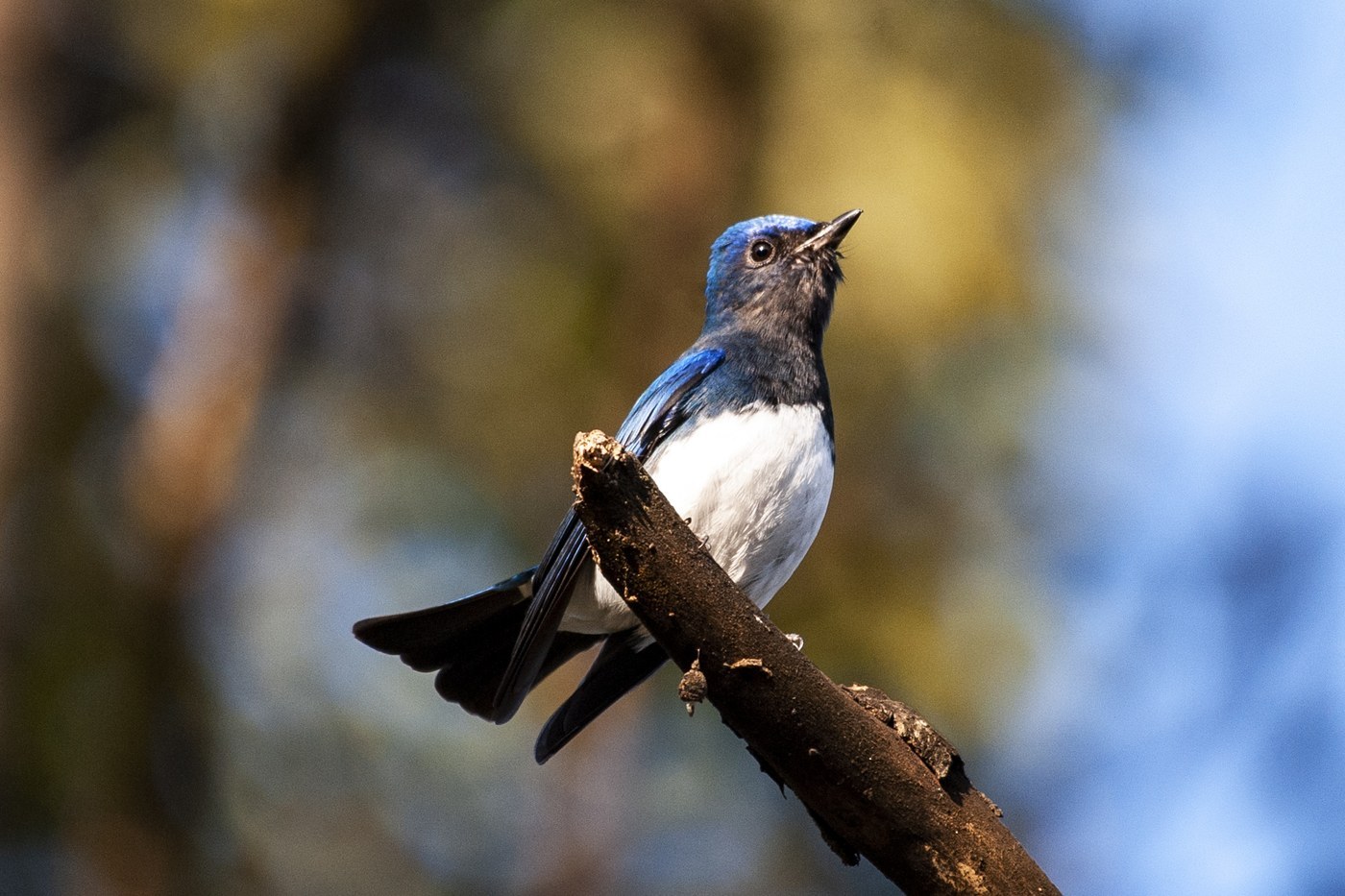
Blue-and-white Flycatcher
Cyanoptila cyanomelana
A vivid forest flycatcher; the male is deep blue above with a black face and throat and a clean white belly.
- Size
- 16-17 cm (6.3-6.7 in) long
- Habitat
- dense mountain and lowland forests
- Type
- songbird
Spotted a bird like this?
Identify any bird from a photo, free.
Overview
The Blue-and-white Flycatcher is a striking forest songbird showing strong sexual dimorphism. Males are a rich, deep cobalt-blue across the crown, back, wings, and tail, with a black face, throat, and upper breast that sharply contrasts against a clean white belly. Females are far more subdued, with soft olive-brown upperparts, a buffy throat and breast, and paler underparts, lacking any blue or black.
A prized and eagerly sought species among birdwatchers for the male's brilliant coloring, it inhabits dense, shaded forest, often near streams, where it typically perches quietly within the canopy or mid-story rather than in the open.
How to identify it
Key field marks
- Male: deep cobalt-blue upperparts, black face and throat, white belly
- Female: plain olive-brown upperparts with a buffy throat and breast
- Fairly large flycatcher size with an upright posture
- Often stays within shaded forest canopy or mid-story
Similar species
- Siberian Blue Robin male is also blue above but has a white (not black) throat and a different overall shape.
- Narcissus Flycatcher male has bright yellow-orange underparts rather than blue-and-white, easily distinguished by color alone.
Habitat & range
Habitat
Inhabits dense, shaded broadleaf and mixed forest, often near streams or ravines with a closed canopy.
Range
Breeds across Japan, the Korean Peninsula, and parts of northeastern China; winters across Southeast Asia, including the Philippines, Borneo, and the Malay Peninsula.
Migration
A long-distance migrant, moving from East Asian breeding grounds to Southeast Asian wintering areas.
Behavior & voice
Behavior
Often stays within the forest canopy or mid-story, sallying out to catch insects in flight and returning to a favored perch; males sing persistently from high perches during the breeding season.
Voice
A rich, loud, whistled song with a slightly metallic quality, often delivered from a high, exposed branch within the forest.
Feeding
Feeds mainly on flying insects caught by sallying from a perch, along with some insects gleaned from foliage.
Nesting
Builds a cup nest in a tree cavity, rock crevice, or on a mossy bank; lays 3-5 pale eggs with reddish speckling.
Frequently asked questions
How do you identify a male Blue-and-white Flycatcher?
Look for deep cobalt-blue upperparts, a black face and throat, and a clean white belly, a striking combination unique among East Asian flycatchers.
What does a female Blue-and-white Flycatcher look like?
Females are much plainer, with soft olive-brown upperparts and a buffy throat and breast, lacking any blue or black coloring.
Where does the Blue-and-white Flycatcher breed?
It breeds in dense forest across Japan, the Korean Peninsula, and parts of northeastern China, wintering in Southeast Asia.
What does a Blue-and-white Flycatcher eat?
Mainly flying insects, caught by sallying from a perch within the forest canopy or mid-story.
Blue-and-white Flycatcher guides
In-depth guides for identifying, finding, and understanding Blue-and-white Flycatcher.
Other birds you may enjoy

Black Redstart
13-14.5 cm (5.1-5.7 in) long, 23-26 cm wingspan

Black-throated Sparrow
12-14 cm (4.7-5.5 in) long, about 19-20 cm (7.5-8 in) wingspan

Greater Bird-of-paradise
Body about 43 cm; males with additional flank plumes up to 50 cm and long tail wires

Blue Tit
11-12 cm (4.3-4.7 in) long, 17-20 cm wingspan

Red-billed Quelea
11.5–13 cm long, wingspan about 20–22 cm
White-plumed Antbird
13-14 cm (5-5.5 in) long

Pyrrhuloxia
19-22 cm (7.5-8.7 in) long, 30 cm wingspan

Blue-gray Tanager
16-18 cm (6-7 in) long

Blackburnian Warbler
11-13 cm (4.3-5.1 in) long, 20-22 cm wingspan

Bluethroat
13-14 cm (5.1-5.5 in) long, 20-22 cm wingspan

Eurasian Nuthatch
12-14.5 cm (4.7-5.7 in) long, 22.5-27 cm wingspan

Wood Thrush
19-21 cm (7.5-8.3 in) long, about 33 cm (13 in) wingspan