
Blue-and-white Flycatcher Identification Guide
A striking East Asian forest flycatcher whose male combines deep blue upperparts with a sharply defined black-and-white underside.
Read the full Blue-and-white Flycatcher encyclopedia entry →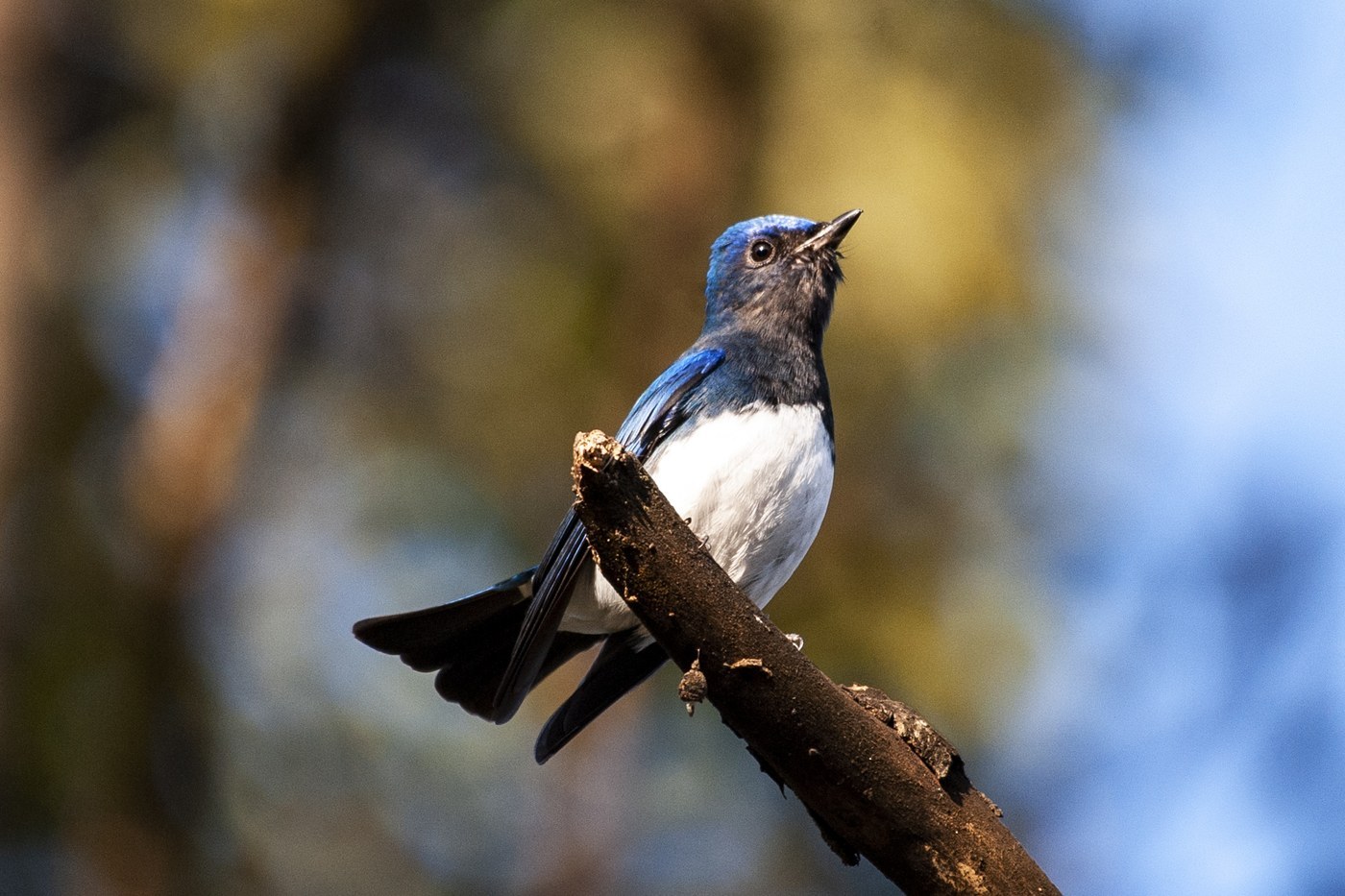
Key Field Marks
- Size & shape: A small flycatcher (about 16 cm) with a fairly large head, black bill, and the upright perching posture typical of true flycatchers, often perching conspicuously and sallying out after insects.
- Male: Deep, rich blue upperparts covering the crown, back, wings, and tail; a black face, throat, and upper breast; and a crisp white belly with a sharp, clean line dividing the black breast from the white belly.
- Female: Warm brown to olive-brown upperparts, a buffy throat and breast, and a whitish belly — entirely lacking the male's blue tones, making females much less distinctive.
- Behavior: Perches upright on an exposed branch, flicks its tail, and makes short sallying flights to catch flying insects before returning to the same or a nearby perch.
Separating It from Similar Species
- Male could suggest other blue Asian birds such as Blue Rock Thrush, but that species is larger, has a heavier bill, and lacks the crisp black bib/white belly split.
- Siberian Blue Robin males also show blue upperparts but have orange flanks and a different, more skulking behavior near the ground.
- Females are trickier and can resemble female Narcissus Flycatcher, but Narcissus shows a yellowish rump patch that Blue-and-white Flycatcher lacks.
Where & When to See It
- Breeding range: Montane broadleaf and mixed forests of Japan, the Korean Peninsula, eastern China, and the Russian Far East, generally at mid- to high elevations in summer.
- Winter range: Forest understory and mid-story of Southeast Asia, including Thailand, Malaysia, Indonesia, and the Philippines.
- Season: A long-distance migrant — present on breeding grounds roughly April to September, wintering in the tropics the rest of the year; also occurs as a passage migrant through eastern China and Taiwan.
Voice
- The song is rich, loud, and complex — a series of clear, varied whistled phrases often described as unusually beautiful and musical for a flycatcher, typically delivered from a high, exposed perch in the canopy.
- Calls include sharp, dry ticking notes given in alarm or contact.
Frequently asked questions
What does a male Blue-and-white Flycatcher look like?
Deep blue upperparts, a black face, throat, and upper breast, and a crisp white belly with a sharply defined boundary between the black chest and white underside.
How do I identify a female Blue-and-white Flycatcher?
Females lack blue entirely, showing brown to olive-brown upperparts, a buffy throat and breast, and a whitish belly — best identified by range, habitat, and association with males.
Where does the Blue-and-white Flycatcher breed?
In montane forests of Japan, Korea, eastern China, and the Russian Far East, usually at higher elevations during the breeding season.
Where does the Blue-and-white Flycatcher spend the winter?
It migrates to forest understory habitats across Southeast Asia, including Thailand, Malaysia, Indonesia, and the Philippines.