
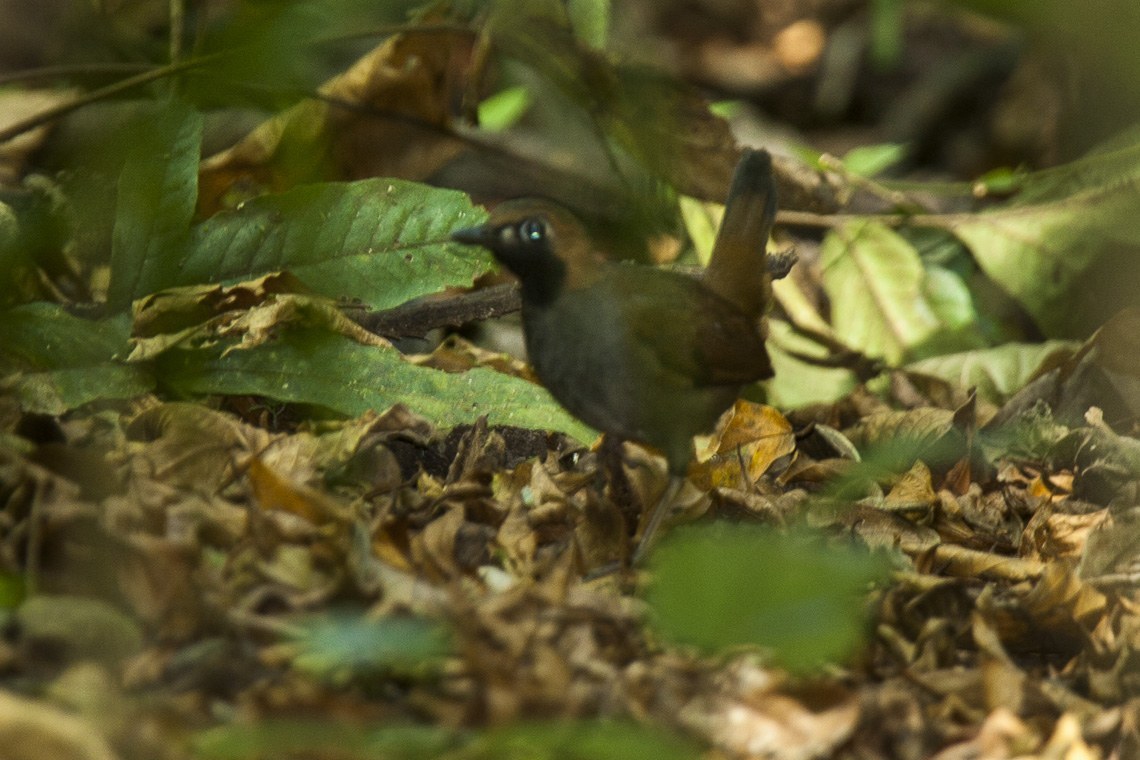
Black-faced Antthrush
Formicarius analis
A plump, ground-dwelling forest bird with a black face and a short cocked tail, more often heard than seen as it walks quietly through leaf litter.
- Size
- 16-19 cm (6.3-7.5 in) long
- Habitat
- floor of humid lowland forest
- Type
- songbird
Spotted a bird like this?
Identify any bird from a photo, free.
Overview
The Black-faced Antthrush is a chunky, terrestrial member of the antthrush family (Formicariidae), built more like a small rail or tinamou than a typical songbird, with a rounded body, long legs, and a short, frequently cocked tail. Plumage is rich olive-brown above with a contrasting black face and throat and gray underparts. It walks deliberately across the forest floor rather than hopping, often stopping to flick its tail upward.
Although easily overlooked in the dim forest interior, its clear, whistled song is one of the characteristic sounds of lowland Neotropical rainforest.
How to identify it
Key field marks
- Chunky, short-tailed, long-legged silhouette on the forest floor.
- Black face and throat contrasting with olive-brown upperparts and gray underparts.
- Frequent tail-cocking while walking.
Similar species
Other antthrushes have different face patterns (e.g., rufous or gray faces) and largely non-overlapping ranges or habitats. The combination of ground-walking behavior, black face, and cocked tail is distinctive within its range; it is far more often identified by voice than sight.
Habitat & range
This species inhabits the floor of humid lowland and (locally) foothill evergreen forest from southern Mexico through Central America and across much of Amazonia to Bolivia and Brazil, generally below about 1,200 m. It is a non-migratory resident that keeps to shaded forest interior and rarely ventures into open or disturbed habitat.
Behavior & voice
Voice
The song is a series of clear, evenly spaced, far-carrying whistled notes, often given at dawn and dusk; the ventriloquial quality makes the singing bird difficult to pinpoint.
Feeding
Black-faced Antthrushes walk steadily across the leaf litter, turning over leaves and probing debris for insects, spiders, and other invertebrates; they associate with army ant swarms only opportunistically rather than as obligate followers.
Nesting and breeding
Nests are built in cavities such as low tree stumps, banks, or hollow logs rather than open cups. Both parents are believed to share incubation and care of the young, which are notably precocial-looking with dark, sooty down.
Frequently asked questions
Why is the Black-faced Antthrush hard to see?
It walks quietly on the shaded forest floor and its dark plumage blends with leaf litter, so it is usually detected by its whistled song rather than sight.
Does it follow army ants?
It will opportunistically feed at ant swarms but is not an obligate ant-follower like some other antbird-family species.
What does its song sound like?
A series of clear, evenly spaced whistled notes that carry well through the forest and can sound ventriloquial.
Where is the Black-faced Antthrush found?
In lowland forest from southern Mexico through Central America and across much of the Amazon basin.
Black-faced Antthrush guides
In-depth guides for identifying, finding, and understanding Black-faced Antthrush.
Other birds you may enjoy

Black Redstart
13-14.5 cm (5.1-5.7 in) long, 23-26 cm wingspan

Black-throated Sparrow
12-14 cm (4.7-5.5 in) long, about 19-20 cm (7.5-8 in) wingspan

Greater Bird-of-paradise
Body about 43 cm; males with additional flank plumes up to 50 cm and long tail wires

Blue Tit
11-12 cm (4.3-4.7 in) long, 17-20 cm wingspan

Red-billed Quelea
11.5–13 cm long, wingspan about 20–22 cm
White-plumed Antbird
13-14 cm (5-5.5 in) long

Pyrrhuloxia
19-22 cm (7.5-8.7 in) long, 30 cm wingspan

Blue-gray Tanager
16-18 cm (6-7 in) long

Blackburnian Warbler
11-13 cm (4.3-5.1 in) long, 20-22 cm wingspan

Bluethroat
13-14 cm (5.1-5.5 in) long, 20-22 cm wingspan

Eurasian Nuthatch
12-14.5 cm (4.7-5.7 in) long, 22.5-27 cm wingspan

Wood Thrush
19-21 cm (7.5-8.3 in) long, about 33 cm (13 in) wingspan