
Black-faced Antthrush Identification Guide
A chunky, ground-dwelling rainforest bird with long pink legs and a black face, more often heard than seen as it walks the forest floor.
Read the full Black-faced Antthrush encyclopedia entry →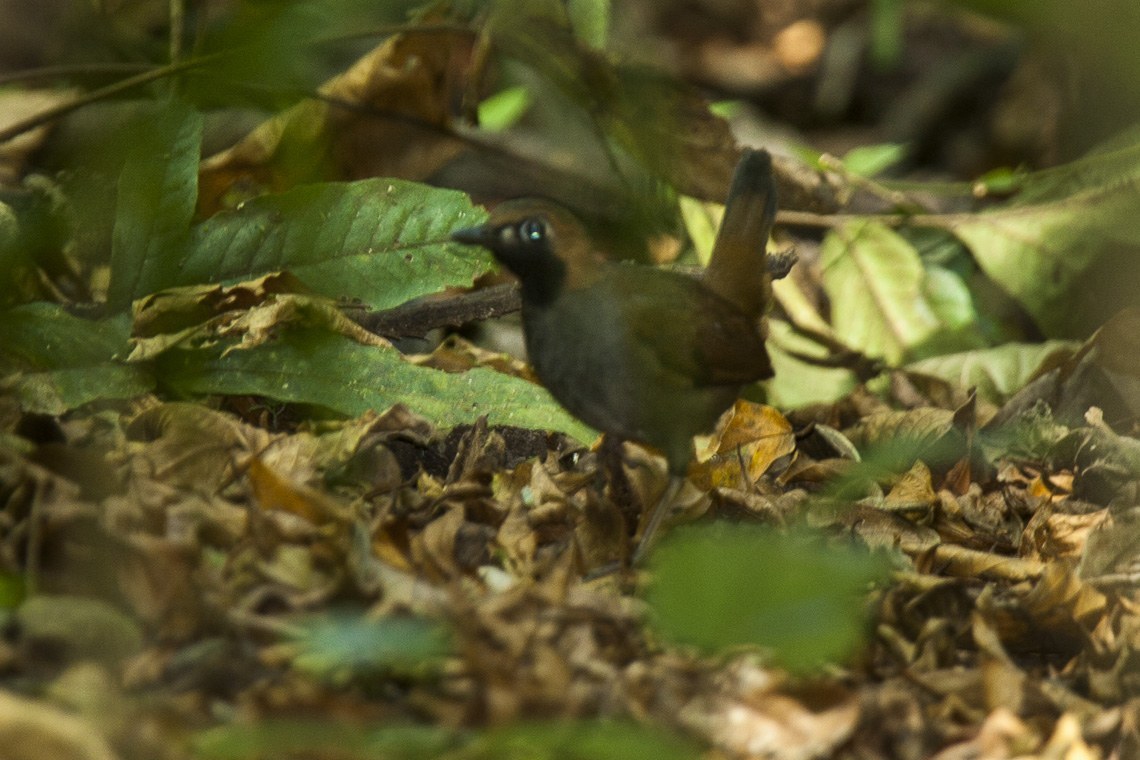
Key Field Marks
- Plump, short-tailed, terrestrial bird about the size of a small quail, with a rounded body and an almost tailless appearance when the short tail is cocked upward.
- Upperparts are rich olive-brown; underparts are grey, with a black face and throat that give the species its name.
- Legs are notably long and pale pink, adapted for its habit of walking briskly across the forest floor.
- Bill is fairly short and slightly downcurved.
- Walks with a distinctive chicken-like gait, frequently pumping or bobbing its short tail up and down.
Separating It From Similar Species
- Other antthrushes, such as Rufous-breasted Antthrush and Black-headed Antthrush, differ mainly in underpart color (rufous vs. grey) and the extent of black on the head; range and voice are the most reliable ways to separate similar-looking antthrushes where distributions meet.
- Antpittas are similarly terrestrial but are typically rounder, shorter-tailed, and lack the antthrush's habit of holding its tail cocked and walking with deliberate steps.
- Its ventriloquial, evenly-paced whistled song is often the best way to confirm identification, since the bird itself is notoriously difficult to see in dense undergrowth.
Where and When to See It
- Resident in lowland and foothill rainforest understory from southern Mexico and Central America through much of the Amazon Basin.
- Prefers the dark interior of humid forest with a relatively open floor, often near streams or ravines.
- Non-migratory; pairs hold permanent territories and can be encountered year-round, though they are shy and quick to slip into cover.
Voice and Behavior
- Song is a distinctive, evenly spaced series of clear, ringing whistles that often speeds up or changes pitch, carrying well through dense forest and frequently the only sign of the bird's presence.
- Forages on the forest floor, flipping leaf litter and probing for insects and other invertebrates; sometimes attends army ant swarms to catch prey flushed by the ants, though less obligately than true antbirds.
- Extremely wary; typically detected by voice long before it is glimpsed walking across a trail or forest opening.
Frequently asked questions
Why is Black-faced Antthrush so hard to see despite being common?
It stays low in dense forest understory, walks quietly on the ground, and freezes or slips into cover at the first sign of disturbance, so most encounters are by voice rather than sight.
What does a Black-faced Antthrush sound like?
An evenly paced, ringing series of clear whistles, often accelerating or shifting pitch partway through, that carries well through the forest interior.
Does Black-faced Antthrush follow army ants?
It will forage at army ant swarms opportunistically to catch flushed insects, but it is not a dedicated ant-swarm specialist the way some true antbirds are.
How is Black-faced Antthrush different from an antpitta?
Antthrushes have a longer, cocked tail and a more upright walking gait, while antpittas are rounder and nearly tailless with a hopping movement.