
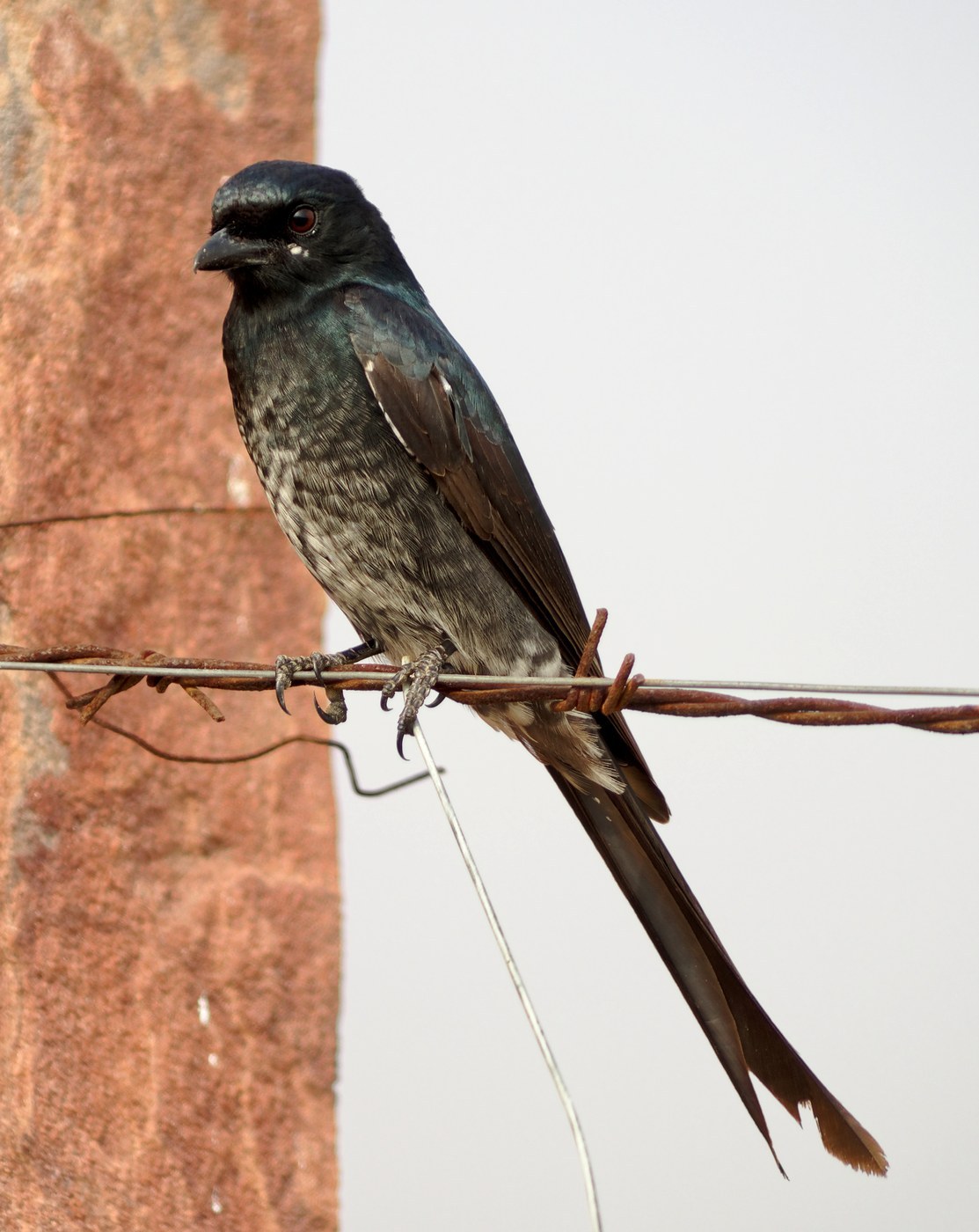
Black Drongo
Dicrurus macrocercus
A glossy black, red-eyed bird with a deeply forked tail, famous for fearlessly mobbing crows and raptors.
- Size
- 28-32 cm (11-12.5 in) long including deeply forked tail
- Habitat
- farmland, open country, roadsides, and wetland edges across South and Southeast Asia
- Type
- songbird
Spotted a bird like this?
Identify any bird from a photo, free.
Overview
The Black Drongo, often called the "king crow" for its habit of aggressively chasing off much larger birds, is one of the most conspicuous perching birds of South Asian farmland. It is entirely glossy black with a blue-green sheen, a stout black bill, and deep red eyes, and is instantly recognizable by its long, deeply forked "fish-tail" tail.
Often seen perched on wires, fences, or the backs of grazing cattle, Black Drongos are bold, confident birds that sally out from a perch to snatch flying insects in mid-air before returning to the same or a nearby perch — a behavior known as hawking or sallying.
How to identify it
Key field marks
- All-black glossy plumage with a bluish-green sheen
- Deeply forked, scissor-like tail, often held slightly upturned at the tips
- Red eyes and a stout, slightly hooked black bill
- Upright posture on open perches; bold, aggressive behavior toward larger birds
Similar species
The Ashy Drongo is grey rather than black. The Greater Racket-tailed Drongo is larger, has a distinctive forehead crest, and carries long wire-like tail streamers ending in rackets. Crows are much larger and lack the deeply forked tail.
Habitat & range
Black Drongos are widespread across the Indian subcontinent, extending into parts of Southeast Asia and southern China. They favor open country: farmland, grasslands, scrub, roadside wires, and the edges of wetlands and villages, generally avoiding dense forest.
Most populations are resident, though northern populations show some local seasonal movement.
Behavior & voice
Voice
Calls are varied and harsh, including sharp metallic notes, whistles, and chattering; the species is also a skilled mimic of other birds' calls.
Feeding
Black Drongos hunt mainly by sallying from an exposed perch to catch flying insects in the air, and they frequently follow grazing cattle or tractors to snap up insects disturbed from the grass.
Nesting and breeding
The nest is a shallow cup of twigs and fibers built in the fork of a tree, often quite high. Both sexes are notoriously aggressive in defense of the nest, diving at and driving off crows, kites, and even much larger raptors that stray too close.
Frequently asked questions
Why is the Black Drongo called the 'king crow'?
Because it fearlessly attacks and chases away crows and even large raptors that come near its territory or nest, despite being much smaller.
How do you identify a Black Drongo?
Look for an all-glossy-black bird with red eyes and a deeply forked, fish-tail-shaped tail, often perched on wires or cattle.
What does a Black Drongo eat?
Mainly flying insects such as grasshoppers, beetles, and moths, often caught by sallying from a perch or following grazing animals.
Can Black Drongos mimic other birds?
Yes, they are accomplished mimics and can incorporate the calls of other bird species into their vocal repertoire.
Black Drongo guides
In-depth guides for identifying, finding, and understanding Black Drongo.
Other birds you may enjoy

Black Redstart
13-14.5 cm (5.1-5.7 in) long, 23-26 cm wingspan

Black-throated Sparrow
12-14 cm (4.7-5.5 in) long, about 19-20 cm (7.5-8 in) wingspan

Greater Bird-of-paradise
Body about 43 cm; males with additional flank plumes up to 50 cm and long tail wires

Blue Tit
11-12 cm (4.3-4.7 in) long, 17-20 cm wingspan

Red-billed Quelea
11.5–13 cm long, wingspan about 20–22 cm
White-plumed Antbird
13-14 cm (5-5.5 in) long

Pyrrhuloxia
19-22 cm (7.5-8.7 in) long, 30 cm wingspan

Blue-gray Tanager
16-18 cm (6-7 in) long

Blackburnian Warbler
11-13 cm (4.3-5.1 in) long, 20-22 cm wingspan

Bluethroat
13-14 cm (5.1-5.5 in) long, 20-22 cm wingspan

Eurasian Nuthatch
12-14.5 cm (4.7-5.7 in) long, 22.5-27 cm wingspan

Wood Thrush
19-21 cm (7.5-8.3 in) long, about 33 cm (13 in) wingspan