
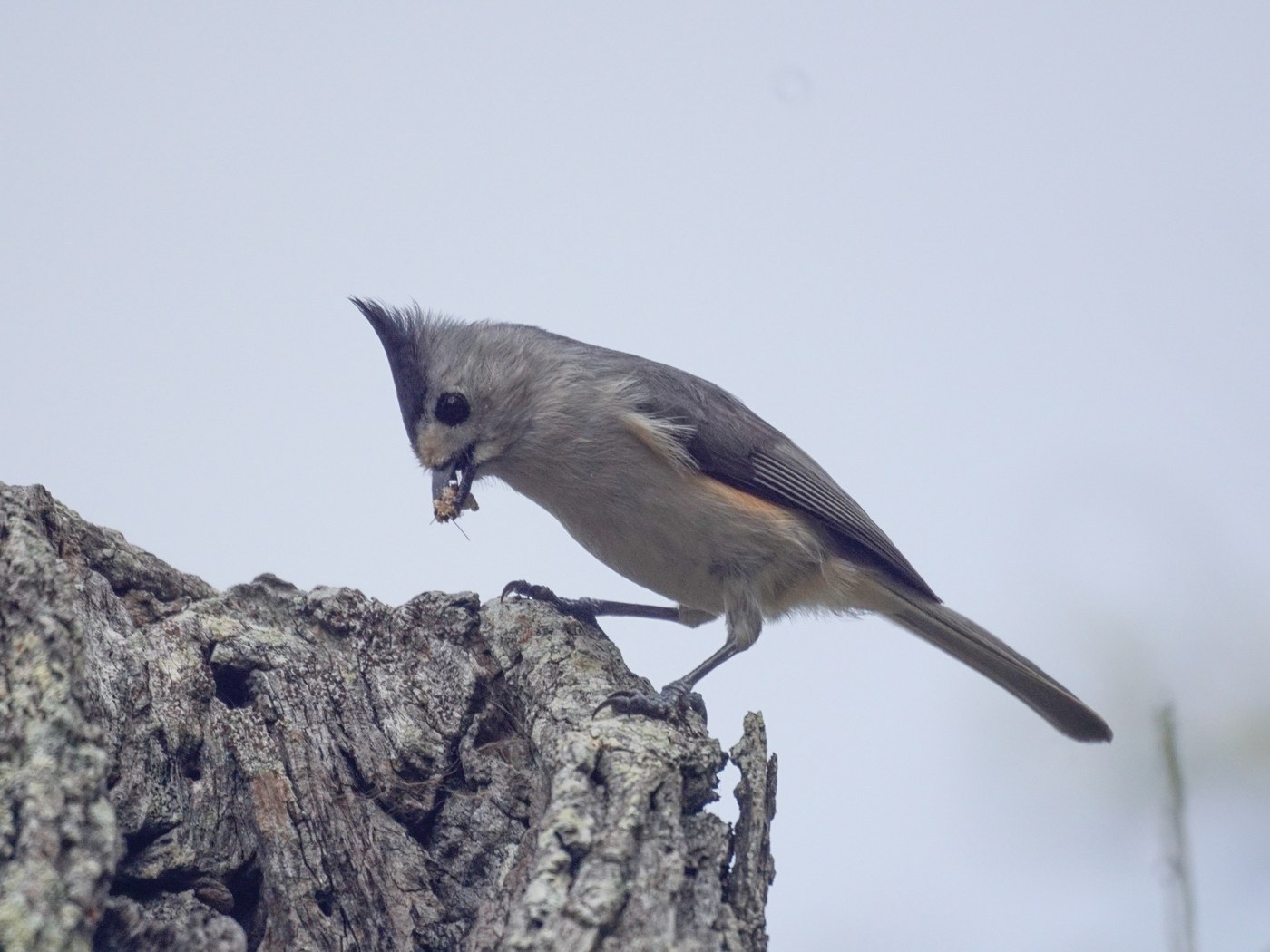
Black-crested Titmouse
Baeolophus atricristatus
A gray titmouse of Texas woodlands, distinguished by a jaunty black crest and pale forehead.
- Size
- 14-16.5 cm (5.5-6.5 in) long, 20-23 cm wingspan
- Habitat
- woodlands, brushlands, and riparian areas of Texas and northeastern Mexico
- Type
- songbird
Spotted a bird like this?
Identify any bird from a photo, free.
Overview
The Black-crested Titmouse is a lively, crested songbird found in the brushy woodlands and riparian corridors of central and southern Texas and northeastern Mexico. It closely resembles the widespread Tufted Titmouse but is easily distinguished by its bold black crest (rather than gray) and pale, whitish forehead, giving the head a striking two-toned look. The body is otherwise soft gray above and buffy-white below, with rusty flanks similar to the Tufted Titmouse.
This species was once considered a subspecies of the Tufted Titmouse, but is now recognized as a full species based on differences in crest color and other traits, with a narrow hybrid zone where the two forms meet in central Texas.
How to identify it
Key Field Marks
- Bold black crest — the defining field mark
- Pale, whitish forehead
- Gray back and wings
- Buffy-white underparts with rusty-orange flanks
- Black eye set off well against the pale face
Similar Species
- Tufted Titmouse: has a gray (not black) crest and a small blackish patch above the bill rather than a pale forehead; the two hybridize in a narrow zone in central Texas.
- Bridled Titmouse: shows a bold black-and-white striped face pattern rather than simply a black crest and pale forehead.
- Oak/Juniper Titmouse: entirely plain-faced without any crest color contrast.
Habitat & range
Habitat
Black-crested Titmice inhabit oak and mesquite woodlands, riparian corridors, and brushy scrub, and are common visitors to backyard feeders within their range.
Range
The species occurs through central and southern Texas and northeastern Mexico, meeting the Tufted Titmouse in a hybrid zone across a band of central Texas.
Migration
Black-crested Titmice are non-migratory residents, remaining on territory year-round within their woodland and scrub habitat.
Behavior & voice
Behavior
Active and vocal, Black-crested Titmice forage through woodland canopy and understory, often joining mixed foraging flocks and readily coming to feeders for sunflower seeds.
Voice
The song is a clear, whistled, repeated "peter-peter-peter," very similar to the Tufted Titmouse's song; calls include a scolding, chattering note.
Feeding
Diet includes insects, spiders, seeds, and acorns, along with readily taking sunflower seeds and other offerings at feeders.
Nesting
Nests are built in tree cavities or nest boxes, lined with soft materials including fur, sometimes plucked directly from live mammals. Clutches typically number 4-7 eggs.
Frequently asked questions
How do I tell a Black-crested Titmouse from a Tufted Titmouse?
Look at the crest color and forehead: Black-crested Titmouse has a black crest and pale whitish forehead, while Tufted Titmouse has a gray crest and a small dark patch just above the bill.
Where do Black-crested and Tufted Titmice overlap?
They meet and hybridize in a narrow zone across central Texas, where intermediate-looking birds can be seen.
Where does the Black-crested Titmouse live?
In woodlands, brush, and riparian areas of central and southern Texas and northeastern Mexico.
Does the Black-crested Titmouse visit bird feeders?
Yes, it is a regular visitor to feeders offering sunflower seeds within its Texas range.
What does the Black-crested Titmouse eat?
Insects, spiders, seeds, and acorns, supplemented with feeder foods like sunflower seeds where available.
Black-crested Titmouse guides
In-depth guides for identifying, finding, and understanding Black-crested Titmouse.
Other birds you may enjoy

Black Redstart
13-14.5 cm (5.1-5.7 in) long, 23-26 cm wingspan

Black-throated Sparrow
12-14 cm (4.7-5.5 in) long, about 19-20 cm (7.5-8 in) wingspan

Greater Bird-of-paradise
Body about 43 cm; males with additional flank plumes up to 50 cm and long tail wires

Blue Tit
11-12 cm (4.3-4.7 in) long, 17-20 cm wingspan

Red-billed Quelea
11.5–13 cm long, wingspan about 20–22 cm
White-plumed Antbird
13-14 cm (5-5.5 in) long

Pyrrhuloxia
19-22 cm (7.5-8.7 in) long, 30 cm wingspan

Blue-gray Tanager
16-18 cm (6-7 in) long

Blackburnian Warbler
11-13 cm (4.3-5.1 in) long, 20-22 cm wingspan

Bluethroat
13-14 cm (5.1-5.5 in) long, 20-22 cm wingspan

Eurasian Nuthatch
12-14.5 cm (4.7-5.7 in) long, 22.5-27 cm wingspan

Wood Thrush
19-21 cm (7.5-8.3 in) long, about 33 cm (13 in) wingspan