
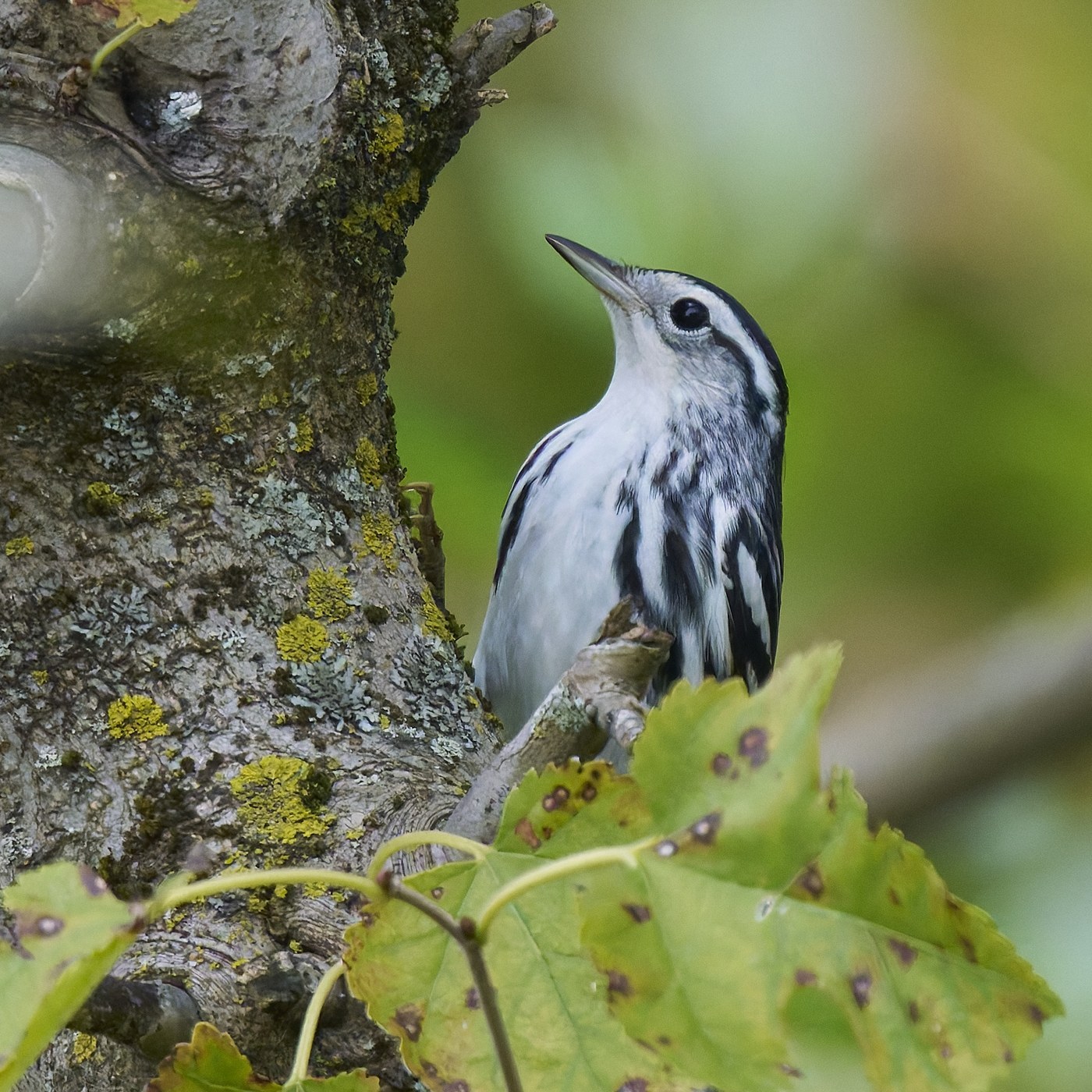
Black-and-white Warbler
Mniotilta varia
A strikingly striped black-and-white warbler that creeps along tree trunks and branches like a nuthatch, gleaning insects from bark.
- Size
- 11-13 cm (4.3-5.1 in) long, 18-21 cm wingspan
- Habitat
- deciduous and mixed forests, especially mature woods with large trees
- Type
- songbird
Spotted a bird like this?
Identify any bird from a photo, free.
Overview
The Black-and-white Warbler is instantly recognizable by its bold, all-over pattern of black and white stripes running the length of its body, head, and wings, with no other warbler showing quite the same zebra-like plumage. Males have more solid black on the throat and cheek, while females and immatures show white or buffy throats and less black overall.
Unlike most warblers that forage in foliage, this species behaves much like a nuthatch or creeper, spiraling up, down, and around tree trunks and along thick branches as it searches bark crevices for hidden insects. Its unusually long hind claw and slightly decurved bill are adaptations suited to this bark-foraging lifestyle.
How to identify it
Key Field Marks
- Bold black-and-white stripes covering the head, back, and underparts
- Male: solid black throat and cheek patch; female: white or pale buffy throat
- White stripe through the center of the crown
- Habit of creeping along tree trunks and branches like a nuthatch
- Slightly downcurved bill relative to most warblers
Similar Species
Blackpoll Warbler in breeding plumage shows a solid black cap and white cheek rather than overall striping, and forages in foliage rather than climbing trunks. Black-throated Gray Warbler has a gray back rather than striped black-and-white, plus a small yellow spot before the eye. No other warbler combines the fully striped plumage with trunk-climbing behavior.
Habitat & range
Habitat
Black-and-white Warblers favor deciduous and mixed forests, particularly mature woodlands with large trees that offer abundant bark surface for foraging.
Range
This species breeds across most of the eastern United States and Canada, from the Southeast north into the boreal forest. It winters from Florida and Mexico south through Central America, the Caribbean, and into northern South America.
Migration
Black-and-white Warblers are long-distance migrants, among the earlier warblers to arrive in spring and one of the more frequently detected species during migration due to their conspicuous foraging habits.
Behavior & voice
Behavior
This warbler forages methodically, creeping along trunks and thick branches in a spiraling pattern much like a nuthatch or Brown Creeper, probing bark crevices rather than gleaning from leaves.
Voice
The song is a very thin, high-pitched, repetitive 'wee-see, wee-see, wee-see,' often likened to a squeaky wheel. The call is a sharp 'chip.'
Feeding
It gleans insects and spiders from bark crevices on trunks and large branches, an unusual foraging niche among warblers that reduces competition with species foraging in foliage.
Nesting & Breeding
Unlike its trunk-climbing foraging habit, this species nests on the ground, tucking a cup nest of leaves and bark strips at the base of a tree, stump, or rock, often well hidden. The female lays 4-5 eggs.
Frequently asked questions
Why does the Black-and-white Warbler climb trees like a nuthatch?
It has adapted to forage on bark surfaces, creeping along trunks and branches to probe crevices for hidden insects and spiders, a niche unusual among warblers.
How do you identify a Black-and-white Warbler?
Look for bold black-and-white stripes covering the entire body and head, plus its distinctive habit of creeping along tree trunks rather than foraging in foliage.
Where does the Black-and-white Warbler nest?
Despite foraging on tree trunks, it nests on the ground, building a hidden cup nest at the base of a tree, stump, or rock.
What does a Black-and-white Warbler sound like?
Its song is a very thin, high-pitched, repeated 'wee-see, wee-see, wee-see,' often compared to a squeaky wheel.
How can you tell a male from a female Black-and-white Warbler?
Males show a solid black throat and cheek patch, while females have a white or pale buffy throat and less black overall.
Black-and-white Warbler guides
In-depth guides for identifying, finding, and understanding Black-and-white Warbler.
Other birds you may enjoy

Black Redstart
13-14.5 cm (5.1-5.7 in) long, 23-26 cm wingspan

Black-throated Sparrow
12-14 cm (4.7-5.5 in) long, about 19-20 cm (7.5-8 in) wingspan

Greater Bird-of-paradise
Body about 43 cm; males with additional flank plumes up to 50 cm and long tail wires

Blue Tit
11-12 cm (4.3-4.7 in) long, 17-20 cm wingspan

Red-billed Quelea
11.5–13 cm long, wingspan about 20–22 cm
White-plumed Antbird
13-14 cm (5-5.5 in) long

Pyrrhuloxia
19-22 cm (7.5-8.7 in) long, 30 cm wingspan

Blue-gray Tanager
16-18 cm (6-7 in) long

Blackburnian Warbler
11-13 cm (4.3-5.1 in) long, 20-22 cm wingspan

Bluethroat
13-14 cm (5.1-5.5 in) long, 20-22 cm wingspan

Eurasian Nuthatch
12-14.5 cm (4.7-5.7 in) long, 22.5-27 cm wingspan

Wood Thrush
19-21 cm (7.5-8.3 in) long, about 33 cm (13 in) wingspan