
Black-and-white Warbler Identification Guide
A boldly striped, nuthatch-like warbler that creeps along tree trunks and branches, easily identified by its crisp black-and-white plumage and distinctive bark-foraging behavior.
Read the full Black-and-white Warbler encyclopedia entry →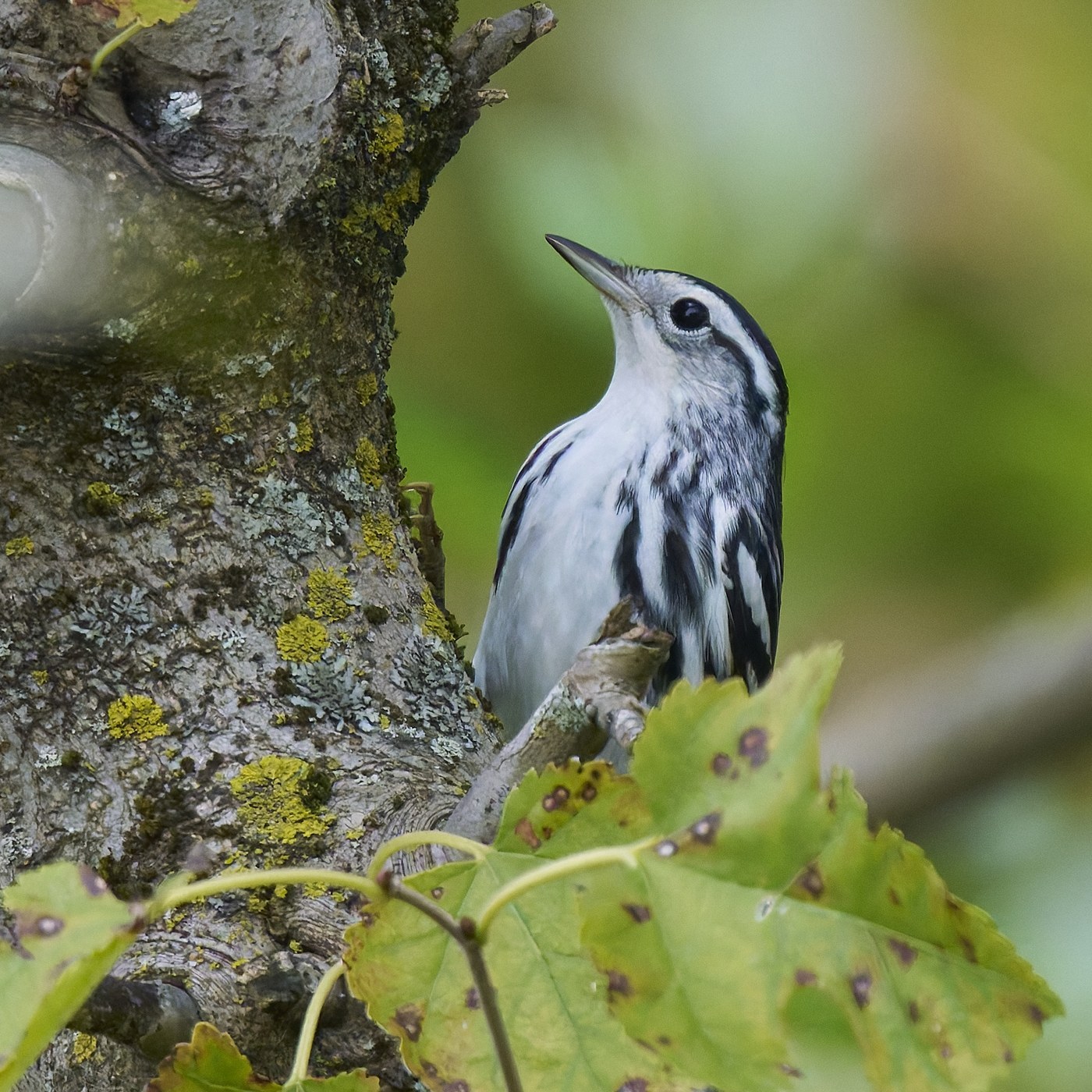
Key Field Marks
- Size & shape: Small warbler (about 11-13 cm) with a relatively long, slightly downcurved bill and short legs, giving it a distinctive shape adapted for creeping along bark - unusual among warblers.
- Plumage: Entirely striped black and white all over the body, including the head, back, wings, and flanks - no other North American warbler shows this fully striped, no-green-or-yellow pattern.
- Male vs. female: Breeding males show extensive solid black on the throat and cheek/auricular area; females and non-breeding males have a whitish throat and grayer cheek, with less black overall, especially on the face and flanks.
- Wings: Two bold white wingbars stand out against the black-and-white striped body.
- Behavior: Highly distinctive foraging behavior - creeps up, down, and around tree trunks and thick branches much like a nuthatch or Brown Creeper, probing bark crevices for insects rather than gleaning foliage in the typical warbler fashion.
Similar Species
- Blackpoll Warbler (breeding male): Has a black cap contrasting with white cheeks and lacks the fully striped body and back of Black-and-white Warbler; body plumage is grayish rather than boldly black-and-white striped throughout.
- Black-throated Gray Warbler: Has a gray (not striped) back, a small yellow spot before the eye, and a solid black throat/cap pattern rather than fine stripes covering the whole body.
- Behavior as an identification aid: No other warbler habitually creeps along trunks and large branches the way Black-and-white Warbler does; this bark-foraging behavior alone is often diagnostic even at a distance or in poor light.
Where & When to See
- Habitat: Deciduous and mixed forests, favoring mature woodland with plenty of large trees for bark-foraging; found in forest interior as well as edges during migration.
- Range: Breeds across much of the eastern United States and Canada, from the Southeast north through the boreal forest; winters from Florida and the Gulf Coast south through Mexico, Central America, and into northern South America and the Caribbean.
- Season: A migratory species, typically arriving on breeding grounds in April and departing by September/October; one of the earlier-arriving and longer-staying warblers in spring and fall migration.
- Best viewing tips: Watch tree trunks and large horizontal branches rather than foliage tips, since this species spends much of its foraging time working bark surfaces; it is often one of the easier warblers to get a good look at because of its slow, deliberate trunk-creeping movements.
Voice
- Song is a very thin, high-pitched, repetitive series of squeaky notes often rendered as 'wee-see, wee-see, wee-see,' with a rhythmic, wheel-like quality.
- The song's thin, high pitch can be difficult for some observers to hear, especially at a distance, but its repetitive, evenly paced squeaky rhythm is distinctive once learned.
- Call note is a sharp, clear 'chip,' typical of many wood-warblers, given as a contact note during migration and around territories.
Frequently asked questions
What is the most reliable way to identify a Black-and-white Warbler?
Its fully black-and-white striped plumage covering the entire body, combined with its distinctive habit of creeping along tree trunks and branches like a nuthatch, makes it one of the most recognizable warblers.
How do I tell a male from a female Black-and-white Warbler?
Breeding males show extensive solid black on the throat and face, while females and non-breeding males have a whitish throat and grayer cheek with less black overall.
Why does the Black-and-white Warbler behave differently from other warblers?
It has a specialized bill and foraging style adapted for probing bark crevices on trunks and large branches for insects, rather than gleaning leaves and twigs the way most warblers do.
When is the best time to see Black-and-white Warblers?
They are among the earlier warblers to arrive in spring migration (often in April) and can be found on breeding territories through summer before departing in fall migration by September or October.
Where does the Black-and-white Warbler spend the winter?
It winters from Florida and the Gulf Coast south through Mexico, Central America, the Caribbean, and into northern South America.