
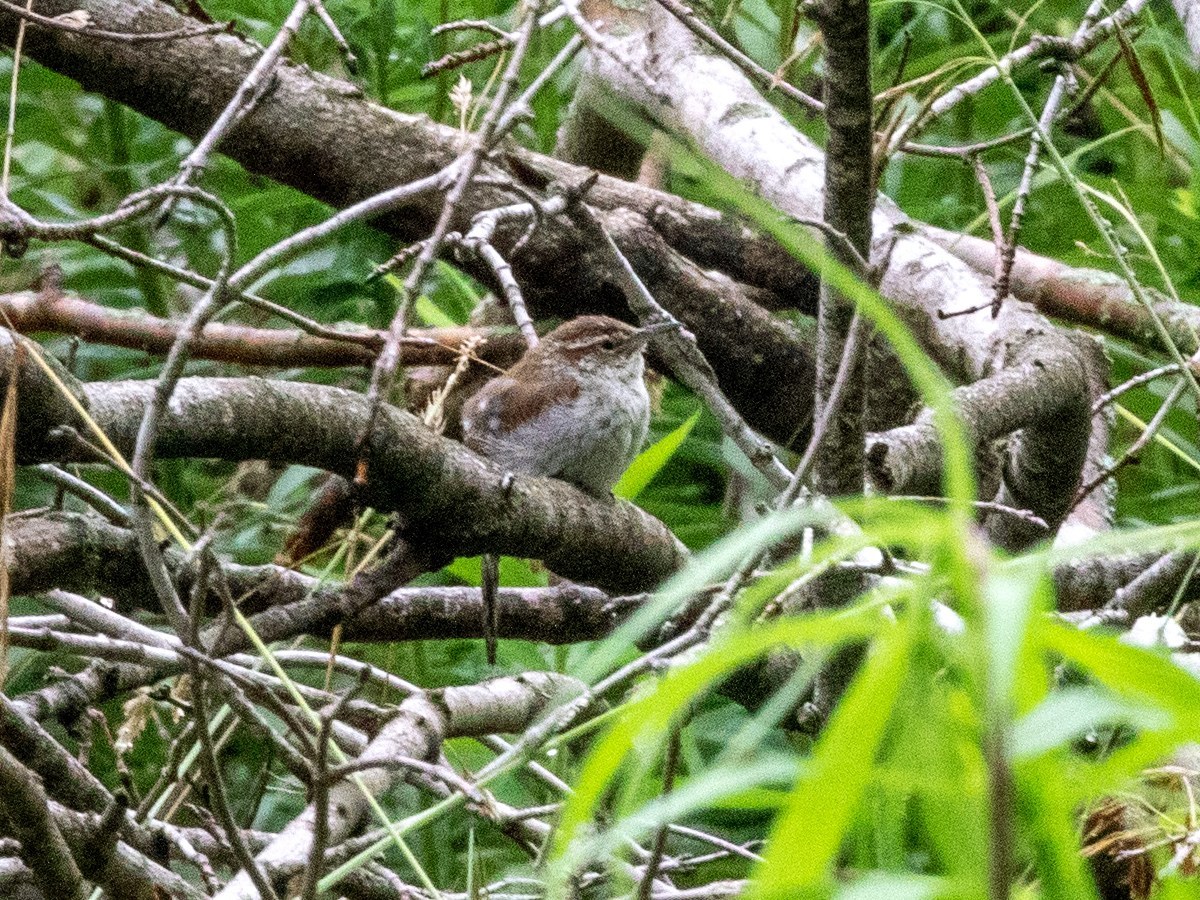
Bewick's Wren
Thryomanes bewickii
A slender, long-tailed wren with a bold white eyebrow, known for its varied song and once-widespread eastern range now largely lost.
- Size
- 13-14 cm (5.1-5.5 in) long, 14-18 cm wingspan
- Habitat
- brushy areas, chaparral, woodland edges, and gardens of the western and south-central United States
- Type
- songbird
Spotted a bird like this?
Identify any bird from a photo, free.
Overview
Bewick's Wren is a slim, active wren with warm brown upperparts, pale grayish-white underparts, and a long, expressive tail frequently held cocked upward and flicked from side to side, edged with white spots visible from below. A bold white eyebrow stripe extends from the bill well past the eye, one of its most distinctive features. Populations vary somewhat in overall color tone across the range, from grayer coastal birds to more rufous interior populations.
This species was formerly widespread across much of the eastern United States as well, but has largely disappeared east of the Mississippi over the past century, a decline attributed in part to competition with the expanding House Wren population, leaving it now primarily a bird of the West.
How to identify it
Key Field Marks
- Long tail, often cocked upward, with white spots visible on the underside
- Bold, long white eyebrow stripe
- Warm brown upperparts, grayish-white underparts
- Slender build with a slightly downcurved bill
Similar Species
- House Wren: shorter tail, lacks the bold white eyebrow, and is overall plainer and grayer-brown.
- Carolina Wren: larger and more richly rufous, with a buffier (not white) underside and a bolder buffy-orange eyebrow.
- Marsh Wren: has a streaked back and occurs in marsh habitat rather than brushy uplands.
Habitat & range
Habitat
Bewick's Wrens favor brushy habitats including chaparral, scrub, woodland edges, riparian thickets, and residential gardens with dense shrub cover.
Range
The species is widespread across the western United States and parts of Mexico, with a small, declining remnant population in the Appalachians and Ozarks representing the last vestiges of a once much broader eastern range.
Migration
Most populations are non-migratory residents, though northern and higher-elevation populations may move to lower elevations or slightly south in winter.
Behavior & voice
Behavior
Bewick's Wrens are active, inquisitive birds that forage low in dense brush, often holding the tail cocked and flicking it side to side while investigating cover for insects.
Voice
The song is a rich, variable series of buzzes, trills, and clear notes, often compared favorably to the Song Sparrow's song in complexity; individual males may know a large repertoire of song variations.
Feeding
Diet consists almost entirely of insects and spiders, gleaned from dense vegetation, leaf litter, and bark crevices.
Nesting
Nests are built in cavities, brush piles, or various nooks including birdhouses, old cans, and building crevices, constructed of twigs, grass, and feathers. Clutches typically number 5-7 eggs.
Frequently asked questions
Why has Bewick's Wren disappeared from the eastern United States?
Its decline in the East, where it was once common, is thought to be linked in part to competition with the range-expanding House Wren, which can destroy the eggs of other cavity-nesting birds.
How do I tell Bewick's Wren from a House Wren?
Bewick's Wren has a longer tail with white spots visible underneath and a bold white eyebrow stripe, both of which the plainer, shorter-tailed House Wren lacks.
Where does Bewick's Wren live today?
It is now found mainly across the western and south-central United States and Mexico, with only small, declining remnant populations in parts of the eastern U.S.
What does Bewick's Wren eat?
Almost entirely insects and spiders, gleaned from brush, leaf litter, and bark.
Does Bewick's Wren have a complex song?
Yes, males sing a rich, varied song made up of buzzes, trills, and clear notes, with considerable individual variation in the specific pattern used.
Bewick's Wren guides
In-depth guides for identifying, finding, and understanding Bewick's Wren.
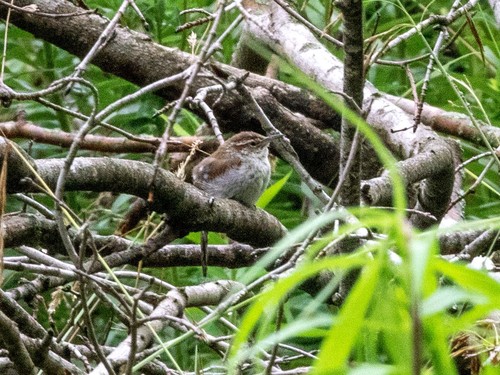
Bewick's Wren identified by the community
Real birds identified with Bird Identifier.
Other birds you may enjoy

Black Redstart
13-14.5 cm (5.1-5.7 in) long, 23-26 cm wingspan

Black-throated Sparrow
12-14 cm (4.7-5.5 in) long, about 19-20 cm (7.5-8 in) wingspan

Greater Bird-of-paradise
Body about 43 cm; males with additional flank plumes up to 50 cm and long tail wires

Blue Tit
11-12 cm (4.3-4.7 in) long, 17-20 cm wingspan

Red-billed Quelea
11.5–13 cm long, wingspan about 20–22 cm
White-plumed Antbird
13-14 cm (5-5.5 in) long

Pyrrhuloxia
19-22 cm (7.5-8.7 in) long, 30 cm wingspan

Blue-gray Tanager
16-18 cm (6-7 in) long

Blackburnian Warbler
11-13 cm (4.3-5.1 in) long, 20-22 cm wingspan

Bluethroat
13-14 cm (5.1-5.5 in) long, 20-22 cm wingspan

Eurasian Nuthatch
12-14.5 cm (4.7-5.7 in) long, 22.5-27 cm wingspan

Wood Thrush
19-21 cm (7.5-8.3 in) long, about 33 cm (13 in) wingspan