Bewick's Wren Identification Guide
A slim, long-tailed wren of the western and southern United States, identified by its bold white eyebrow stripe, white-edged outer tail feathers, and rich, variable song.
Read the full Bewick's Wren encyclopedia entry →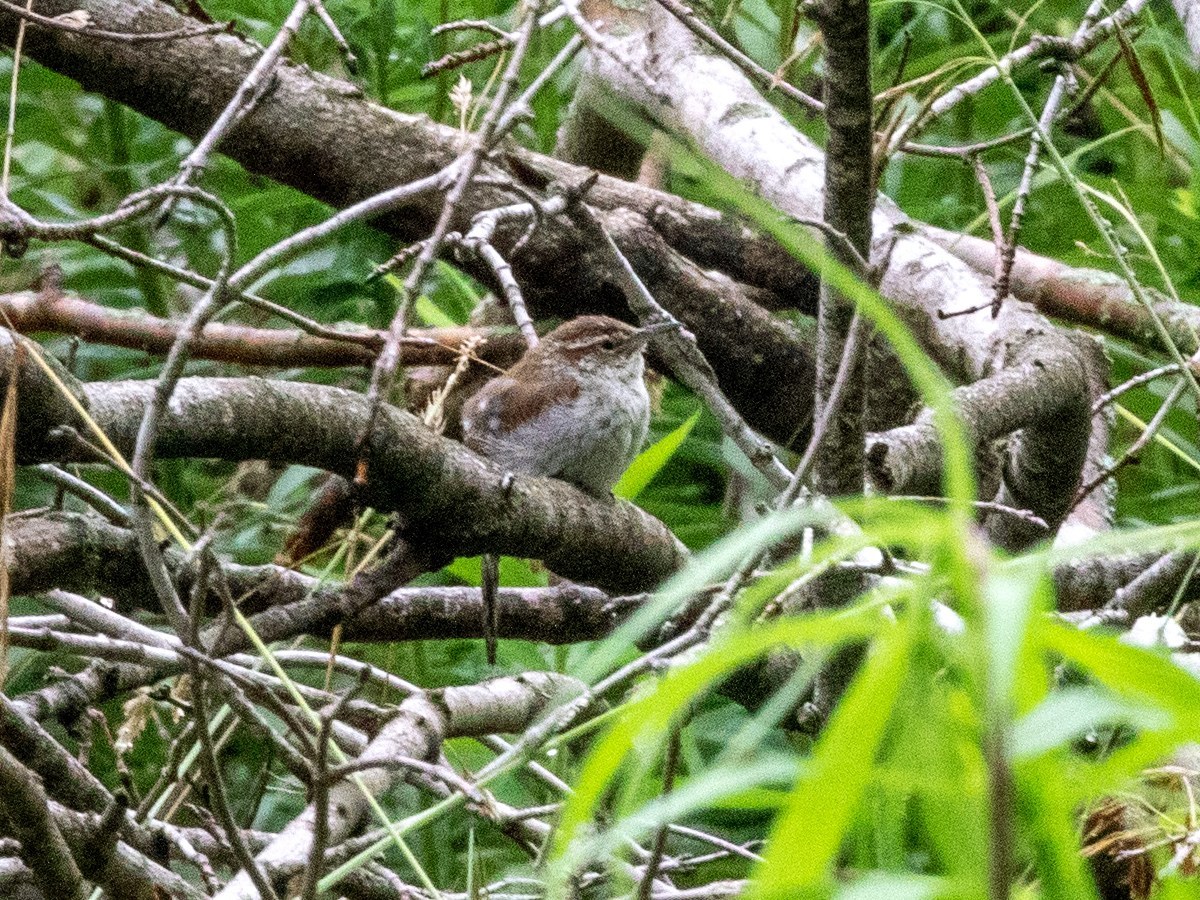
Key Field Marks
- Size & shape: Medium-sized wren (about 13 cm), slimmer and longer-tailed than many other wrens, with a fairly long, slightly downcurved bill.
- Plumage: Brown to grayish-brown above (color varies geographically, grayer in the west, browner in the east), with pale grayish-white underparts.
- Face pattern: A bold, long white eyebrow (supercilium) stripe extending from the base of the bill well behind the eye is the most distinctive facial feature.
- Tail: Long tail, often cocked upward or flicked side to side, with white spots and edges visible on the outer tail feathers, especially noticeable from below or in flight - a good mark separating it from most other wrens.
- Behavior: Active and inquisitive, constantly flicking and fanning its tail while foraging low in brush, woodpiles, and dense vegetation; frequently sings from a low to mid-level exposed perch.
Similar Species
- House Wren: Smaller, plainer-faced with only a faint, indistinct eyebrow (not bold and white), a shorter tail without white outer tail spots, and a more uniformly brown, less patterned plumage.
- Carolina Wren: Larger, richer rufous-brown above with a buffier (not whitish) underside and a shorter tail lacking white outer tail markings; also has a louder, more strongly whistled song pattern.
- Cactus Wren: Much larger and heavily spotted/streaked overall with a different, harsher call, easily separated by size and pattern alone.
Where & When to See
- Habitat: Dense shrubby thickets, brushy woodland edges, chaparral, riparian scrub, and increasingly suburban gardens and hedgerows with dense cover.
- Range: Resident across the western United States, parts of the Great Basin and Southwest, and disjunctly in parts of the southeastern and Appalachian United States, with populations having contracted in much of the eastern part of its former range over the past century.
- Season: Largely resident year-round throughout its range, with limited seasonal movement.
- Best viewing tips: Check dense brush piles, thickets, and shrub understory in appropriate habitat; the male's varied and persistent song from a low perch is often the quickest way to locate a territory.
Voice
- Song is a loud, rich, and highly variable series of buzzy trills and clear whistled notes, often compared in quality and complexity to a Song Sparrow's song, though patterns differ regionally and even between individuals.
- Calls include a harsh, buzzy scolding note and a sharp 'chip,' given when the bird is agitated or during interactions with other birds.
- Regional dialects exist across the species' range, so song pattern alone should be combined with visual field marks like the white eyebrow and tail spots for confident identification.
Frequently asked questions
What is the best field mark for Bewick's Wren?
A long, bold white eyebrow stripe combined with white spots and edges on the outer tail feathers, visible especially when the tail is fanned or viewed from below.
How do I tell Bewick's Wren from House Wren?
Bewick's Wren has a much bolder, longer white eyebrow and white-edged outer tail feathers, while House Wren has only a faint eyebrow and a plainer tail without white markings.
Has Bewick's Wren declined in parts of its range?
Yes, it has largely disappeared from much of the eastern and Appalachian United States over the past century, likely linked in part to competition with House Wrens, while remaining common in the West.
Does Bewick's Wren migrate?
No, it is generally resident year-round across its range with only limited local movements.
Why does Bewick's Wren's song vary so much between locations?
The species shows strong regional song dialects, with different populations singing distinct patterns of trills and whistles, so song alone can vary geographically even though the visual field marks remain consistent.
Bewick's Wren identified by the community
Recent Bewick's Wren sightings identified with Bird Identifier.