
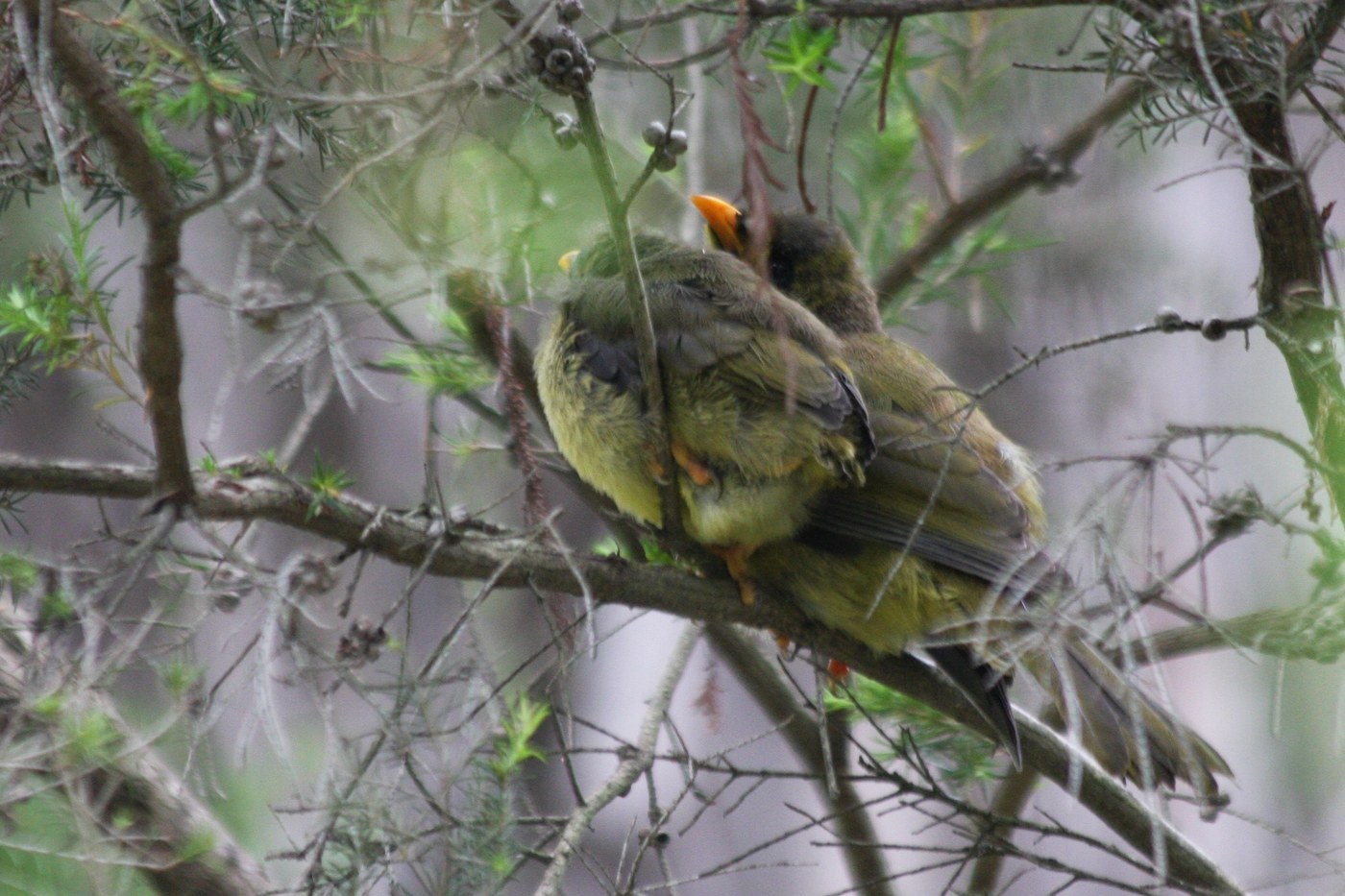
Bell Miner
Manorina melanophrys
A small, olive-green colonial honeyeater famous for its incessant, high-pitched, bell-like tinkling call, usually heard before it is seen.
- Size
- 18-20 cm (7-8 in) long
- Habitat
- dense wet eucalypt forest with a shrubby understory in eastern Australia
- Type
- songbird
Spotted a bird like this?
Identify any bird from a photo, free.
Overview
The Bell Miner is a small, olive-green honeyeater, closely related to the Noisy Miner but notably smaller and more uniformly colored, with a dark cap, an orange-yellow bill and legs, and a small patch of yellow bare skin near the eye. Its most distinctive feature by far is its voice: dense colonies produce an almost constant chorus of clear, high, bell-like "tink" notes that can be heard well before any bird is actually seen in the canopy.
Bell Miners live in large, tightly bonded colonies and have an unusual ecological relationship with psyllid insects (lerp), whose sugary coverings form a major part of the birds' diet; this relationship can, in some forest areas, contribute to a phenomenon known as bell miner associated dieback, where dense miner colonies suppress other insectivorous birds and allow psyllid populations to damage eucalypt canopies.
How to identify it
Key field marks
- Small size, olive-green plumage overall
- Dark cap and small patch of yellow bare skin near the eye
- Orange-yellow bill and legs
- Distinctive, constant high-pitched, bell-like "tink" calls from dense colonies
Similar species
- Noisy Miner: larger, greyer overall, with harsher chattering calls rather than bell-like tinkling.
- Other small olive-toned honeyeaters lack the Bell Miner's distinctive voice and colonial habits, which are usually the quickest way to confirm identification.
Habitat & range
Habitat
Bell Miners favor dense, wet eucalypt forest with a well-developed shrubby understory, particularly areas with high populations of sap-sucking psyllid insects on eucalypt leaves.
Range
The species occurs along the east coast and ranges of Australia, from southeastern Queensland through New South Wales into eastern Victoria.
Migration
Sedentary, with resident colonies defending the same forest patch, sometimes for many years.
Behavior & voice
Behavior
Bell Miners live in large, complex, cooperatively breeding colonies that aggressively defend their territory against other bird species, a behavior that, combined with their reliance on lerp-producing insects, can allow psyllid populations to build up and contribute to canopy dieback in some forest areas.
Voice
The call is an almost continuous, high, clear, bell-like "tink" or "ting," repeated by many birds within a colony, creating a distinctive tinkling chorus audible well before the birds are seen.
Feeding
Diet centers on lerp (the sugary protective covering produced by psyllid insects) and honeydew, along with other small insects and some nectar.
Nesting and breeding
Nests are small cups built in dense shrubs or low tree foliage within the colony's territory. Clutches typically contain two to three pale, spotted eggs, incubated by the female, with numerous helper birds from the colony assisting in feeding chicks.
Frequently asked questions
Why is the Bell Miner called that?
It is named for its distinctive, almost constant high-pitched, bell-like 'tink' call, which is usually heard well before the bird itself is seen.
What is bell miner associated dieback?
It is a forest health issue where dense, territorial Bell Miner colonies exclude other insectivorous birds, allowing populations of sap-sucking psyllid insects (which the miners feed on but do not fully control) to damage eucalypt canopies over time.
What do Bell Miners eat?
Mainly lerp and honeydew produced by small sap-sucking psyllid insects on eucalypt leaves, along with other insects and some nectar.
Where do Bell Miners live?
They are found in dense, wet eucalypt forest with a shrubby understory along the east coast of Australia, from southeastern Queensland to eastern Victoria.
Bell Miner guides
In-depth guides for identifying, finding, and understanding Bell Miner.
Other birds you may enjoy

Black Redstart
13-14.5 cm (5.1-5.7 in) long, 23-26 cm wingspan

Black-throated Sparrow
12-14 cm (4.7-5.5 in) long, about 19-20 cm (7.5-8 in) wingspan

Greater Bird-of-paradise
Body about 43 cm; males with additional flank plumes up to 50 cm and long tail wires

Blue Tit
11-12 cm (4.3-4.7 in) long, 17-20 cm wingspan

Red-billed Quelea
11.5–13 cm long, wingspan about 20–22 cm
White-plumed Antbird
13-14 cm (5-5.5 in) long

Pyrrhuloxia
19-22 cm (7.5-8.7 in) long, 30 cm wingspan

Blue-gray Tanager
16-18 cm (6-7 in) long

Blackburnian Warbler
11-13 cm (4.3-5.1 in) long, 20-22 cm wingspan

Bluethroat
13-14 cm (5.1-5.5 in) long, 20-22 cm wingspan

Eurasian Nuthatch
12-14.5 cm (4.7-5.7 in) long, 22.5-27 cm wingspan

Wood Thrush
19-21 cm (7.5-8.3 in) long, about 33 cm (13 in) wingspan