
Bell Miner Identification Guide
A social Australian honeyeater famous for its incessant, bell-like 'tink' calls and colonies that dominate eucalypt forest, identified by olive plumage and an orange bill and legs.
Read the full Bell Miner encyclopedia entry →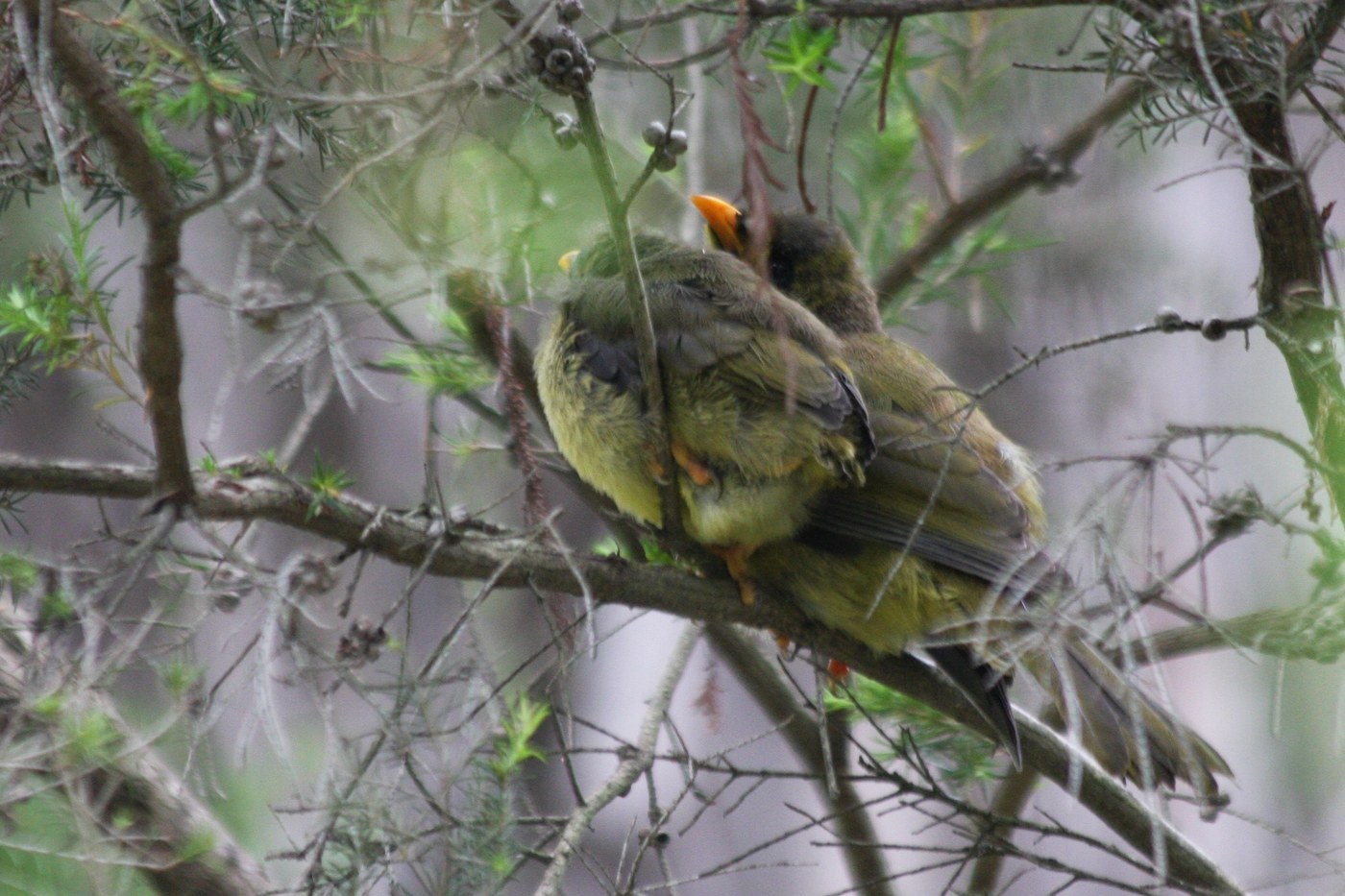
Key Field Marks
- Size & shape: Small to medium honeyeater (about 17-20 cm) with a fairly slim body, moderate tail length, and a slightly downcurved, pointed bill typical of honeyeaters.
- Plumage: Overall olive-green to yellowish-olive body, slightly darker on the crown and wings, with a small patch of bare yellowish-orange skin behind the eye that is diagnostic at close range.
- Bill: Bright orange to orange-red, contrasting with the duller olive body - a key mark distinguishing it from similar honeyeaters.
- Legs: Orange, matching the bill tone.
- Behavior: Intensely social and territorial, living in dense, noisy colonies that can number in the dozens to hundreds. Colonies aggressively exclude most other bird species from their territory, leading to dense but low-diversity 'bell miner associated dieback' patches in eucalypt forest. Feeds partly on lerps (sugary insect secretions on eucalypt leaves) as well as nectar and invertebrates, often gleaning low in the canopy or among foliage.
Similar Species
- Noisy Miner: Larger, greyer overall with a black cap and yellow (not orange) bill and legs; Noisy Miners also favor more open woodland and urban parks rather than dense wet eucalypt forest.
- Other honeyeaters (e.g., Lewin's Honeyeater): Lack the bright orange bill/leg combination and the small bare orange eye-patch; also do not form the same dense, exclusionary colonies.
- Colony behavior as a clue: The sheer number of birds calling constantly from one patch of forest, combined with a notable scarcity of other bird species in that same patch, is itself a strong identification clue for Bell Miner presence.
Where & When to See
- Habitat: Wet and dry eucalypt forest, especially areas with a dense shrubby understorey and abundant lerp-infested eucalypt foliage; also found in forest remnants and along forest edges.
- Range: Endemic to eastern Australia, from southeastern Queensland south through New South Wales and Victoria into parts of South Australia.
- Season: Resident year-round within its colony territories, which are held permanently and defended cooperatively.
- Best viewing tips: Listen for the constant tinkling chorus first - colonies are usually easy to locate by ear even before any bird is seen, then look and listen from forest edges or tracks where the colony territory borders more open habitat.
Voice
- The signature call is a high, clear, metallic 'tink' or 'ting,' repeated incessantly and often overlapping among many individuals, producing a continuous bell-like chorus that gives the species its name.
- This bell-like chorus is one of the most recognizable soundscapes of eastern Australian eucalypt forest and can be heard from a considerable distance.
- Additional scolding and chattering calls are given when mobbing intruders or other birds attempting to enter colony territory.
Frequently asked questions
What is the easiest way to identify a Bell Miner by sound?
Listen for a continuous, high-pitched metallic 'tink' or bell-like chorus coming from many birds at once - this chorus is highly distinctive and often heard before any bird is seen.
How do I tell a Bell Miner from a Noisy Miner?
Bell Miners are smaller, more olive-green, and have an orange bill and legs, while Noisy Miners are larger, greyer with a black cap, and have a yellow bill and legs.
Why do Bell Miner colonies seem to have few other bird species around?
Bell Miners aggressively defend colony territories and exclude most other insectivorous birds, which can allow lerp and dieback problems to build up in the canopy - a phenomenon known as bell miner associated dieback.
Where in Australia are Bell Miners found?
They are endemic to eastern Australia, occurring in eucalypt forest from southeastern Queensland through New South Wales and Victoria to parts of South Australia.
What color is a Bell Miner's bill and eye-patch?
The bill is bright orange, and there is a small patch of bare orange-yellow skin behind the eye, both contrasting with the bird's olive-green body plumage.