
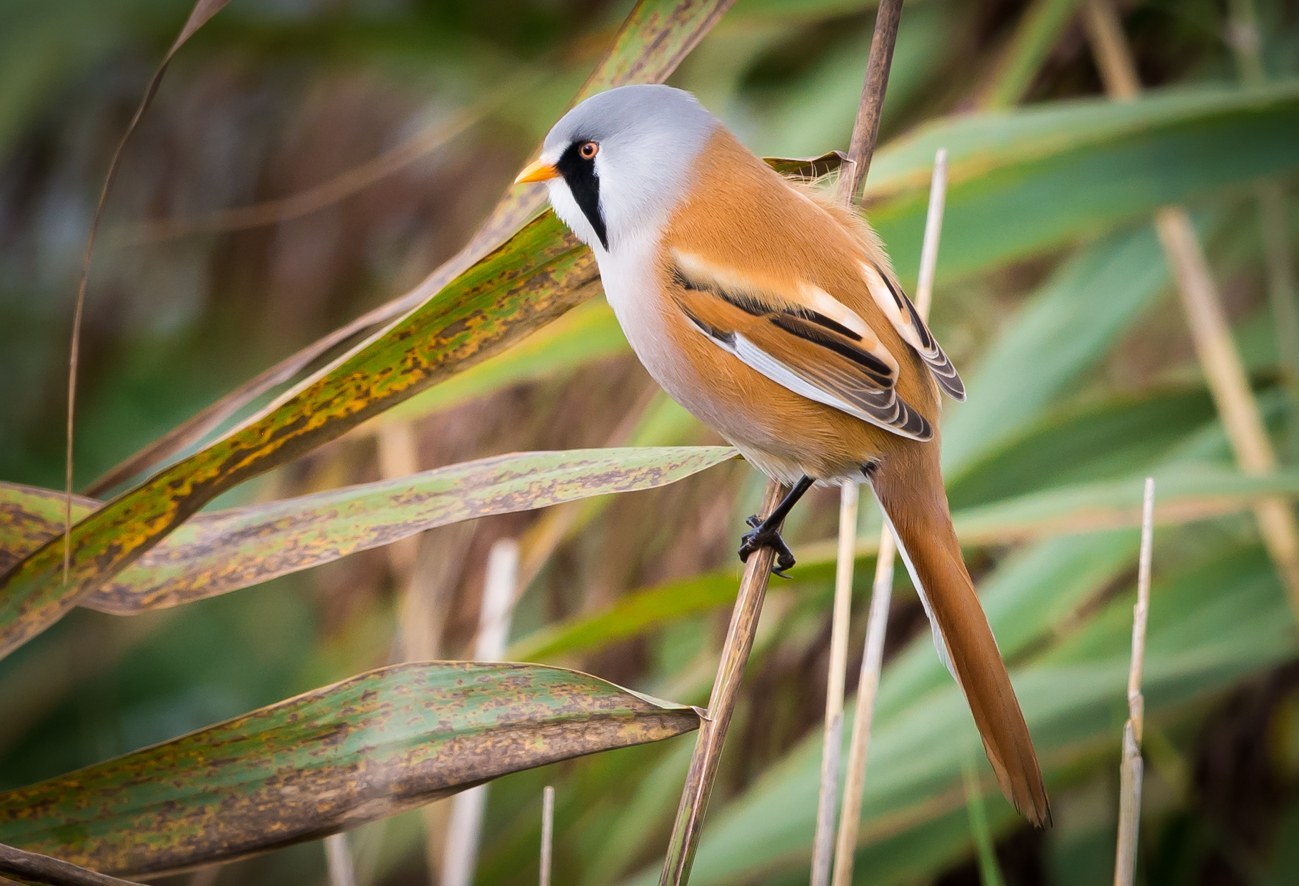
Bearded Reedling
Panurus biarmicus
A long-tailed, tawny reedbed specialist; males sport a striking grey head with a black "moustache" despite the misleading name Bearded Tit.
- Size
- 12-17 cm (5-6.5 in) long including tail, 16-18 cm wingspan
- Habitat
- extensive reedbeds and wetland vegetation
- Type
- songbird
Spotted a bird like this?
Identify any bird from a photo, free.
Overview
The Bearded Reedling is a distinctive, long-tailed bird of dense reedbeds, despite its old name "Bearded Tit" it is not a true tit and is now placed in its own family. It has warm, tawny-orange body plumage, a long graduated tail, and short rounded wings adapted for weaving through dense reed stems rather than sustained flight.
The male is particularly striking, with a soft blue-grey head and a bold black "moustache" stripe running down from the eye -- the feature that gives the species its common name -- along with black undertail coverts. Females and juveniles lack the grey head and moustache, appearing more uniformly tawny-brown.
How to identify it
Key field marks
- Long, graduated tail and tawny-orange body plumage
- Male: pale grey head with a black "moustache" stripe below the eye
- Female: plainer tawny-brown head lacking the moustache
- Weak, whirring flight low over reedbeds, usually in small parties
Similar species
No other reedbed bird combines the long tail, tawny color, and (in males) grey head with black moustache; its unique voice and habitat also help separate it from other small passerines like reed and sedge warblers.
Habitat & range
Range
Found patchily across Europe and temperate Asia, from Britain and Spain east to China and Japan, wherever large reedbeds occur.
Habitat
Almost entirely restricted to extensive stands of common reed, particularly around lakes, marshes, and river deltas; rarely strays far from reed cover.
Migration
Largely resident but can be locally nomadic or irruptive, especially after population booms, with some individuals dispersing to find new reedbed habitat.
Behavior & voice
Behavior
Moves in small, loose flocks, clambering acrobatically among reed stems and rarely straying far from cover; flies weakly and reluctantly over open water.
Voice
A distinctive metallic, pinging "ching-ching" call, often the easiest way to detect its presence within dense reedbeds.
Feeding
Eats insects and other small invertebrates gleaned from reed stems in summer, switching almost entirely to reed seeds in winter, aided by grit swallowed to help digest the tough seed coats.
Nesting and breeding
Builds a cup nest low in reed litter or vegetation near the base of reed stems, laying 4-7 eggs. Pairs can raise multiple broods in a good season, with populations capable of rapid growth after mild winters.
Frequently asked questions
Is the Bearded Reedling a type of tit?
No, despite the old name "Bearded Tit," it is not a true tit and is now classified in its own family, Panuridae.
Why does the male Bearded Reedling look like it has a beard?
It has a bold black "moustache" stripe running down from the eye, which gave rise to the descriptive but slightly misleading common name.
Where does the Bearded Reedling live?
It is almost entirely restricted to large reedbeds around lakes, marshes, and river deltas across Europe and temperate Asia.
What does the Bearded Reedling eat in winter?
It switches from insects to reed seeds, swallowing grit to help digest the tough seed coats.
Bearded Reedling guides
In-depth guides for identifying, finding, and understanding Bearded Reedling.
Other birds you may enjoy

Black Redstart
13-14.5 cm (5.1-5.7 in) long, 23-26 cm wingspan

Black-throated Sparrow
12-14 cm (4.7-5.5 in) long, about 19-20 cm (7.5-8 in) wingspan

Greater Bird-of-paradise
Body about 43 cm; males with additional flank plumes up to 50 cm and long tail wires

Blue Tit
11-12 cm (4.3-4.7 in) long, 17-20 cm wingspan

Red-billed Quelea
11.5–13 cm long, wingspan about 20–22 cm
White-plumed Antbird
13-14 cm (5-5.5 in) long

Pyrrhuloxia
19-22 cm (7.5-8.7 in) long, 30 cm wingspan

Blue-gray Tanager
16-18 cm (6-7 in) long

Blackburnian Warbler
11-13 cm (4.3-5.1 in) long, 20-22 cm wingspan

Bluethroat
13-14 cm (5.1-5.5 in) long, 20-22 cm wingspan

Eurasian Nuthatch
12-14.5 cm (4.7-5.7 in) long, 22.5-27 cm wingspan

Wood Thrush
19-21 cm (7.5-8.3 in) long, about 33 cm (13 in) wingspan