
Bearded Reedling Identification Guide
A tiny, long-tailed reed-dwelling bird of Eurasian marshes, easily told by the male's grey head and black 'moustache' or by its pinging call heard from dense reedbeds.
Read the full Bearded Reedling encyclopedia entry →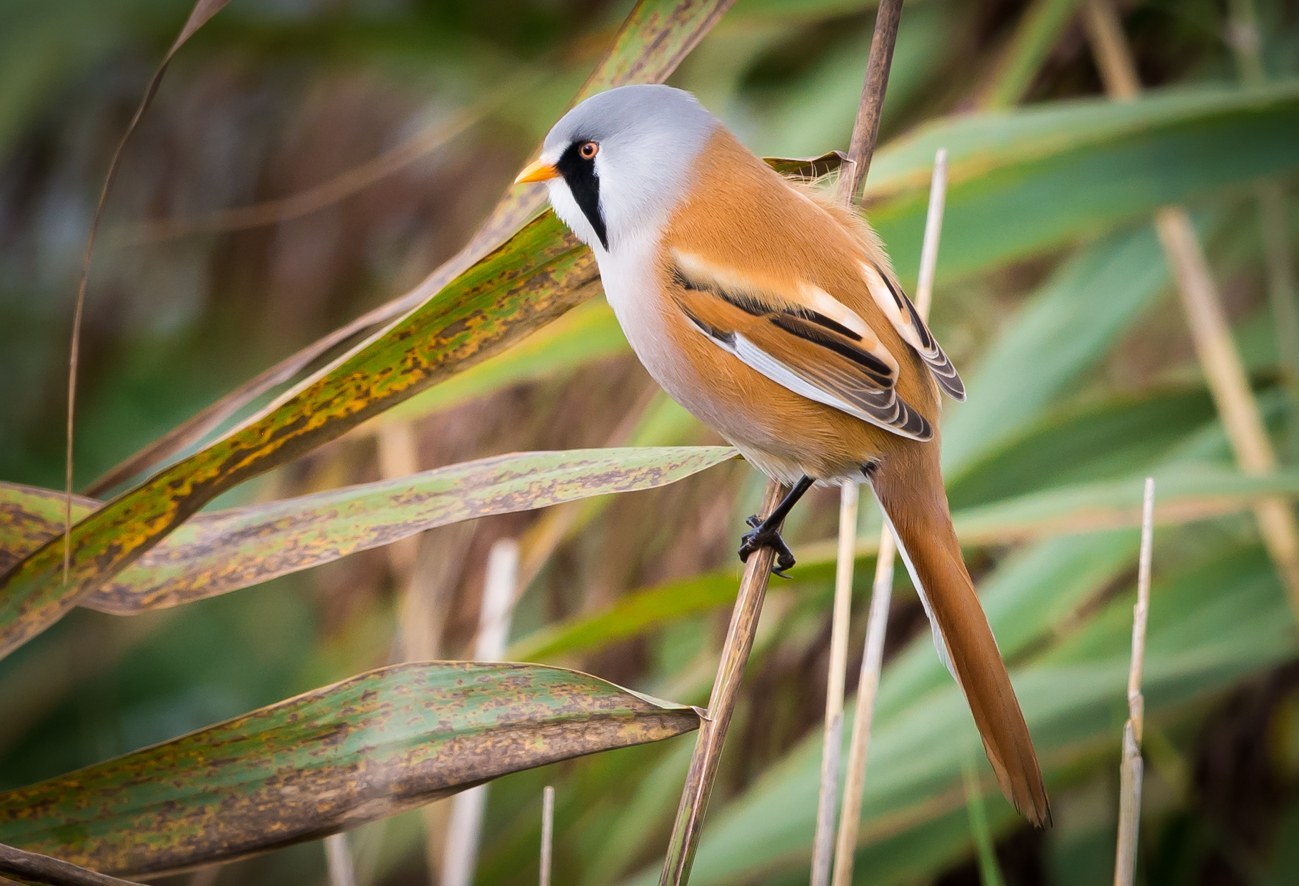
Key Field Marks
- Size & shape: Very small (12-13 cm) with an exceptionally long, graduated tail that makes up nearly half its length. Round-bodied and small-headed in profile, often likened to a miniature parakeet silhouette.
- Plumage (male): Pale grey-blue head, tawny-orange back and flanks, and a bold black 'moustache' stripe (actually a drooping malar mark) running from the eye down the side of the face - the source of the old name 'Bearded Tit.'
- Plumage (female): Duller overall, lacking the grey head and black moustache; plain tawny-buff head and body, giving a more uniform sandy appearance.
- Bill: Short, stubby, and bright orange-yellow in both sexes - distinctive against the plumage and useful even in poor light.
- Legs: Black, and used to grip vertical reed stems with a strong, parrot-like clasp.
- Behavior: Highly acrobatic, clambering up and down reed stems rather than hopping on the ground. Often stays low and hidden, revealing itself only when it perches briefly atop a reed or flies low and fast between reedbed patches with a whirring, bouncing flight showing the long tail streaming behind.
Similar Species
- True tits (Paridae) such as Long-tailed Tit: Long-tailed Tit has a much shorter, stubbier bill, black-and-white plumage, and lacks the orange bill and moustache; it also favors woodland edges rather than pure reedbed.
- Reed and sedge warblers: These are streaky brown, slimmer-billed, and lack the reedling's orange bill, grey head, or long graduated tail.
- Juveniles: Young birds are blacker on the back and lack a moustache, but the orange bill and reedbed habitat quickly rule out warblers or other passerines.
Where & When to See
- Habitat: A reedbed specialist, found almost exclusively in extensive stands of common reed (Phragmites) in marshes, fen, and wetland margins; rarely strays far from reeds.
- Range: Resident across much of temperate Eurasia, from Britain and continental Europe east through Central Asia to China and Japan, in scattered wetland populations.
- Season: Present year-round where resident, though northern and inland populations may make short-distance movements or irruptions in harsh winters when reedbeds ice over, sometimes appearing at new sites.
- Best viewing tips: Calm, still mornings are best, as the birds are easier to hear and reeds are less likely to mask movement in the wind; scan the tops of reed stems where birds pause briefly to look around.
Voice
- The diagnostic call is a distinctive metallic 'ping' or 'pyoo-ting,' often given in short bursts by flocking birds and audible well before the birds are seen.
- Contact calls keep loose winter flocks together as they move through reedbeds; the song itself is a simple, quiet warbling rarely heard well away from the nest.
- Listen for the pinging calls as the first clue to a reedbed holding this species, then watch reed tops for the tell-tale silhouette and long tail.
Frequently asked questions
How can I tell a male from a female Bearded Reedling?
Males have a pale grey head and a black moustache stripe; females lack both, showing a plainer tawny-buff head without the grey or black markings.
What is the easiest way to detect a Bearded Reedling in a reedbed?
Listen first - the sharp, metallic 'ping' call usually gives the bird away before it is seen, then scan reed tops for a small bird with a long tail and orange bill.
Do Bearded Reedlings ever leave reedbeds?
They rarely stray far from reed habitat, though in severe winters some populations irrupt and disperse to find new wetlands when reedbeds freeze.
Is the Bearded Reedling related to true tits?
No - despite the old name 'Bearded Tit,' it is not a true tit (Paridae) but is now placed in its own family, Panuridae, related to lark and swallow lineages.
What time of year is best to look for Bearded Reedlings?
They can be seen year-round in resident areas, but they are often most conspicuous in autumn and winter when family groups form flocks and move more actively through reedbeds.