
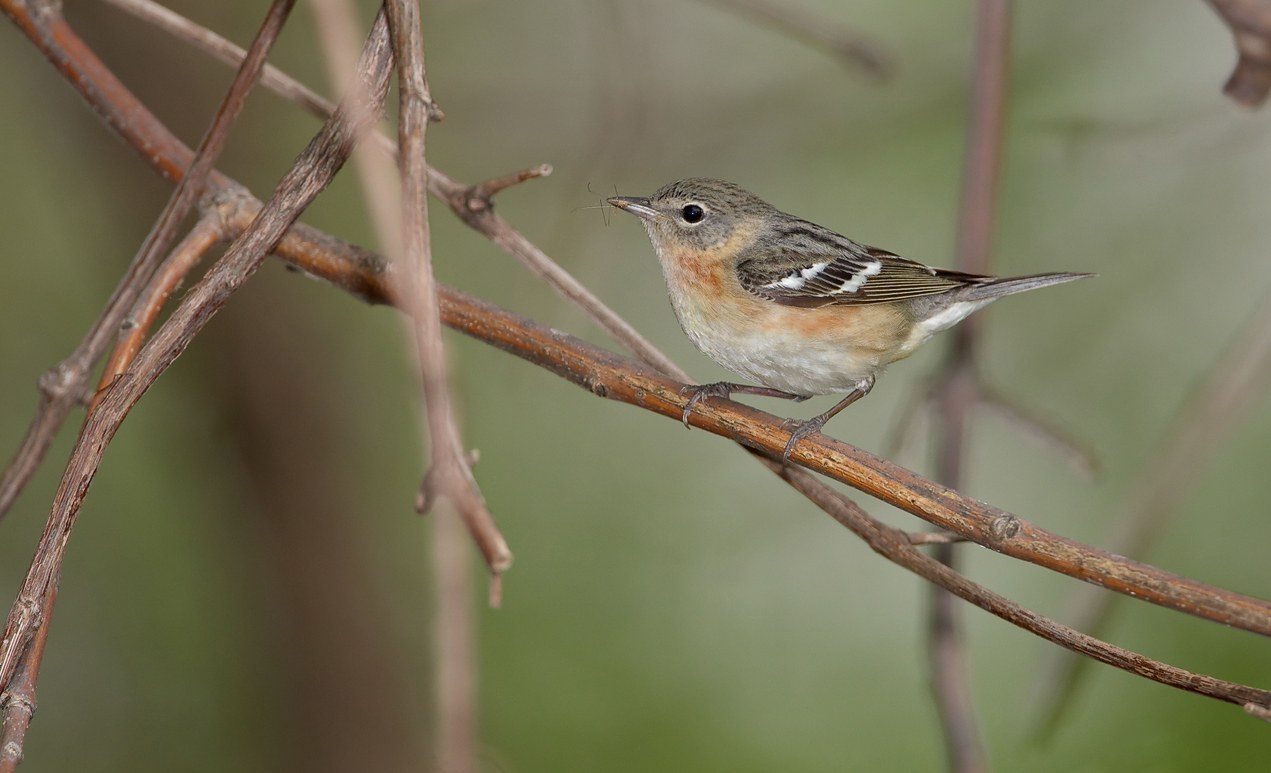
Bay-breasted Warbler
Setophaga castanea
A boreal-forest warbler whose breeding males show rich chestnut on the crown, throat, and flanks, while fall birds turn plain greenish and are easily confused with Blackpoll Warbler.
- Size
- 13-15 cm (5-6 in) long, 20-24 cm wingspan
- Habitat
- boreal spruce-fir forests; migrates through deciduous and mixed woodlands
- Type
- songbird
Spotted a bird like this?
Identify any bird from a photo, free.
Overview
The Bay-breasted Warbler is a striking boreal-forest songbird whose numbers rise and fall with outbreaks of spruce budworm, its favorite prey. In breeding plumage, males are unmistakable: a rich chestnut ("bay") crown, throat, and flanks contrast with a black face mask, a pale buffy patch on the side of the neck, and a streaked blue-gray back.
Females are much duller, showing only a wash of bay color on the flanks and a greenish-gray head, but they retain the same overall pattern in miniature. By fall, both sexes molt into a plain, nondescript greenish-olive plumage with whitish underparts, making autumn identification one of the trickier challenges in warbler-watching.
How to identify it
Key field marks
- Breeding male: chestnut crown, throat, and flanks; black face mask; buffy neck patch; two white wingbars
- Female: much paler version of the male pattern, with only a faint bay wash on the flanks
- Fall/immature birds: plain greenish-olive above, dull whitish below, with faint wingbars and dark legs and feet
- Stocky build with a fairly heavy, slightly downcurved bill for a warbler
Similar species
Fall Bay-breasted Warblers are notoriously similar to fall Blackpoll Warblers. The best distinctions are leg color (Bay-breasted has entirely dark legs; Blackpoll has pale yellowish legs and feet, especially the feet) and underparts (Bay-breasted is cleaner and less streaked below, and often shows a buffy wash on the flanks and undertail coverts, whereas Blackpoll shows fine streaking on the breast).
Habitat & range
Bay-breasted Warblers breed almost exclusively in mature boreal spruce-fir forest across Canada and the northernmost United States, where their population can boom locally during spruce budworm outbreaks and crash again once the outbreak subsides. During migration they pass through a broad swath of eastern North America, favoring mixed and deciduous woodland canopy, forest edges, and shade trees in parks.
They are long-distance migrants that winter in the forest canopy and edge habitats of Panama and northern South America, particularly Venezuela and Colombia.
Behavior & voice
Behavior and voice
Bay-breasted Warblers forage methodically in the mid to upper canopy, gleaning caterpillars and other insects from foliage and twigs; during budworm outbreaks they can consume enormous numbers of the pest caterpillars. The song is a very high, thin, and sibilant "seetzy-seetzy-seetzy-seetzy," pitched so high that it can be difficult for some listeners to hear, and it closely resembles the songs of Blackpoll and Cape May Warblers.
Nesting
Nests are built by the female, a loose cup of twigs and grass placed on a horizontal conifer branch, usually well up in a spruce or fir tree. Clutches typically hold 4-6 eggs, and pairs may raise more young when caterpillar prey is abundant.
Frequently asked questions
How can I tell a fall Bay-breasted Warbler from a Blackpoll Warbler?
Check the legs and feet: Bay-breasted Warblers have entirely dark legs, while Blackpolls show pale yellowish legs and feet. Bay-breasted birds also tend to look cleaner below with less streaking and often a buffy wash on the flanks and undertail coverts.
Why do Bay-breasted Warbler numbers fluctuate so much?
Their population closely tracks outbreaks of spruce budworm, an important boreal-forest caterpillar. Numbers surge during budworm outbreaks and decline again once the outbreak collapses.
Where do Bay-breasted Warblers spend the winter?
They migrate long distances to winter in forest canopy habitats of Panama and northern South America, especially Colombia and Venezuela.
What does a Bay-breasted Warbler sound like?
Its song is a very high, thin, buzzy "seetzy-seetzy-seetzy-seetzy," quite similar to the songs of Blackpoll and Cape May Warblers.
Do female Bay-breasted Warblers look like males?
No, females are much duller, showing only a faint wash of chestnut on the flanks rather than the bold bay crown, throat, and flanks of breeding males.
Bay-breasted Warbler guides
In-depth guides for identifying, finding, and understanding Bay-breasted Warbler.
Other birds you may enjoy

Black Redstart
13-14.5 cm (5.1-5.7 in) long, 23-26 cm wingspan

Black-throated Sparrow
12-14 cm (4.7-5.5 in) long, about 19-20 cm (7.5-8 in) wingspan

Greater Bird-of-paradise
Body about 43 cm; males with additional flank plumes up to 50 cm and long tail wires

Blue Tit
11-12 cm (4.3-4.7 in) long, 17-20 cm wingspan

Red-billed Quelea
11.5–13 cm long, wingspan about 20–22 cm
White-plumed Antbird
13-14 cm (5-5.5 in) long

Pyrrhuloxia
19-22 cm (7.5-8.7 in) long, 30 cm wingspan

Blue-gray Tanager
16-18 cm (6-7 in) long

Blackburnian Warbler
11-13 cm (4.3-5.1 in) long, 20-22 cm wingspan

Bluethroat
13-14 cm (5.1-5.5 in) long, 20-22 cm wingspan

Eurasian Nuthatch
12-14.5 cm (4.7-5.7 in) long, 22.5-27 cm wingspan

Wood Thrush
19-21 cm (7.5-8.3 in) long, about 33 cm (13 in) wingspan