
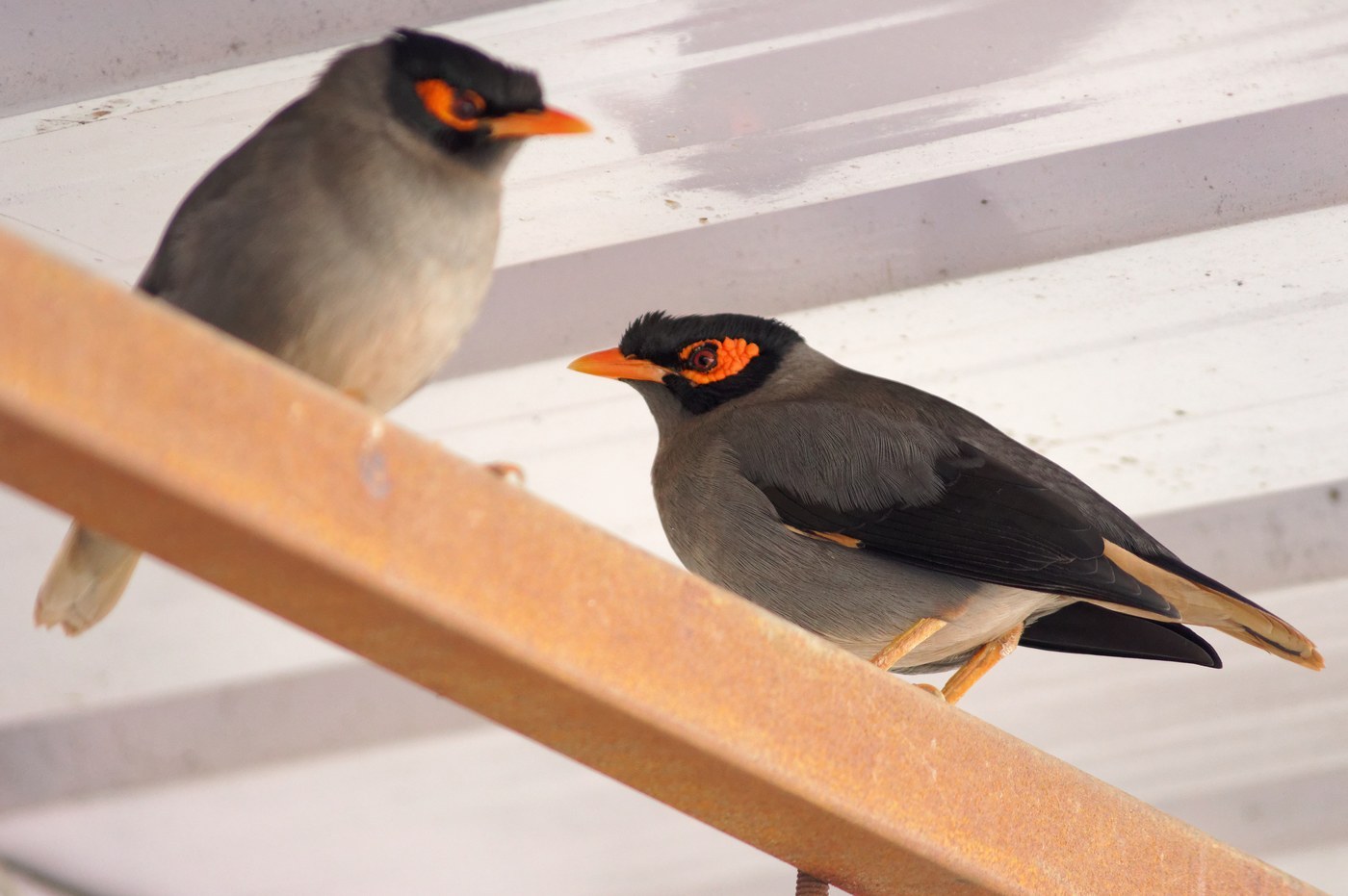
Bank Myna
Acridotheres ginginianus
A pale bluish-grey myna with an orange bare-skin eye patch, common around towns and riverbanks of the Indian subcontinent, where it nests in burrows in earthen banks.
- Size
- 21-23 cm (8-9 in) long, 33-36 cm wingspan
- Habitat
- towns, farmland, and river banks in the Indian subcontinent
- Type
- songbird
Spotted a bird like this?
Identify any bird from a photo, free.
Overview
The Bank Myna is a medium-sized myna, paler and greyer than its close relative the Common Myna, with an overall soft bluish-grey body plumage. Its most distinctive feature is a patch of bare, brick-orange skin around the eye, contrasting with an orange-based yellow bill.
True to its name, the Bank Myna is closely associated with the earthen banks of rivers, where it excavates nesting burrows, often alongside other Bank Mynas in loose colonies.
How to identify it
Key field marks
- Pale bluish-grey body plumage, darker on the head
- Bare orange skin patch around the eye (rather than yellow, as in Common Myna)
- Orange-yellow bill and legs
- White wing patches visible in flight, similar to other mynas
Similar species
The Common Myna is browner with a yellow bare eye patch, while the Jungle Myna has a forehead tuft and pale blue-white eyes. The Bank Myna's grey tone and orange eye patch are diagnostic.
Habitat & range
Range
Found across much of the northern and central Indian subcontinent, including Pakistan, India, Nepal, and Bangladesh.
Habitat
Strongly associated with towns, agricultural land, and particularly the earthen banks of rivers and canals, where it excavates nest burrows.
Migration
Largely resident, with some local movements related to food and nesting site availability.
Behavior & voice
Behavior
Gregarious, often seen in flocks foraging on farmland, grazing land, or following livestock and plows to catch disturbed insects; nests colonially in riverbanks.
Voice
Chattering, gurgling calls typical of mynas, often given in noisy group interactions at communal roosts.
Feeding
An opportunistic omnivore, eating insects, grain, fruit, and scraps, frequently foraging close to human activity and livestock.
Nesting and breeding
Excavates nesting burrows in vertical earthen riverbanks, often in loose colonies with multiple pairs nesting close together. Lays 4-6 eggs, with both parents helping raise the young.
Frequently asked questions
Why is it called the Bank Myna?
It nests in burrows excavated into earthen riverbanks, often in loose colonies, which gives the species its common name.
How do you distinguish a Bank Myna from a Common Myna?
The Bank Myna is paler bluish-grey with an orange bare eye patch, while the Common Myna is browner with a yellow eye patch.
Where is the Bank Myna found?
It is native to the northern and central Indian subcontinent, including Pakistan, India, Nepal, and Bangladesh.
What does the Bank Myna eat?
It is an omnivore that eats insects, grain, fruit, and food scraps, often near farmland and human settlements.
Bank Myna guides
In-depth guides for identifying, finding, and understanding Bank Myna.
Other birds you may enjoy

Black Redstart
13-14.5 cm (5.1-5.7 in) long, 23-26 cm wingspan

Black-throated Sparrow
12-14 cm (4.7-5.5 in) long, about 19-20 cm (7.5-8 in) wingspan

Greater Bird-of-paradise
Body about 43 cm; males with additional flank plumes up to 50 cm and long tail wires

Blue Tit
11-12 cm (4.3-4.7 in) long, 17-20 cm wingspan

Red-billed Quelea
11.5–13 cm long, wingspan about 20–22 cm
White-plumed Antbird
13-14 cm (5-5.5 in) long

Pyrrhuloxia
19-22 cm (7.5-8.7 in) long, 30 cm wingspan

Blue-gray Tanager
16-18 cm (6-7 in) long

Blackburnian Warbler
11-13 cm (4.3-5.1 in) long, 20-22 cm wingspan

Bluethroat
13-14 cm (5.1-5.5 in) long, 20-22 cm wingspan

Eurasian Nuthatch
12-14.5 cm (4.7-5.7 in) long, 22.5-27 cm wingspan

Wood Thrush
19-21 cm (7.5-8.3 in) long, about 33 cm (13 in) wingspan