
Bank Myna Identification Guide
A South Asian myna distinguished from the larger Common Myna by its bluish-grey plumage and orange-red (not yellow) bare skin around the eye.
Read the full Bank Myna encyclopedia entry →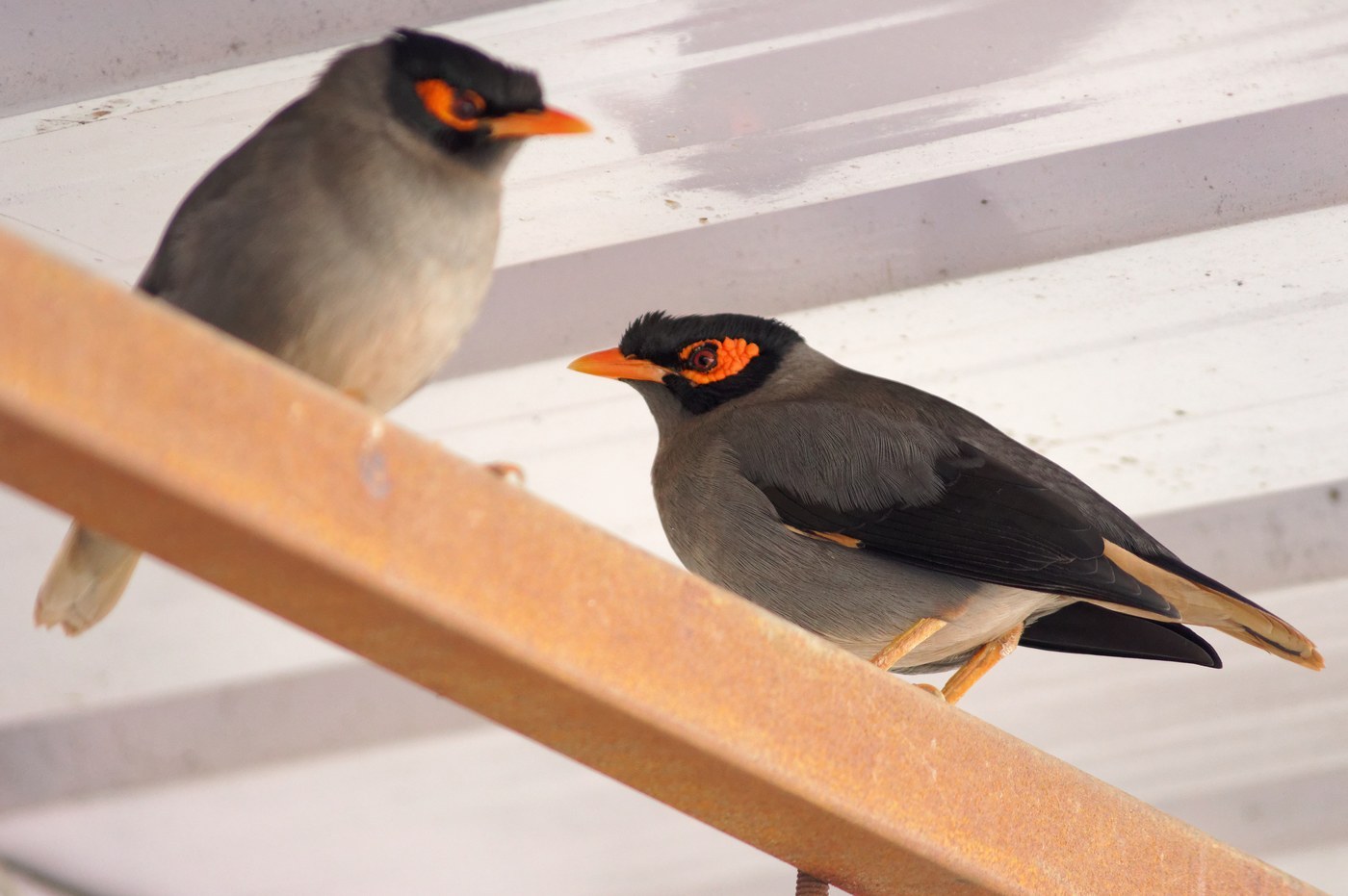
Key Field Marks
- Size & shape: A medium-sized myna (about 21–23 cm), slightly smaller and slimmer than the widespread Common Myna, with the typical upright, confident myna posture and gait.
- Plumage: Overall bluish-grey body, distinctly cooler and bluer in tone than the warmer brown of Common Myna; darker, blackish-glossed head, wings, and tail.
- Bare parts: Orange-red bare skin patch around the eye (versus bright yellow in Common Myna) and an orange-red base to the bill, with the rest of the bill yellowish; orange-red legs.
- In flight: Shows a white patch on the primaries similar to Common Myna, along with white on the undertail coverts and tail tip.
Similar Species
- Common Myna: Larger, browner overall, with bright yellow (not orange-red) bare skin around the eye and a yellow bill and legs — the color of the bare facial skin is the quickest way to separate the two where ranges overlap.
- Jungle Myna: Has a small tuft of feathers on the forehead and pale (not orange-red) eyes, plus a different bill-base color; ranges overlap with Bank Myna in parts of South Asia.
Behavior
- Highly social and gregarious, typically seen in noisy flocks; often associates with livestock, following grazing cattle to catch disturbed insects.
- True to its name, it nests colonially in burrows excavated into vertical earthen or sandy riverbanks and cliffs, sometimes also using holes in buildings or bridges.
- An adaptable omnivore, taking insects, grain, fruit, and scraps, and it thrives around human settlements and agricultural land.
Where & When to See It
- Native to the Indian subcontinent, especially the Indo-Gangetic plain of northern India, Pakistan, Nepal, and Bangladesh, generally near rivers and cultivated lowlands.
- Strongly associated with riverine habitat because of its bank-nesting behavior, but also common in towns, farmland, and near livestock enclosures.
- Non-migratory resident, though flocks may move locally in response to food and water availability.
Voice
- Typical myna chattering, squeaky, and gurgling calls, similar in character to Common Myna but generally described as slightly higher-pitched or thinner.
Frequently asked questions
What is the quickest way to separate a Bank Myna from a Common Myna?
Check the bare skin around the eye: Bank Myna shows orange-red facial skin and an orange-red bill base, while Common Myna shows bright yellow facial skin and a yellow bill.
Why is it called the Bank Myna?
It nests colonially in tunnels dug into vertical riverbanks and earthen cliffs, a habit that gives the species its common name.
Where is the Bank Myna found?
It is native to the Indian subcontinent, concentrated along the rivers and agricultural lowlands of northern India, Pakistan, Nepal, and Bangladesh.
Does the Bank Myna often associate with livestock?
Yes, it commonly forages around grazing cattle and other livestock, catching insects stirred up as the animals move through fields.