
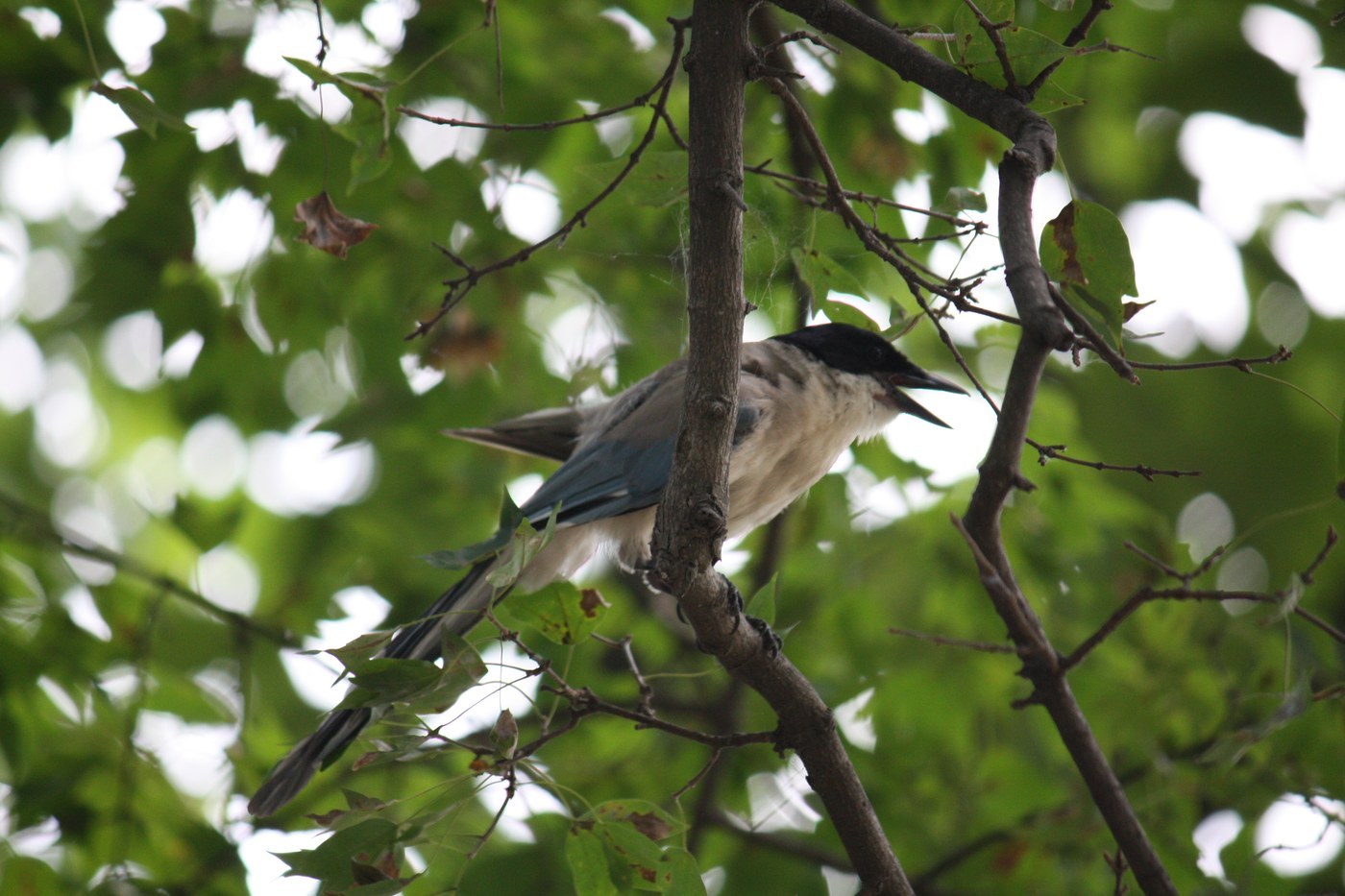
Azure-winged Magpie
Cyanopica cyanus
A slender, sociable corvid with a black cap, soft grey-buff body, and striking pale azure-blue wings and tail.
- Size
- 33-38 cm (13-15 in) long including tail
- Habitat
- open pine and mixed woodlands, parks, and farmland with scattered trees
- Type
- songbird
Spotted a bird like this?
Identify any bird from a photo, free.
Overview
The Azure-winged Magpie is a graceful, long-tailed member of the crow family, easily told apart from typical black-and-white magpies by its soft, pastel coloring. It has a neat black cap, pale grey-buff body plumage, and long wings and an even longer graduated tail washed in a delicate sky-blue.
The species is notable for its highly disjunct distribution, occurring both in East Asia (Japan, Korea, and eastern China) and, as a closely related but now separately classified species, in the Iberian Peninsula of far southwestern Europe — a curious biogeographic puzzle long debated by ornithologists. It is a highly social bird, living in cooperative flocks and often helping to raise young that are not its own.
How to identify it
Key field marks
- Solid black cap contrasting with a pale grey-buff body
- Long, pale azure-blue wings and an even longer, graduated azure-blue tail
- Slender build and buoyant, floating flight
- Usually encountered in noisy, active flocks
Similar species
- Eurasian Magpie is much larger with bold black-and-white plumage and lacks the pastel blue tones.
- No other East Asian corvid shares its combination of black cap and pale blue wings and tail.
Habitat & range
Habitat
Favors open woodland with pines or mixed trees, riverside groves, farmland edges, and parks with scattered mature trees.
Range
Found across Japan, the Korean Peninsula, and eastern and central China, with a separate, disjunct population (often treated as the related Iberian Magpie) in Spain and Portugal.
Migration
Largely resident, with flocks moving locally in search of food outside the breeding season.
Behavior & voice
Behavior
Highly social and cooperative, living in flocks and sometimes breeding cooperatively, with related birds helping feed nestlings that are not their own; flies with a distinctive light, undulating action.
Voice
A variety of harsh, nasal, chattering calls, including a repeated "gwink-gwink" and softer contact notes kept up within the flock.
Feeding
Omnivorous, taking insects, spiders, seeds, fruit, and occasionally small vertebrates or the eggs and nestlings of other birds.
Nesting
Builds a bulky stick nest in a tree, often in loose colonies; lays 5-8 pale eggs with darker markings, sometimes assisted by helper birds from previous broods.
Frequently asked questions
Why does the Azure-winged Magpie have such a strange distribution?
It occurs in East Asia and also, as a very closely related form, in Spain and Portugal, thousands of miles apart, a disjunct pattern that has puzzled scientists and is thought to reflect a once much wider range that contracted over time.
How can you identify an Azure-winged Magpie?
Look for a black cap, pale grey-buff body, and long wings and tail washed in soft azure-blue, along with its habit of traveling in noisy flocks.
Is the Azure-winged Magpie the same species found in Spain?
The Iberian population is now usually classified as a separate species, the Iberian Magpie, very similar in appearance to the East Asian Azure-winged Magpie.
What does an Azure-winged Magpie eat?
A wide variety of foods including insects, seeds, fruit, and occasionally small vertebrates or other birds' eggs.
Azure-winged Magpie guides
In-depth guides for identifying, finding, and understanding Azure-winged Magpie.
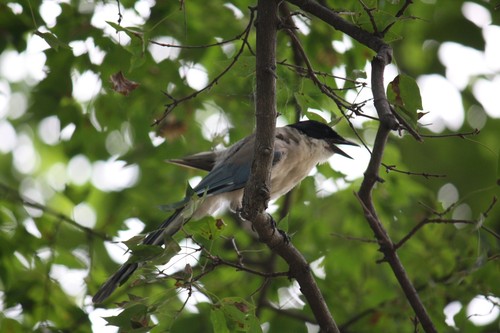
Azure-winged Magpie identified by the community
Real birds identified with Bird Identifier.
Other birds you may enjoy

Black Redstart
13-14.5 cm (5.1-5.7 in) long, 23-26 cm wingspan

Black-throated Sparrow
12-14 cm (4.7-5.5 in) long, about 19-20 cm (7.5-8 in) wingspan

Greater Bird-of-paradise
Body about 43 cm; males with additional flank plumes up to 50 cm and long tail wires

Blue Tit
11-12 cm (4.3-4.7 in) long, 17-20 cm wingspan

Red-billed Quelea
11.5–13 cm long, wingspan about 20–22 cm
White-plumed Antbird
13-14 cm (5-5.5 in) long

Pyrrhuloxia
19-22 cm (7.5-8.7 in) long, 30 cm wingspan

Blue-gray Tanager
16-18 cm (6-7 in) long

Blackburnian Warbler
11-13 cm (4.3-5.1 in) long, 20-22 cm wingspan

Bluethroat
13-14 cm (5.1-5.5 in) long, 20-22 cm wingspan

Eurasian Nuthatch
12-14.5 cm (4.7-5.7 in) long, 22.5-27 cm wingspan

Wood Thrush
19-21 cm (7.5-8.3 in) long, about 33 cm (13 in) wingspan