Azure-winged Magpie Identification Guide
A slender, pale grey-buff corvid identified by its black cap and vivid azure-blue wings and tail.
Read the full Azure-winged Magpie encyclopedia entry →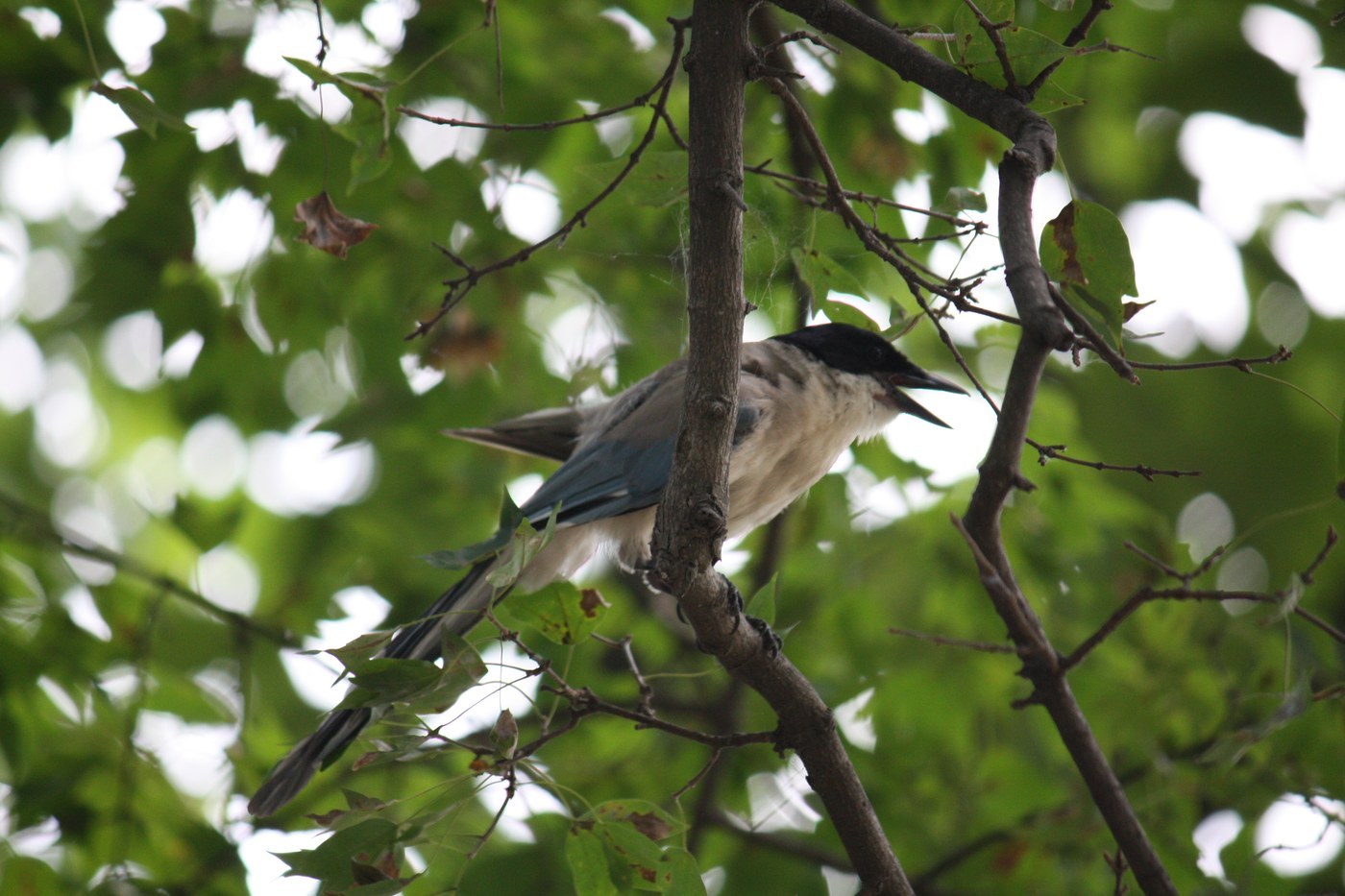
Key Field Marks
- Size & shape: A slim, long-tailed corvid around 33–35 cm long, with a substantial share of that length in a graduated, blue tail.
- Head: Solid, glossy black cap extending from the forehead down through the nape and eye area, sharply demarcated from the pale body.
- Body: Soft grey-buff to pale fawn underparts and back, contrasting strongly with the wings.
- Wings & tail: Bright, powder-blue to azure wings and a long blue tail, often the most eye-catching feature in flight or at rest.
- Bill & legs: Black bill; dark legs.
Behavior
- Highly social, living in noisy family groups or small flocks year-round; cooperative breeders in many populations, with helpers assisting at the nest.
- Forages both in trees and on the ground for insects, seeds, and fruit; flight is light and undulating with the tail streaming behind.
- Often fairly wary but can become tame in parks and gardens where it is common.
Similar Species
- Iberian Magpie (treated by some authorities as a separate species from the Asian population): Near-identical in plumage; range is the only reliable separator, as the two populations are widely disjunct (Iberian Peninsula vs. East Asia).
- Eurasian Magpie: Much larger, with bold black-and-white (not blue) plumage and a longer, straighter tail — easily separated by pattern and size.
Where & When to See It
- Two widely separated ranges: East Asia (Japan, Korea, and parts of China/Mongolia/Russian Far East) and the Iberian Peninsula (Spain and Portugal).
- Favors open woodland, pine groves, farmland with scattered trees, parks, and gardens.
- Resident year-round across its range, typically seen in family parties.
Voice
- A varied repertoire including harsh, chattering "chur" or "kwink" calls and softer conversational notes exchanged within the flock.
Frequently asked questions
Why are there Azure-winged Magpies in both Spain and East Asia?
The species has a naturally disjunct range, with one population in the Iberian Peninsula and another across East Asia; some taxonomies now split the Iberian birds as a distinct species, the Iberian Magpie.
What is the easiest field mark for an Azure-winged Magpie?
The combination of a solid black cap, pale grey-buff body, and bright azure-blue wings and tail is distinctive and shared by no other corvid in its range.
Does the Azure-winged Magpie migrate?
No, it is a non-migratory resident, though family groups and flocks may wander locally in search of food outside the breeding season.
How is the Azure-winged Magpie different from a Eurasian Magpie?
It is smaller and slimmer with blue (not black-and-white) wings and tail, and it lives in more cohesive social flocks than the more solitary Eurasian Magpie.
Azure-winged Magpie identified by the community
Recent Azure-winged Magpie sightings identified with Bird Identifier.