
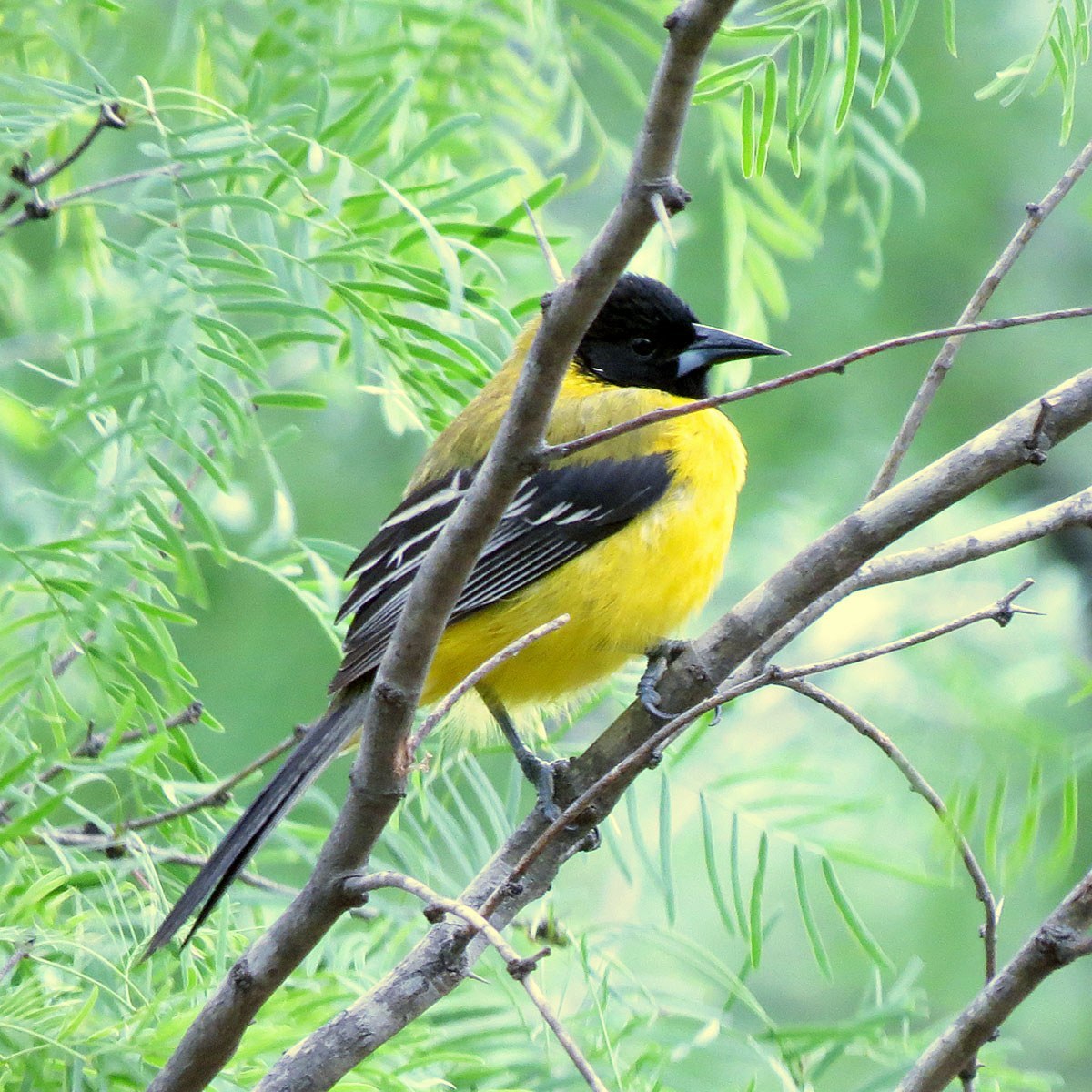
Audubon's Oriole
Icterus graduacauda
A secretive yellow-and-black oriole with a full black hood, found in the United States only in the dense brushlands of the lower Rio Grande Valley.
- Size
- 22-24 cm (8.7-9.5 in) long, 33 cm wingspan
- Habitat
- dense riparian woodlands and thorn scrub of extreme south Texas and eastern Mexico
- Type
- songbird
Spotted a bird like this?
Identify any bird from a photo, free.
Overview
Audubon's Oriole is a striking but often elusive oriole named in honor of naturalist John James Audubon. Adults show a solid black hood covering the head and throat, a black tail, and black wings with a yellow shoulder patch, contrasting with an otherwise greenish-yellow body. Unlike many orioles, males and females look essentially alike, and the species tends to be quieter and more skulking than its showier relatives.
In the United States, Audubon's Oriole is restricted to dense woodlands and thorn scrub of the lower Rio Grande Valley in south Texas, where it is considered a local specialty much sought after by birders, while the species is more widespread through the woodlands of eastern and southern Mexico.
How to identify it
Key Field Marks
- Solid black hood covering the entire head and throat
- Greenish-yellow body, black wings and tail, yellow shoulder patch
- Stocky build with a fairly heavy, straight bill
- Sexes similar in appearance
Similar Species
- Scott's Oriole has a black back in addition to the black hood, with more sharply demarcated lemon-yellow (not greenish-yellow) underparts, and prefers arid yucca habitat rather than dense woodland.
- Altamira Oriole is larger and brighter orange rather than greenish-yellow, without a full black hood extending as far down.
Habitat & range
Habitat
Audubon's Oriole favors dense riparian woodland, thorn forest, and brushy understory, generally staying low and hidden within thick vegetation rather than the open canopy favored by many other orioles.
Range
In the U.S., restricted to the lower Rio Grande Valley of south Texas; more broadly distributed through the woodlands of eastern and central Mexico.
Migration
Non-migratory (resident) throughout its range.
Behavior & voice
Behavior
More retiring than most orioles, Audubon's Oriole tends to stay low in dense cover and can be difficult to observe despite its bold plumage, often detected first by voice.
Voice
The song is a slow, deliberate series of clear, whistled notes with a somewhat hesitant, halting quality, quite different from the faster warbling songs of most other orioles.
Feeding
Feeds on insects, fruit, and nectar gleaned from dense shrub and understory vegetation.
Nesting & Breeding
Builds a shallow, cup-shaped hanging nest (less elongated than many oriole nests), typically placed in dense foliage. The female incubates the eggs while remaining well hidden from view.
Frequently asked questions
Where can you find Audubon's Oriole in the United States?
It occurs in the U.S. only in the dense woodlands and thorn scrub of the lower Rio Grande Valley in south Texas, making it a sought-after specialty for birders visiting the region.
How is Audubon's Oriole different from Scott's Oriole?
Both have black hoods and yellow bodies, but Audubon's Oriole has a greenish-yellow body and prefers dense woodland, while Scott's Oriole has a black back, brighter lemon-yellow underparts, and favors arid yucca-studded habitat.
Who was Audubon's Oriole named after?
It was named in honor of the naturalist and painter John James Audubon.
Why is Audubon's Oriole hard to see?
It tends to stay low and hidden within dense vegetation and has a quieter, more hesitant song than many other orioles, making it easy to overlook despite its bold coloring.
Audubon's Oriole guides
In-depth guides for identifying, finding, and understanding Audubon's Oriole.
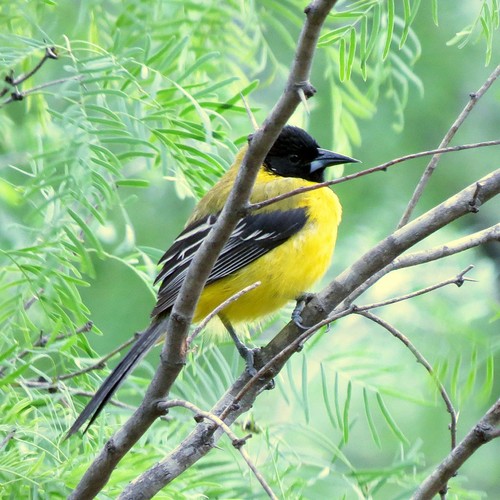
Other birds you may enjoy

Black Redstart
13-14.5 cm (5.1-5.7 in) long, 23-26 cm wingspan

Black-throated Sparrow
12-14 cm (4.7-5.5 in) long, about 19-20 cm (7.5-8 in) wingspan

Greater Bird-of-paradise
Body about 43 cm; males with additional flank plumes up to 50 cm and long tail wires

Blue Tit
11-12 cm (4.3-4.7 in) long, 17-20 cm wingspan

Red-billed Quelea
11.5–13 cm long, wingspan about 20–22 cm
White-plumed Antbird
13-14 cm (5-5.5 in) long

Pyrrhuloxia
19-22 cm (7.5-8.7 in) long, 30 cm wingspan

Blue-gray Tanager
16-18 cm (6-7 in) long

Blackburnian Warbler
11-13 cm (4.3-5.1 in) long, 20-22 cm wingspan

Bluethroat
13-14 cm (5.1-5.5 in) long, 20-22 cm wingspan

Eurasian Nuthatch
12-14.5 cm (4.7-5.7 in) long, 22.5-27 cm wingspan

Wood Thrush
19-21 cm (7.5-8.3 in) long, about 33 cm (13 in) wingspan