
Audubon's Oriole Identification Guide
A shy, slow-singing oriole of South Texas brushlands, told from other orioles by its solid black hood over a lemon-yellow body.
Read the full Audubon's Oriole encyclopedia entry →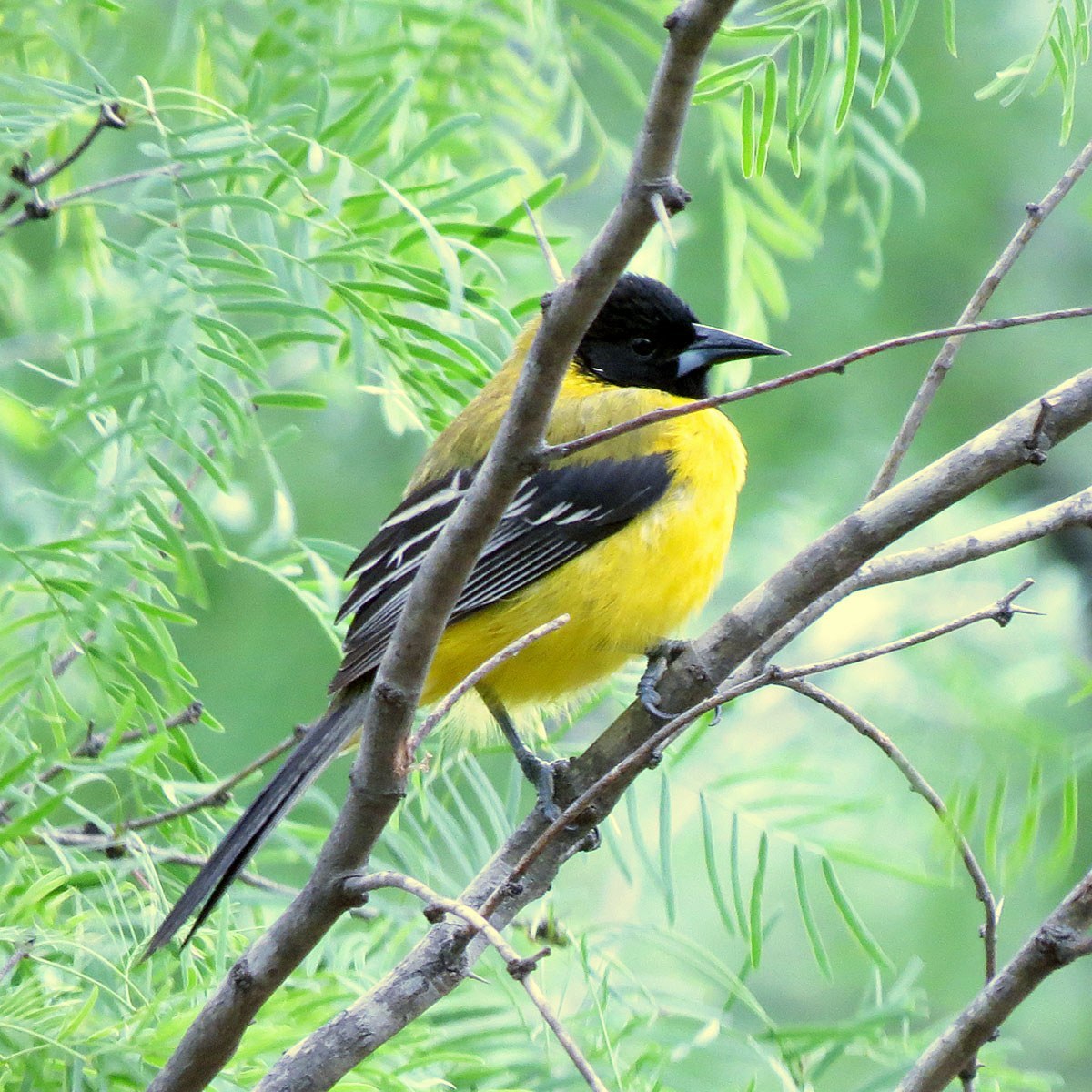
Key Field Marks
- Size & shape: A medium-large oriole (about 22–24 cm) with a fairly long tail, thick-based pointed bill, and a somewhat heavy-bodied look compared to smaller orioles.
- Plumage: Adults show a solid black hood that covers the entire head and throat, sharply demarcated from a bright lemon-yellow to greenish-yellow body. The back is olive-yellow, the wings are black with a crisp white wing bar and white edging on the flight feathers, and the tail is black.
- Bill & legs: Bill is straight, sharply pointed, and blackish-gray, slightly downcurved at the tip; legs are blue-gray.
- Behavior: Skulking and deliberate — it forages methodically in dense brush and low tangles rather than out in the open, often staying low and hidden, unlike more conspicuous orioles that feed high in canopy or visit feeders readily.
Separating It From Similar Species
- Altamira Oriole: Larger and bulkier, with orange (not yellow) body, a broader white wing patch, and orange (not black) shoulder patch — Altamira also lacks the fully solid black hood extending onto the back.
- Scott's Oriole: Male Scott's has a black back and black chest continuing onto the upper breast in a bib, with more contrasting black-and-yellow pattern and a different, more open desert habitat preference; female/immature Scott's are duller and lack the crisp black hood.
- Hooded Oriole: Smaller and slimmer, with orange (not yellow) body tones in most populations, a thinner decurved bill, and a black throat patch that does not form a complete solid hood over the crown in females/immatures.
- Immatures: Young Audubon's Orioles are olive-yellow overall without the black hood, developing the black head gradually — told from other immature orioles mainly by range, bill shape, and the muted, unhurried behavior.
Where & When to See It
- Habitat: Dense thorn-scrub, riparian woodland edges, and live oak mottes in South Texas brushlands; it prefers thick cover and is rarely seen in the open.
- Range: A non-migratory resident restricted in the U.S. to the Lower Rio Grande Valley and south Texas brush country, with the core range extending south through eastern Mexico.
- Season: Present year-round where found; no strong seasonal movement, though it can be harder to detect outside the breeding season when singing drops off.
Voice & Song Cues
- Song is a series of slow, clear, melancholy whistled phrases delivered with long pauses between notes — often likened to someone learning to whistle, quite unlike the fast, rich warbling of most other orioles.
- Call notes include a sharp, cat-like mewing or chattering note used in alarm or contact, useful for locating a bird hidden in dense cover before it is seen.
Frequently asked questions
What is the easiest way to tell an Audubon's Oriole from other yellow orioles?
Look for the combination of a fully solid black hood (head and throat) sharply set off against a lemon-yellow, not orange, body, plus a black (not orange) back and shoulder.
Where in the United States can I find Audubon's Oriole?
It is essentially limited to South Texas, especially the Lower Rio Grande Valley brushlands, where it is a year-round resident.
Does Audubon's Oriole sing like other orioles?
No — its song is unusually slow and disjointed, made up of separated whistled notes rather than the fast, fluid warble typical of most oriole species.
Why is Audubon's Oriole hard to spot even where it occurs?
It is a skulking bird that forages low in dense thorn-scrub and tangles rather than in the open canopy, so it is often heard before it is seen.