
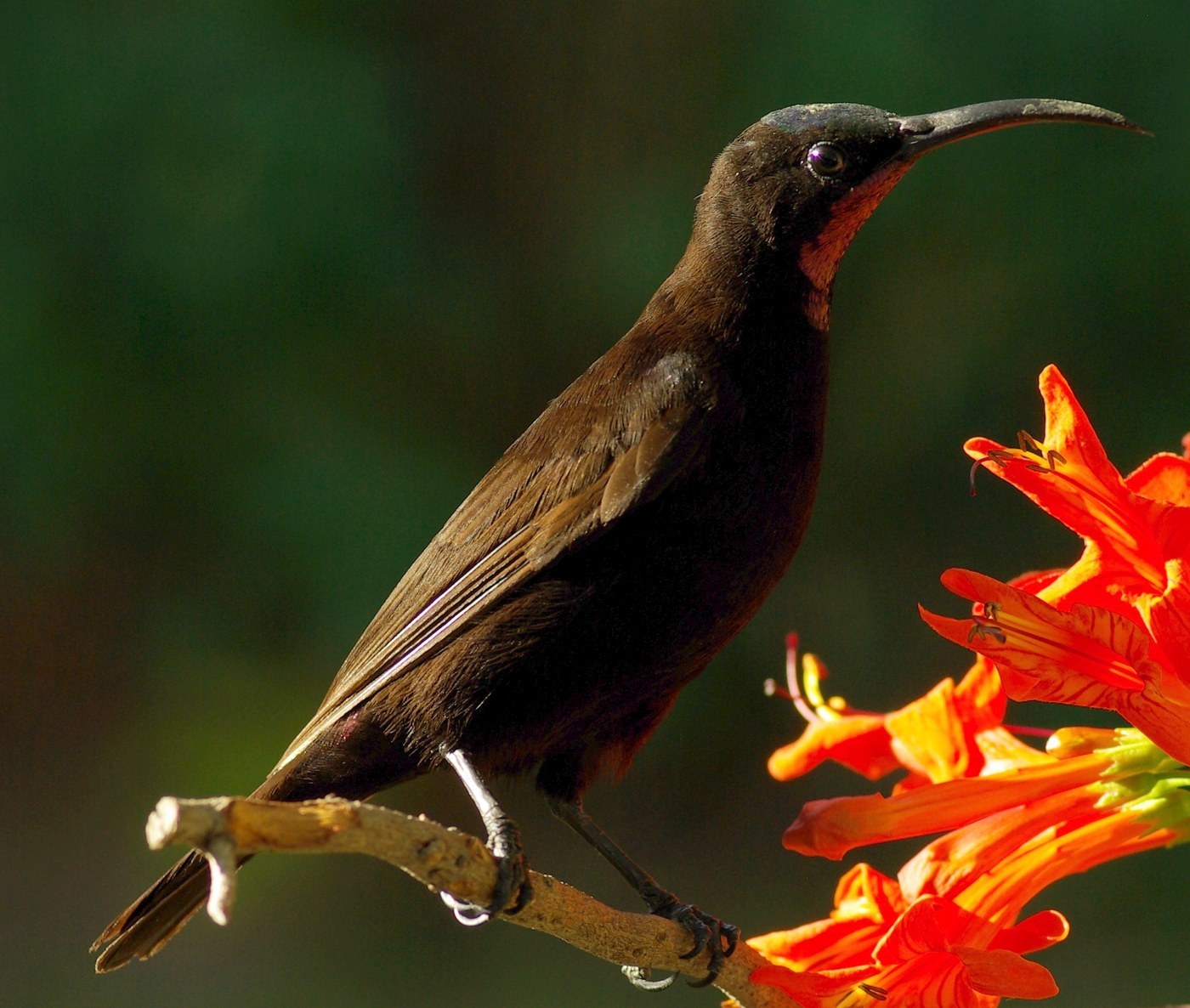
Amethyst Sunbird
Chalcomitra amethystina
A sunbird that looks almost entirely black at rest but flashes brilliant amethyst-purple on its crown and throat when caught in good light.
- Size
- About 14-15 cm long
- Habitat
- Woodland, forest edge, savanna and gardens across eastern and southern Africa
- Type
- songbird
Spotted a bird like this?
Identify any bird from a photo, free.
Overview
The Amethyst Sunbird, sometimes called the Black Sunbird, is a fairly large, striking sunbird of eastern and southern Africa. In dull light the male appears essentially black overall, but in direct sunlight brilliant iridescent purple and green patches flare on the crown, throat, and shoulders.
Appearance
Males are sooty black with an iridescent violet-purple crown and throat patch and a green or purplish shoulder patch (lesser coverts), the colors only becoming visible at certain angles to light. Females are much duller: dark brownish-grey above with heavy dusky mottling or streaking on a paler underside, lacking any iridescence.
How to identify it
Key field marks
- Fairly large sunbird that looks all-black until light catches its head, revealing amethyst-purple iridescence
- Male: black body, glittering purple crown and throat, small colored shoulder patch
- Female: dark brown-grey above, heavily streaked or mottled buffy underparts
- Deep, slightly decurved bill typical of larger sunbirds
Similar species
Other all-dark sunbirds in the region, such as the Scarlet-chested Sunbird, show obvious red or scarlet patches rather than purple, and male Amethyst Sunbirds lack any red. Female Amethyst Sunbirds are heavily mottled below, more so than the plainer females of many other species, which helps separate them from similar dull-plumaged sunbirds sharing the same habitat.
Habitat & range
Habitat
This species uses a broad range of wooded habitats, including savanna woodland, forest edge, coastal bush, and well-planted gardens, often visiting flowering aloes, coral trees, and other nectar-rich blooms.
Range
It is widespread across eastern and southern Africa, from Kenya and Tanzania south through Zambia, Zimbabwe, Mozambique, and much of South Africa.
Migration
Generally resident, though individuals may move locally to track seasonal flowering, particularly of aloes in winter in southern Africa.
Behavior & voice
Behavior
Amethyst Sunbirds are bold and often solitary or territorial at flowering trees, aggressively chasing off other nectar feeders including other sunbirds. Males often perch prominently while singing, making the flash of iridescent color especially noticeable.
Voice
The song is a fast, scratchy warble mixed with clear whistled notes; the common call is a loud, sharp "chip" or "tzik."
Feeding
Nectar from a wide variety of flowering trees and shrubs forms the core diet, supplemented with insects taken by gleaning or short aerial sallies, especially important protein for breeding birds.
Nesting
The nest is a bulky, oval, hanging structure of grass, bark strips, and spider web with a side entrance and often a small overhanging porch, built by the female and suspended from a low branch or shrub. Clutches usually contain one to two eggs, incubated by the female.
Frequently asked questions
Why does the Amethyst Sunbird look black most of the time?
Its iridescent purple crown and throat feathers only reflect their brilliant color at certain angles to light; without direct sun they appear plain black.
What is another name for the Amethyst Sunbird?
It is also commonly called the Black Sunbird because of its predominantly dark plumage.
Where does the Amethyst Sunbird live?
It is found across eastern and southern Africa in woodland, forest edge, savanna, and gardens.
How do you tell a male from a female Amethyst Sunbird?
Males look black with flashes of purple on the crown and throat; females are dark brownish-grey above with heavily streaked or mottled underparts and no iridescence.
Amethyst Sunbird guides
In-depth guides for identifying, finding, and understanding Amethyst Sunbird.
Other birds you may enjoy

Black Redstart
13-14.5 cm (5.1-5.7 in) long, 23-26 cm wingspan

Black-throated Sparrow
12-14 cm (4.7-5.5 in) long, about 19-20 cm (7.5-8 in) wingspan

Greater Bird-of-paradise
Body about 43 cm; males with additional flank plumes up to 50 cm and long tail wires

Blue Tit
11-12 cm (4.3-4.7 in) long, 17-20 cm wingspan

Red-billed Quelea
11.5–13 cm long, wingspan about 20–22 cm
White-plumed Antbird
13-14 cm (5-5.5 in) long

Pyrrhuloxia
19-22 cm (7.5-8.7 in) long, 30 cm wingspan

Blue-gray Tanager
16-18 cm (6-7 in) long

Blackburnian Warbler
11-13 cm (4.3-5.1 in) long, 20-22 cm wingspan

Bluethroat
13-14 cm (5.1-5.5 in) long, 20-22 cm wingspan

Eurasian Nuthatch
12-14.5 cm (4.7-5.7 in) long, 22.5-27 cm wingspan

Wood Thrush
19-21 cm (7.5-8.3 in) long, about 33 cm (13 in) wingspan