
Amethyst Sunbird Identification Guide
A sub-Saharan African sunbird whose male looks black at a distance but flashes brilliant amethyst-purple on the crown, throat, and shoulders in good light.
Read the full Amethyst Sunbird encyclopedia entry →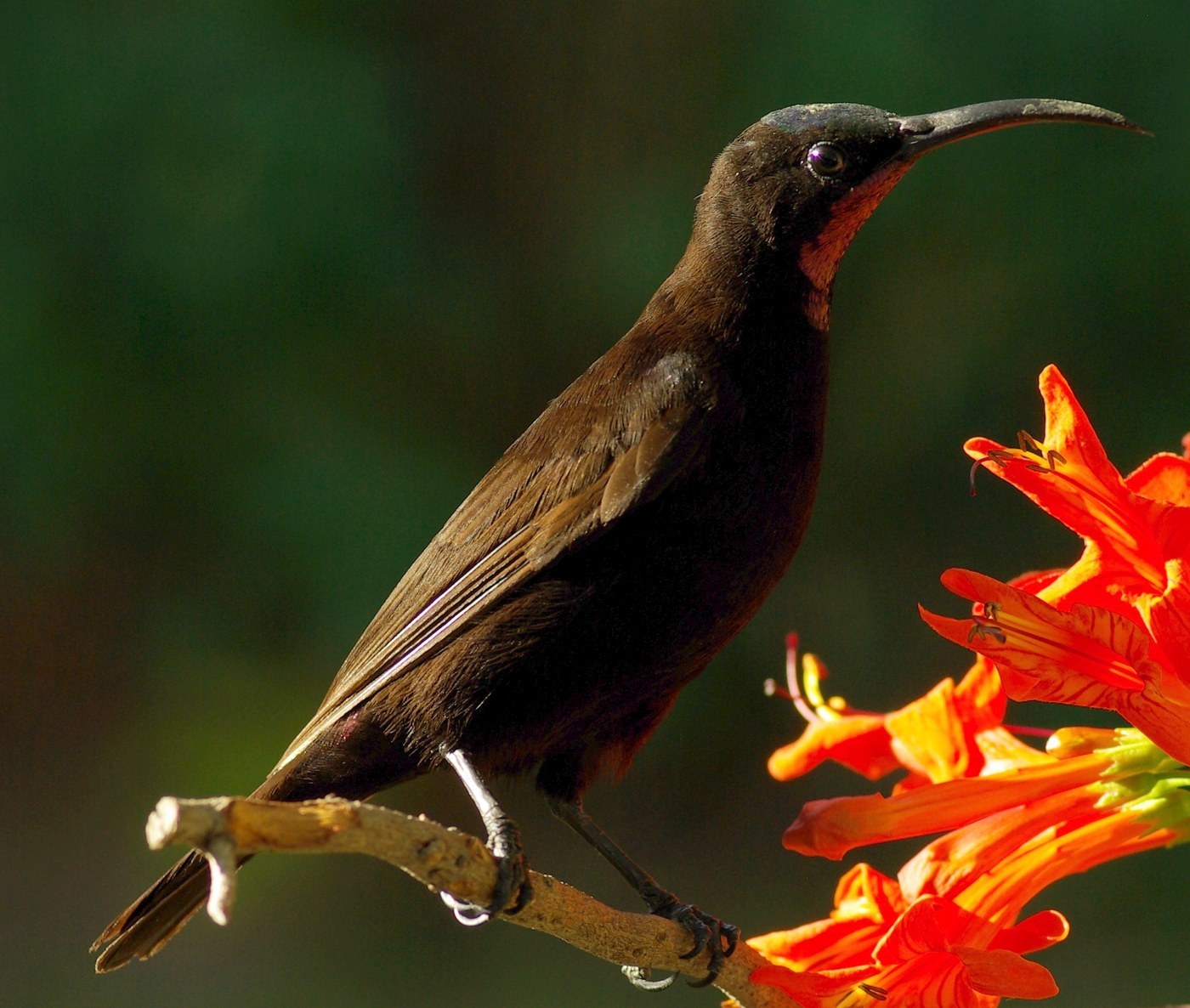
Key Field Marks
- Male: appears all-black in dull light but shows brilliant iridescent amethyst-purple on the crown, throat/chin, and shoulder patches when struck by direct sunlight, with a glossy green or violet sheen elsewhere on the body
- Long, thin, sharply decurved bill typical of sunbirds, adapted for probing tubular flowers
- Female: dusky grayish-brown above with mottled grayish-white, lightly streaked underparts; lacks any iridescence
- Small, active, energetic build
How to Tell It Apart from Similar Species
- Scarlet-chested Sunbird males show a bright scarlet throat patch against a dark body, quite different from the Amethyst Sunbird's purple (not red) throat.
- Malachite Sunbird males are bright iridescent green overall with long central tail streamers, unlike the mostly black-appearing Amethyst Sunbird.
- In poor light, male Amethyst Sunbirds can look simply black; waiting for the bird to turn in good sunlight reveals the diagnostic purple crown, throat, and shoulder flashes that separate it from other dark sunbirds.
Habitat & Range
The Amethyst Sunbird is widespread across sub-Saharan Africa, from parts of eastern and central Africa south through much of southern Africa, occupying savanna woodland, forest edge, coastal scrub, gardens, and cultivated areas wherever flowering trees and shrubs are present.
Behavior
Like other sunbirds, it feeds mainly on nectar from flowering trees and shrubs (including aloes and coral trees), usually perching to feed rather than hovering, though it will hover briefly at flowers when needed. It also takes insects and spiders, particularly when provisioning nestlings. Males are notably feisty, aggressively defending productive flowering trees from other sunbirds and pollinators, and sing from exposed perches.
Voice
The song is a scratchy, energetic, chattering series of notes; the call is a sharp, metallic "chip" or "tsip."
Frequently asked questions
How do you identify an Amethyst Sunbird?
Males look black at a distance but flash iridescent amethyst-purple on the crown, throat, and shoulders in good light; females are plain grayish-brown with lightly streaked underparts and the same thin, decurved bill.
What is the difference between an Amethyst Sunbird and a Scarlet-chested Sunbird?
The Amethyst Sunbird male shows purple (not red) iridescence on the throat and crown, while the Scarlet-chested Sunbird male has a bright scarlet throat patch against an otherwise dark body.
Why do male Amethyst Sunbirds sometimes look completely black?
Their iridescent purple feathering only shows its color when it catches direct light at the right angle; in shade or dull conditions the male can appear plain black.
Where do Amethyst Sunbirds live?
Across sub-Saharan Africa in savanna woodland, forest edges, coastal scrub, and gardens with flowering trees and shrubs.
What do Amethyst Sunbirds eat?
Mainly nectar from flowering trees and shrubs, supplemented with insects and spiders, especially when feeding young.