
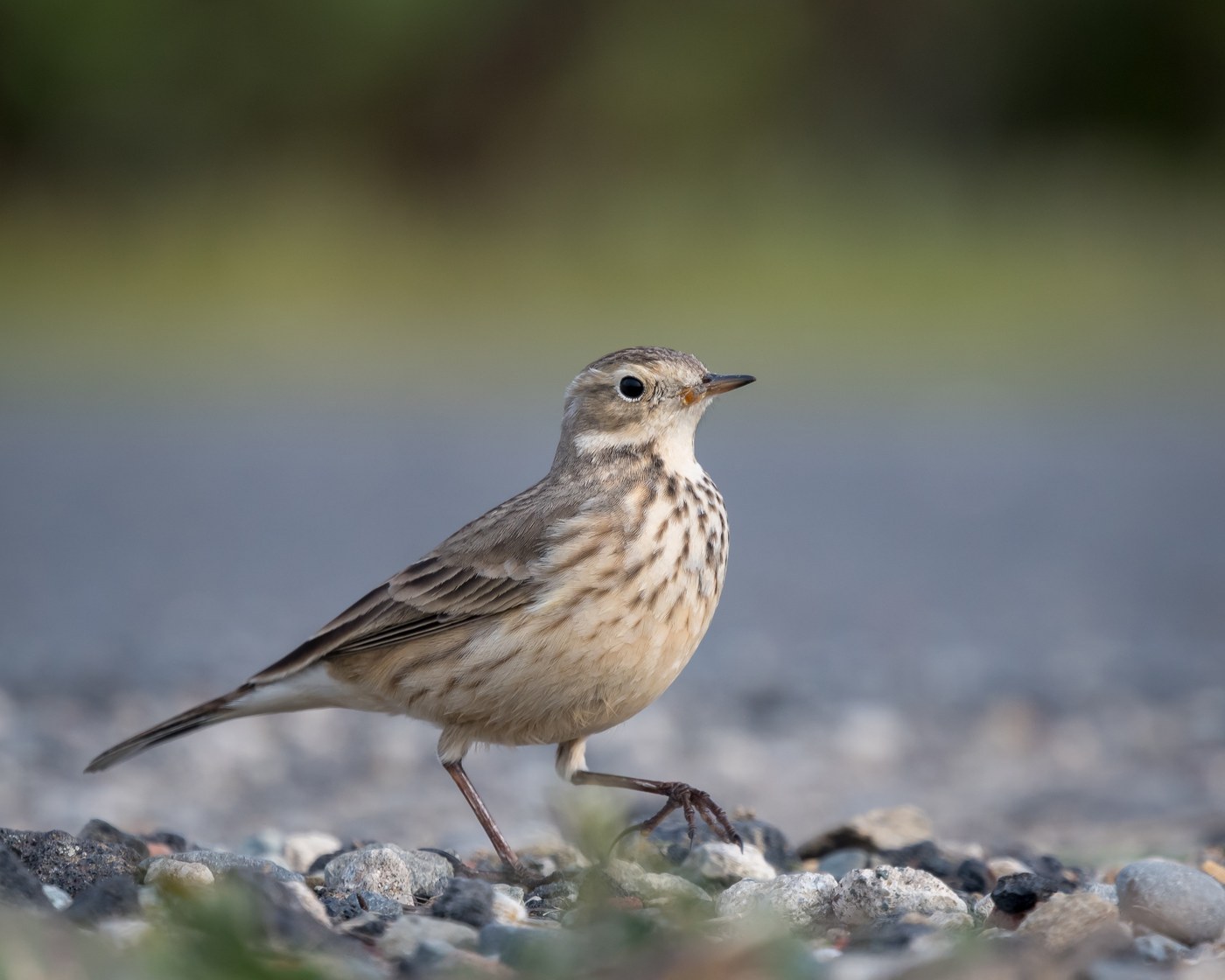
American Pipit
Anthus rubescens
A slender, streaky brown songbird of open ground that constantly bobs its tail as it walks.
- Size
- 14-17 cm (5.5-6.7 in) long, 23-28 cm (9-11 in) wingspan
- Habitat
- alpine and arctic tundra in summer; open fields, mudflats, and shorelines in winter
- Type
- songbird
Spotted a bird like this?
Identify any bird from a photo, free.
Overview
The American Pipit is a slim, streaky, sparrow-like songbird that breeds on arctic and alpine tundra and winters across open lowland habitats. Its brownish-gray, streaked plumage and thin bill give it a nondescript look, but its behavior — constant tail-bobbing while walking briskly across open ground — makes it easy to recognize once learned.
Breeding adults show buffy underparts, faint streaking on the breast, and a grayish-brown back; winter birds tend to be a bit browner and more heavily streaked below. Slender white outer tail feathers flash in flight, and the legs are dark.
How to identify it
Key field marks
- Slender build with a thin, pointed bill
- Streaked, buffy-to-brownish underparts
- Constant up-and-down tail-bobbing while walking
- White outer tail feathers flashing in flight
- Thin, high call note given in flight ("pip-it" or "sip-sip")
Similar species
Sprague's Pipit is paler and more finely streaked above with a plainer face, and rarely walks in the open the way American Pipit does; it also has a very different, high, insect-like flight song. Vesper Sparrow and other open-country sparrows have thicker, conical bills rather than the pipit's thin, straight bill, and do not bob their tails.
Habitat & range
Habitat
Breeds on treeless arctic tundra and high alpine meadows above treeline. In migration and winter, found in open, low-vegetation habitats: plowed fields, pastures, mudflats, beaches, and the shorelines of lakes and rivers.
Range
Breeds across the Arctic and in high mountains of western North America (as well as parts of Siberia and east Asia). Winters broadly across the southern and coastal United States, Mexico, and Central America, often in loose flocks on bare or short-cropped ground.
Behavior & voice
Behavior
American Pipits walk steadily across open ground rather than hopping, constantly pumping their tails up and down. Outside the breeding season they often gather in loose, restless flocks that flush together and wheel around before settling again.
Voice
The flight call is a thin, sharp "pi-pit" or "sip-it," often given repeatedly as flocks move overhead. The breeding song, delivered during a fluttering display flight over tundra, is a rapid, repetitive series of thin notes.
Feeding and nesting
Feeds by walking and picking insects and other invertebrates from the ground or shallow water's edge; seeds become more important in winter. The nest is a cup of grass placed in a sheltered depression on the ground, often tucked against a rock or tuft of vegetation on the open tundra.
Frequently asked questions
How do you identify an American Pipit?
Look for a slender, streaky brown bird walking on open ground while constantly bobbing its tail, with white outer tail feathers flashing in flight.
Where do American Pipits breed?
On arctic tundra and above treeline in alpine meadows of high mountains.
What does an American Pipit eat?
Mostly insects and other small invertebrates, with seeds eaten more often in winter.
Is American Pipit the same as Water Pipit?
American Pipit was once considered the same species as the Eurasian Water Pipit but is now recognized as a separate species, Anthus rubescens.
Why does the American Pipit bob its tail?
The constant tail-bobbing is a characteristic behavior of pipits and wagtails, thought to help with balance or signaling, and is one of the best ways to recognize the species at a glance.
American Pipit guides
In-depth guides for identifying, finding, and understanding American Pipit.
Other birds you may enjoy

Black Redstart
13-14.5 cm (5.1-5.7 in) long, 23-26 cm wingspan

Black-throated Sparrow
12-14 cm (4.7-5.5 in) long, about 19-20 cm (7.5-8 in) wingspan

Greater Bird-of-paradise
Body about 43 cm; males with additional flank plumes up to 50 cm and long tail wires

Blue Tit
11-12 cm (4.3-4.7 in) long, 17-20 cm wingspan

Red-billed Quelea
11.5–13 cm long, wingspan about 20–22 cm
White-plumed Antbird
13-14 cm (5-5.5 in) long

Pyrrhuloxia
19-22 cm (7.5-8.7 in) long, 30 cm wingspan

Blue-gray Tanager
16-18 cm (6-7 in) long

Blackburnian Warbler
11-13 cm (4.3-5.1 in) long, 20-22 cm wingspan

Bluethroat
13-14 cm (5.1-5.5 in) long, 20-22 cm wingspan

Eurasian Nuthatch
12-14.5 cm (4.7-5.7 in) long, 22.5-27 cm wingspan

Wood Thrush
19-21 cm (7.5-8.3 in) long, about 33 cm (13 in) wingspan