
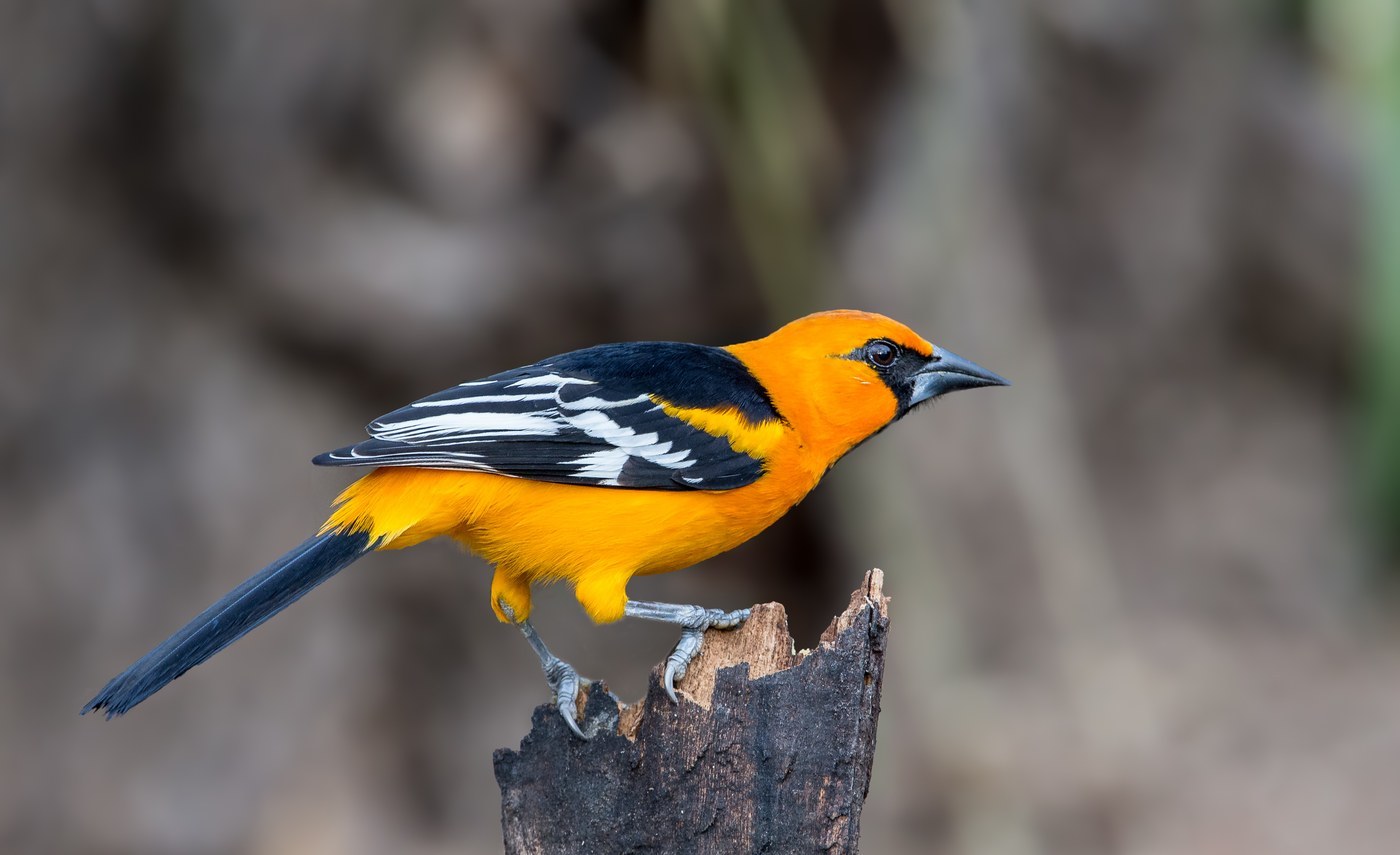
Altamira Oriole
Icterus gularis
The largest oriole in the United States, a bright orange bird found only in the Rio Grande Valley of extreme south Texas, famous for weaving the longest hanging nest of any North American bird.
- Size
- 20-25 cm (8-10 in) long, 34 cm wingspan
- Habitat
- riparian woodlands, brushy thorn forest, and open woods of extreme south Texas and Mexico
- Type
- songbird
Spotted a bird like this?
Identify any bird from a photo, free.
Overview
The Altamira Oriole is the largest oriole species found in the United States, reaching this country only in the brushy woodlands of the extreme lower Rio Grande Valley of south Texas, with the bulk of its range extending through eastern Mexico and northern Central America. Adults are bright orange-yellow with a black face, throat, back, wings, and tail, and, unlike most orioles, show little to no difference in plumage between males and females.
The species is especially famous among birders for building the longest pendulous hanging nest of any bird in North America, sometimes stretching over 60 cm (2 feet) long, suspended from the tip of a tree branch, often overhanging water or open ground for protection from predators.
How to identify it
Key Field Marks
- Large, stocky oriole with a thick, straight bill
- Bright orange-yellow body with a black face, throat, back, wings, and tail
- Orange (not white) lesser wing patch, distinguishing it from similar orioles
- Sexes look alike, unlike most other oriole species
Similar Species
- Hooded Oriole is smaller and slimmer with a thinner, more curved bill and a white wing patch rather than orange.
- Bullock's Oriole males have only a black eyeline, not a full black face and throat.
- Audubon's Oriole has a solid black hood that extends further and shows a greenish-yellow rather than orange back.
Habitat & range
Habitat
Altamira Orioles inhabit riparian woodlands, semi-open thorn forest, and scattered tall trees along rivers and resacas, favoring areas with tall trees for nesting.
Range
In the United States, found only in the lower Rio Grande Valley of extreme south Texas; more widespread from eastern Mexico south through Belize, Guatemala, and Honduras.
Migration
Largely non-migratory (resident) throughout its range, including its small U.S. population, which remains in south Texas year-round.
Behavior & voice
Behavior
Altamira Orioles are often seen in pairs year-round, as they tend to maintain pair bonds outside the breeding season, and they forage deliberately in the mid- to upper canopy.
Voice
The song is a series of loud, clear, varied whistles, and the calls include a nasal, chattering note.
Feeding
Feeds on insects, spiders, fruit, and nectar, gleaned from foliage and flowers in the canopy.
Nesting & Breeding
The species builds the longest pendulous nest of any North American bird, a woven sock-like structure that can exceed 60 cm (2 feet) in length, suspended from a slender outer branch, often over water or open ground to deter predators. The female does most of the nest building and incubates 3-5 eggs.
Frequently asked questions
Where can you see an Altamira Oriole in the United States?
The only place to reliably find Altamira Orioles in the U.S. is the lower Rio Grande Valley of extreme south Texas, where they are year-round residents.
What makes the Altamira Oriole's nest special?
It builds the longest hanging, pendulous nest of any bird in North America, sometimes exceeding 60 cm (2 feet) in length, woven from plant fibers and suspended from a branch tip.
Do male and female Altamira Orioles look different?
No, unlike most orioles, male and female Altamira Orioles are nearly identical in their bright orange-and-black plumage.
Is the Altamira Oriole the largest oriole species?
It is the largest oriole regularly found in the United States, though a few Mexican and Central American orioles are comparably large.
Altamira Oriole guides
In-depth guides for identifying, finding, and understanding Altamira Oriole.
Other birds you may enjoy

Black Redstart
13-14.5 cm (5.1-5.7 in) long, 23-26 cm wingspan

Black-throated Sparrow
12-14 cm (4.7-5.5 in) long, about 19-20 cm (7.5-8 in) wingspan

Greater Bird-of-paradise
Body about 43 cm; males with additional flank plumes up to 50 cm and long tail wires

Blue Tit
11-12 cm (4.3-4.7 in) long, 17-20 cm wingspan

Red-billed Quelea
11.5–13 cm long, wingspan about 20–22 cm
White-plumed Antbird
13-14 cm (5-5.5 in) long

Pyrrhuloxia
19-22 cm (7.5-8.7 in) long, 30 cm wingspan

Blue-gray Tanager
16-18 cm (6-7 in) long

Blackburnian Warbler
11-13 cm (4.3-5.1 in) long, 20-22 cm wingspan

Bluethroat
13-14 cm (5.1-5.5 in) long, 20-22 cm wingspan

Eurasian Nuthatch
12-14.5 cm (4.7-5.7 in) long, 22.5-27 cm wingspan

Wood Thrush
19-21 cm (7.5-8.3 in) long, about 33 cm (13 in) wingspan