
Altamira Oriole Identification Guide
The largest oriole in its range, a bulky orange-and-black bird best known for weaving the longest pendulous nest of any oriole species.
Read the full Altamira Oriole encyclopedia entry →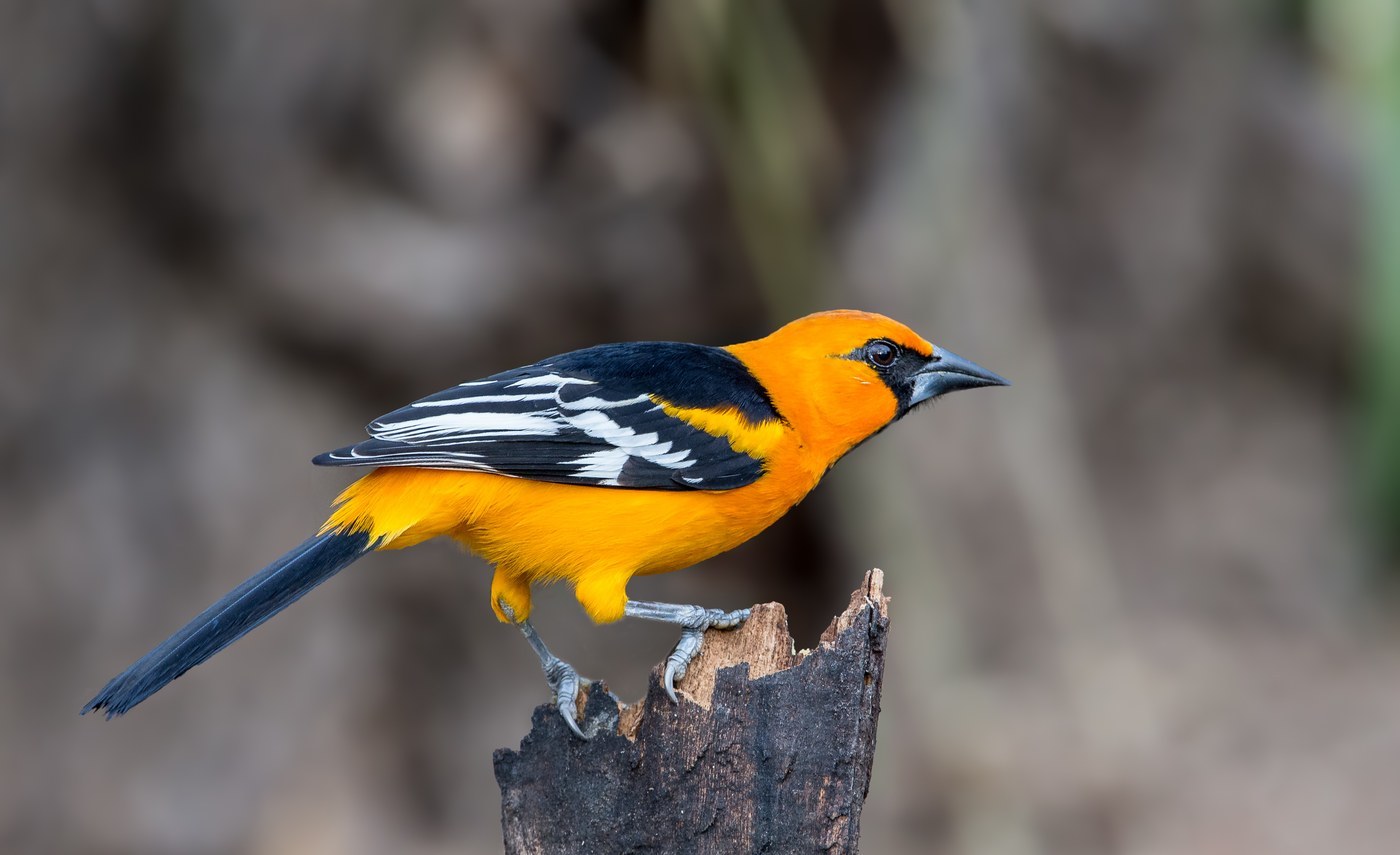
Key Field Marks
- Size: About 20–25 cm long, distinctly larger and bulkier than Baltimore or Bullock's Oriole, with a heavy, thick-based bill.
- Plumage: Rich orange-yellow body with a solid black back (not just the head), a black bib on the throat and upper breast, and black wings.
- Wing bars: Shows a prominent orange-yellow wing bar along with a white wing bar — the combination of a bold orange bar is a useful mark at a glance.
- Tail: Black.
- Bill: Notably thick and heavy compared to other North American orioles, a good structural clue even at a distance.
Behavior
- Pairs are often seen together year-round rather than only during the breeding season, as the species does not migrate away from its resident range.
- Builds an exceptionally long, pendulous woven nest — sometimes up to about 60 cm (2 feet) long — the longest nest of any oriole species, usually hung from an outer branch, sometimes over water or roads.
- Forages in the canopy and understory for insects, fruit, and nectar, and will visit nectar feeders and flowering trees.
Separating It From Similar Species
- Audubon's Oriole shares part of the range but has an olive-green (not black) back and a more extensively black hood; overall pattern and back color separate the two.
- Hooded Oriole is smaller and slimmer with a thinner, more curved bill and a different black facial pattern (more black on the face, less solid black back).
- Baltimore Oriole and Bullock's Oriole are both smaller with orange (not black) backs; the combination of Altamira's large size, thick bill, and solid black back is diagnostic where ranges overlap.
Where and When to See It
- Range: Resident from Mexico south to Nicaragua, with a small resident population reaching the United States only in the Lower Rio Grande Valley of extreme southern Texas.
- Habitat: Open woodland, resacas (oxbow wetlands), riparian corridors, and scrubby woodland edge.
- Season: Present year-round wherever it occurs; pairs typically remain on territory throughout the year rather than migrating.
Voice
- Song is a series of slow, clear whistled notes delivered at a more leisurely pace than the faster warbling songs of Baltimore or Bullock's Oriole.
- Calls include harsh chattering notes, often given as an alarm or contact call between paired birds.
Frequently asked questions
What is the easiest way to identify an Altamira Oriole?
Look for its large size, thick bill, solid black back, and orange-yellow body with a bold orange wing bar — a combination not shown by smaller orioles like Baltimore or Bullock's, which have orange (not black) backs.
How does the Altamira Oriole's nest help with identification?
It builds the longest pendulous nest of any oriole, sometimes up to about 60 cm, hanging from an outer branch — spotting one of these unusually long woven nests is a strong clue to the species even before seeing the bird.
Where in the United States can I find an Altamira Oriole?
Its U.S. range is limited to the Lower Rio Grande Valley of extreme southern Texas, where it is resident year-round in open woodland and riparian habitat.
How is Altamira Oriole different from Audubon's Oriole?
Altamira Oriole has a solid black back and a black bib restricted to the throat/upper breast, while Audubon's Oriole has an olive-green back and a more extensive black hood covering the head.