
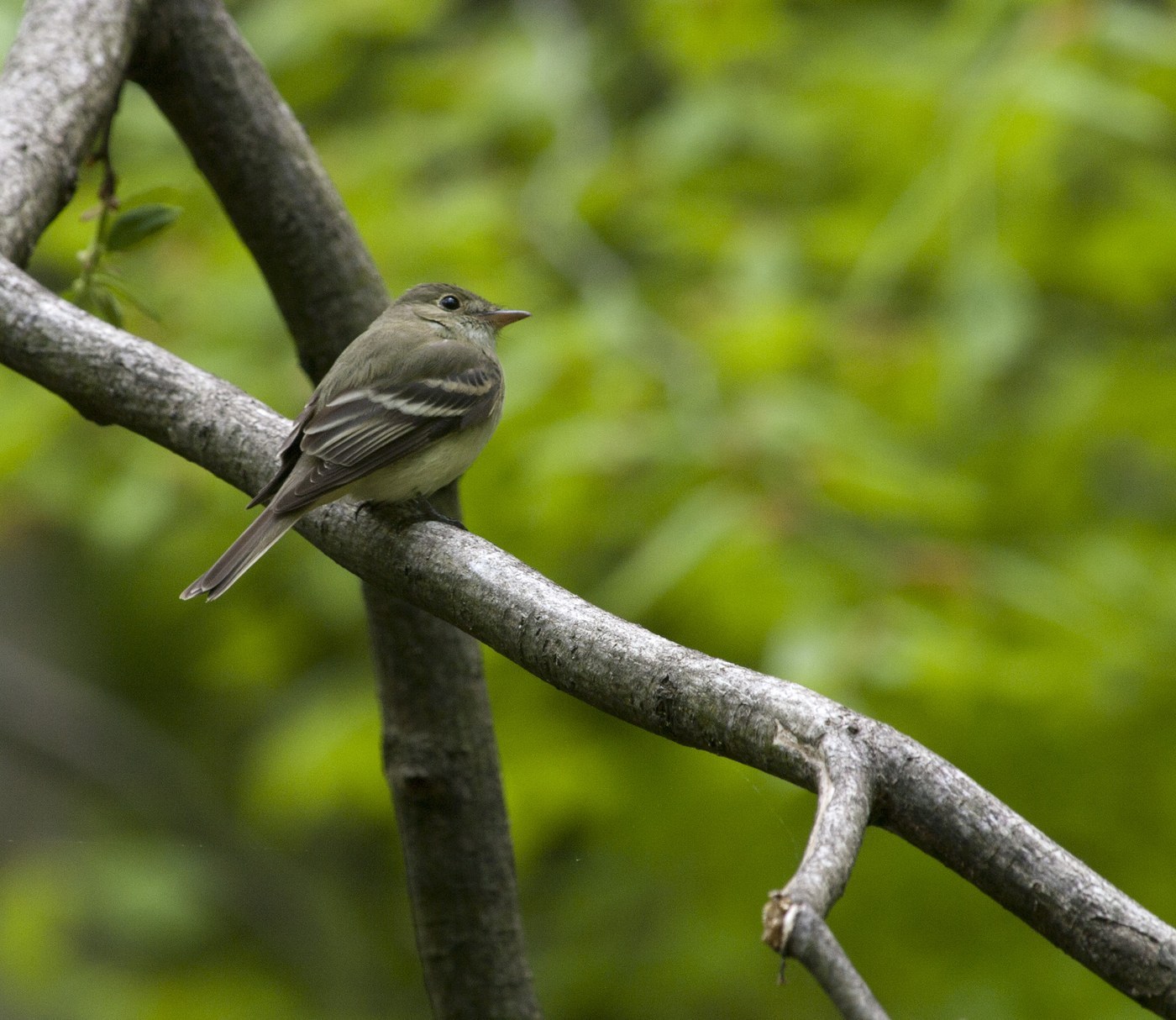
Acadian Flycatcher
Empidonax virescens
A greenish, large-billed Empidonax flycatcher of shaded eastern forest ravines, identified by its explosive 'peet-sah' song.
- Size
- 13-15 cm (5-6 in) long, 22-25 cm wingspan
- Habitat
- mature deciduous forest, especially shaded ravines and stream bottoms, in the eastern United States
- Type
- songbird
Spotted a bird like this?
Identify any bird from a photo, free.
Overview
The Acadian Flycatcher is a small, greenish-toned member of the Empidonax genus closely tied to mature deciduous forest in the eastern United States, particularly favoring shaded ravines, stream bottoms, and forest interiors with a well-developed canopy. It shows olive-green upperparts, a whitish eye-ring, pale wing bars, and a notably broad, wide-based bill for its size, with pale yellowish underparts.
Often more easily heard than seen as it forages in the shaded midstory, this species is identified with confidence by its explosive, two-note song, one of the more distinctive vocalizations among the Empidonax flycatchers.
How to identify it
Key Field Marks
- Olive-green upperparts, brighter and greener than many other Empidonax species
- Whitish eye-ring and pale yellowish wing bars
- Pale yellow wash on the underparts, more pronounced than in many relatives
- Notably broad-based bill
Similar Species
- Willow Flycatcher and Alder Flycatcher are duller and less green, with weaker eye-rings.
- Yellow-bellied Flycatcher shows a brighter, more extensive yellow wash and a boldly marked eye-ring, and breeds in more northern boreal habitat.
- The Acadian Flycatcher's explosive peet-sah song is highly distinctive and the most reliable identification tool.
Habitat & range
Acadian Flycatchers breed in mature deciduous forests across the eastern United States, favoring shaded ravines, stream bottoms, and forest interiors with a closed canopy and open understory, generally avoiding forest edges and young second growth.
The species winters in Central America and northern South America, migrating relatively late in spring compared to some other flycatchers.
Behavior & voice
Voice
Sings an explosive, sneezy peet-sah, often the first indication of its presence in the shaded forest interior; also gives a sharp peet call.
Feeding
Sallies from a perch in the forest midstory or understory to catch flying insects, and also hover-gleans prey from foliage.
Nesting
Builds a loosely constructed, shallow cup nest of plant fibers, often with dangling material hanging beneath, suspended in the fork of a horizontal branch, typically over a stream or in a shaded ravine.
Frequently asked questions
How do I identify an Acadian Flycatcher?
Look for a greenish Empidonax flycatcher with a broad bill and yellowish wash on the underparts in shaded, mature deciduous forest; its explosive 'peet-sah' song is the most reliable identification clue.
What kind of habitat does the Acadian Flycatcher prefer?
It favors mature deciduous forest with a closed canopy, especially shaded ravines and stream bottoms in the eastern United States.
How is the Acadian Flycatcher different from the Yellow-bellied Flycatcher?
The Acadian Flycatcher has a less extensive yellow wash and breeds in eastern deciduous forest, while the Yellow-bellied Flycatcher is brighter yellow overall and breeds farther north in boreal bogs.
Where do Acadian Flycatchers spend the winter?
They migrate to winter in Central America and northern South America.
Acadian Flycatcher guides
In-depth guides for identifying, finding, and understanding Acadian Flycatcher.
Other birds you may enjoy

Black Redstart
13-14.5 cm (5.1-5.7 in) long, 23-26 cm wingspan

Black-throated Sparrow
12-14 cm (4.7-5.5 in) long, about 19-20 cm (7.5-8 in) wingspan

Greater Bird-of-paradise
Body about 43 cm; males with additional flank plumes up to 50 cm and long tail wires

Blue Tit
11-12 cm (4.3-4.7 in) long, 17-20 cm wingspan

Red-billed Quelea
11.5–13 cm long, wingspan about 20–22 cm
White-plumed Antbird
13-14 cm (5-5.5 in) long

Pyrrhuloxia
19-22 cm (7.5-8.7 in) long, 30 cm wingspan

Blue-gray Tanager
16-18 cm (6-7 in) long

Blackburnian Warbler
11-13 cm (4.3-5.1 in) long, 20-22 cm wingspan

Bluethroat
13-14 cm (5.1-5.5 in) long, 20-22 cm wingspan

Eurasian Nuthatch
12-14.5 cm (4.7-5.7 in) long, 22.5-27 cm wingspan

Wood Thrush
19-21 cm (7.5-8.3 in) long, about 33 cm (13 in) wingspan