
Acadian Flycatcher Identification Guide
A small olive-green Empidonax flycatcher of mature eastern forests, best confirmed by its explosive "pizza!" song rather than plumage alone.
Read the full Acadian Flycatcher encyclopedia entry →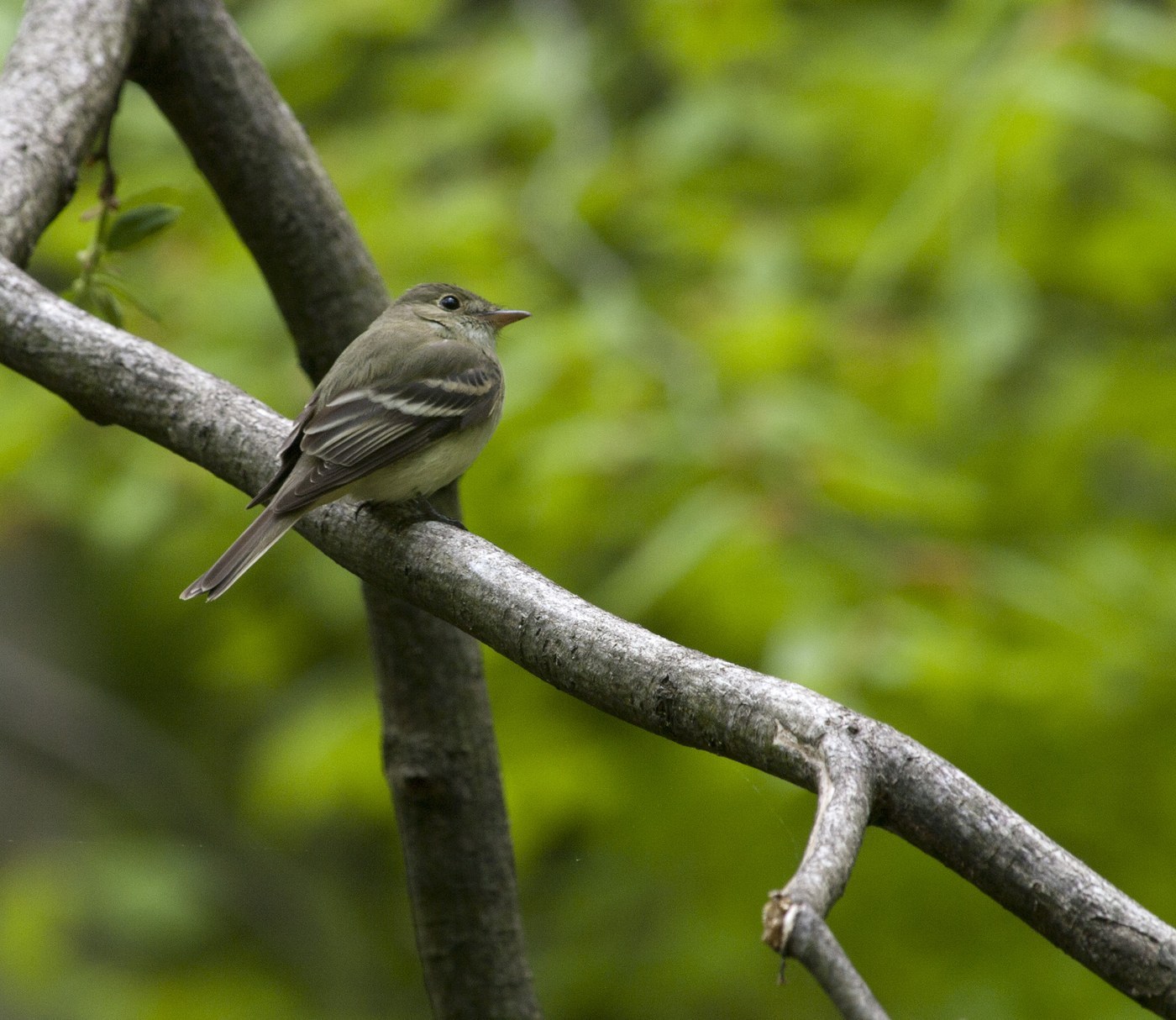
Key Field Marks
- Small flycatcher, about 14-15 cm (5.5-6 in), with a fairly large, wide bill for an Empidonax
- Olive-green upperparts, whitish underparts with a pale olive-yellow wash on the flanks and belly
- Two bold, pale (whitish to pale buff) wing bars
- Distinct whitish eye-ring, evenly thin all around
- Lower mandible entirely pale/pinkish, contrasting with the darker upper mandible
- Tail relatively long; overall a "long-winged, big-billed" impression among Empids
How to Separate It From Similar Species
- Acadian Flycatcher belongs to the notoriously difficult Empidonax genus, where plumage differences are subtle; voice is the most reliable field mark.
- Willow Flycatcher and Alder Flycatcher: both are drabber, browner-olive, with less contrasty wing bars and different calls ("fitz-bew" for Willow, "free-beer" for Alder); Acadian favors shaded forest interior rather than wet shrubby edges.
- Least Flycatcher: smaller, grayer, with a bolder white eye-ring and a shorter primary projection; gives a snappy "che-BEK" song, very different from Acadian's explosive call.
- Yellow-bellied Flycatcher: brighter yellow-green overall with a bolder, more complete eye-ring and a rounder head; breeds in northern bogs rather than southern deciduous forest.
- Structurally, Acadian shows the longest primary projection and largest bill of the eastern Empidonax flycatchers, useful with good views.
Where & When to See It
- Breeds in mature, closed-canopy deciduous and mixed forest, especially in shaded ravines, floodplains, and forest with a nearby stream or seep, across the eastern and southeastern United States.
- A long-distance Neotropical migrant, wintering from southern Mexico through Central America to northern South America; arrives on breeding grounds in late April to May and departs by early fall.
- Stays high in the shaded midstory to subcanopy, making it easier to hear than see.
Voice & Behavior Cues
- Song is an explosive, two-noted "pizza!" or "PEET-sah!" with the accent on the first syllable, delivered from a perch in the forest interior — the single best clue to identification.
- Call note is a sharp "peek" or "peet."
- Sits upright on a horizontal branch and sallies out to catch flying insects, returning to the same or a nearby perch (classic flycatcher behavior).
- Builds a shallow, saucer-like nest of grasses and plant fibers, often decorated with hanging streamers, suspended in a horizontal fork over water or a ravine.
Frequently asked questions
How can I be sure I'm identifying an Acadian Flycatcher and not another Empidonax?
Plumage alone is often insufficient; listen for its distinctive explosive "pizza!" song, which is diagnostic, and note its preference for shaded, mature forest interior.
What does an Acadian Flycatcher sound like?
Its song is a sharp, two-syllable "pizza!" or "PEET-sah!," and its call is a short, sharp "peek."
What habitat does the Acadian Flycatcher prefer?
Mature, shaded deciduous forest, especially in ravines, floodplains, or near streams, in the eastern and southeastern United States.
Is the Acadian Flycatcher migratory?
Yes, it is a long-distance migrant that winters in Central America and northern South America and breeds in the eastern United States in summer.