
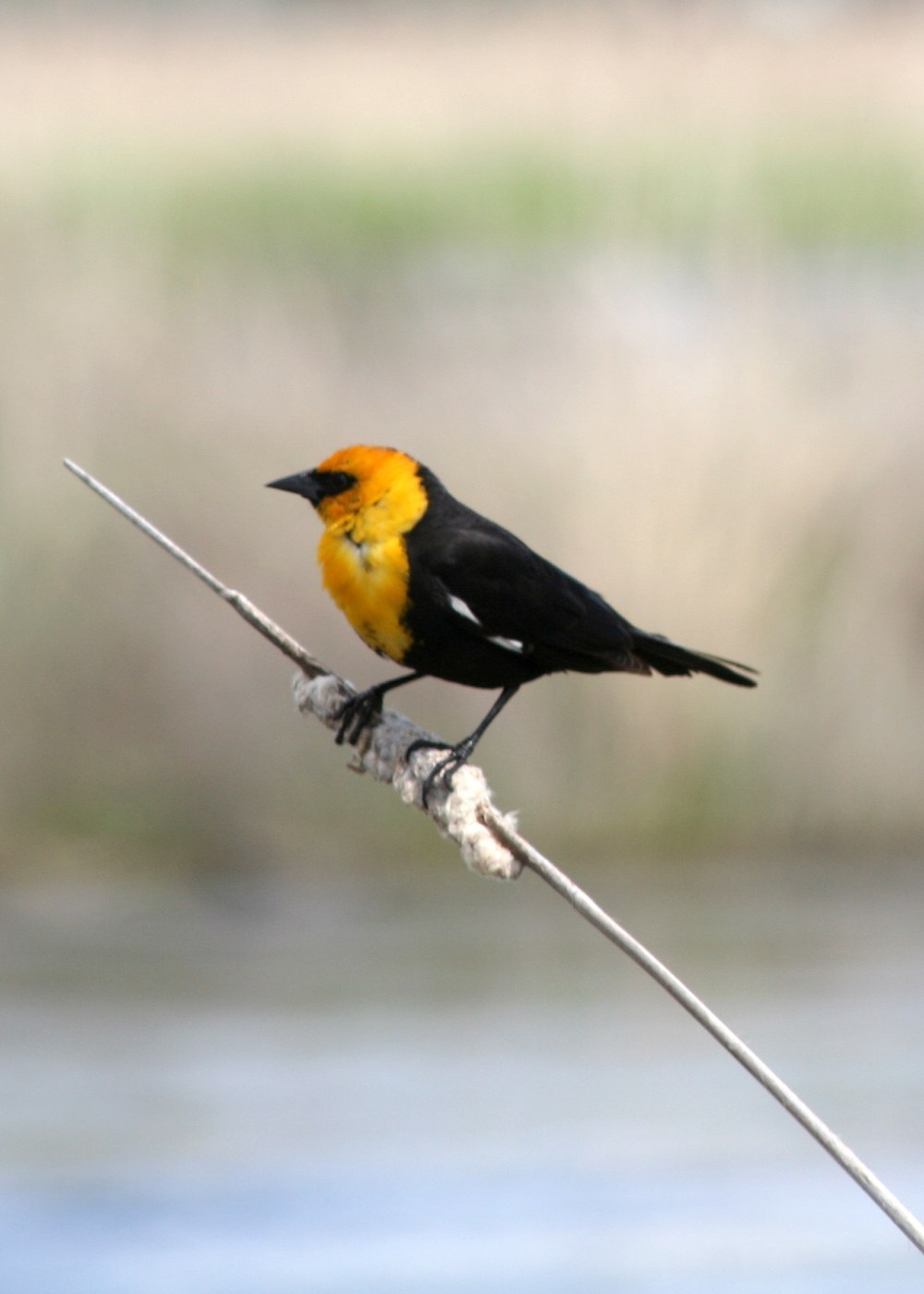
Yellow-headed Blackbird
Xanthocephalus xanthocephalus
A striking marsh blackbird with a brilliant yellow head and breast on males, forming dense breeding colonies over open water.
- Size
- 22-27 cm (8.5-10.5 in) long, about 40 cm (15.7 in) wingspan
- Habitat
- freshwater marshes with cattails and bulrushes
- Type
- songbird
Spotted a bird like this?
Identify any bird from a photo, free.
Overview
The Yellow-headed Blackbird is one of the most striking marsh birds of the western and central United States, its glossy black body topped by a brilliant golden-yellow head and breast in adult males, a color combination unmatched by any other North American blackbird. Females and immatures are considerably duller, showing brownish plumage with a subdued yellow wash on the face and breast.
The species nests colonially in dense marsh vegetation over open water, often alongside Red-winged Blackbirds, and males defend their territories with a memorably harsh, unmusical song that has been compared to a rusty gate hinge.
How to identify it
Key field marks
- Adult male: glossy black body with a bright yellow head and breast, and a white patch on the wing visible in flight
- Female: duller brown overall with a dull yellow face and breast, no white wing patch
- Heavy, pointed bill
- Colonial nesting in marsh vegetation over water
Similar species
No other North American blackbird combines an all-yellow head with a black body; male Yellow-headed Blackbird is essentially unmistakable. Female Red-winged Blackbird is heavily streaked brown without any yellow head coloration, distinguishing it readily from the duller female Yellow-headed Blackbird.
Habitat & range
Habitat
Yellow-headed Blackbirds require freshwater marshes with tall emergent vegetation such as cattails and bulrushes growing over relatively deep, open water for breeding.
Range
The species breeds across the western and central United States and southern Canada, from the Great Plains west to the Pacific states and north into the Prairie Provinces. It winters primarily in Mexico and the southwestern United States.
Migration
Yellow-headed Blackbirds are medium-distance migrants, moving in large flocks between breeding marshes and wintering grounds in agricultural areas and marshes farther south, often mixing with other blackbird species in winter flocks.
Behavior & voice
Behavior
Yellow-headed Blackbirds nest colonially, often in large, dense colonies over open marsh water, with males aggressively defending small territories against rivals including the sometimes co-occurring Red-winged Blackbird. Diet shifts from mainly insects during the breeding season to seeds and grain during migration and winter.
Voice
The song is a harsh, unmusical series of grating, creaking notes, often likened to a rusty hinge or door, quite unlike the more melodic songs of many other blackbirds.
Nesting
Nests are woven baskets of wet vegetation lashed to standing cattails or bulrushes over water, built by the female. Clutches typically contain 3-5 eggs, and males are often polygynous, mating with multiple females within a colony.
Frequently asked questions
What does a male Yellow-headed Blackbird look like?
It has a glossy black body, a bright yellow head and breast, and a white patch on the wing visible in flight.
What does a Yellow-headed Blackbird sound like?
Its song is a harsh, grating series of creaking notes, often compared to the sound of a rusty hinge.
Where do Yellow-headed Blackbirds nest?
They nest colonially in freshwater marshes, weaving nests into stands of cattails or bulrushes over open water.
How can you tell a female Yellow-headed Blackbird from a Red-winged Blackbird?
Female Yellow-headed Blackbird is brown with a dull yellow wash on the face and breast, while female Red-winged Blackbird is heavily streaked brown without any yellow coloration.
Yellow-headed Blackbird guides
In-depth guides for identifying, finding, and understanding Yellow-headed Blackbird.
Other birds you may enjoy

Black Redstart
13-14.5 cm (5.1-5.7 in) long, 23-26 cm wingspan

Black-throated Sparrow
12-14 cm (4.7-5.5 in) long, about 19-20 cm (7.5-8 in) wingspan

Greater Bird-of-paradise
Body about 43 cm; males with additional flank plumes up to 50 cm and long tail wires

Blue Tit
11-12 cm (4.3-4.7 in) long, 17-20 cm wingspan

Red-billed Quelea
11.5–13 cm long, wingspan about 20–22 cm
White-plumed Antbird
13-14 cm (5-5.5 in) long

Pyrrhuloxia
19-22 cm (7.5-8.7 in) long, 30 cm wingspan

Blue-gray Tanager
16-18 cm (6-7 in) long

Blackburnian Warbler
11-13 cm (4.3-5.1 in) long, 20-22 cm wingspan

Bluethroat
13-14 cm (5.1-5.5 in) long, 20-22 cm wingspan

Eurasian Nuthatch
12-14.5 cm (4.7-5.7 in) long, 22.5-27 cm wingspan

Wood Thrush
19-21 cm (7.5-8.3 in) long, about 33 cm (13 in) wingspan