
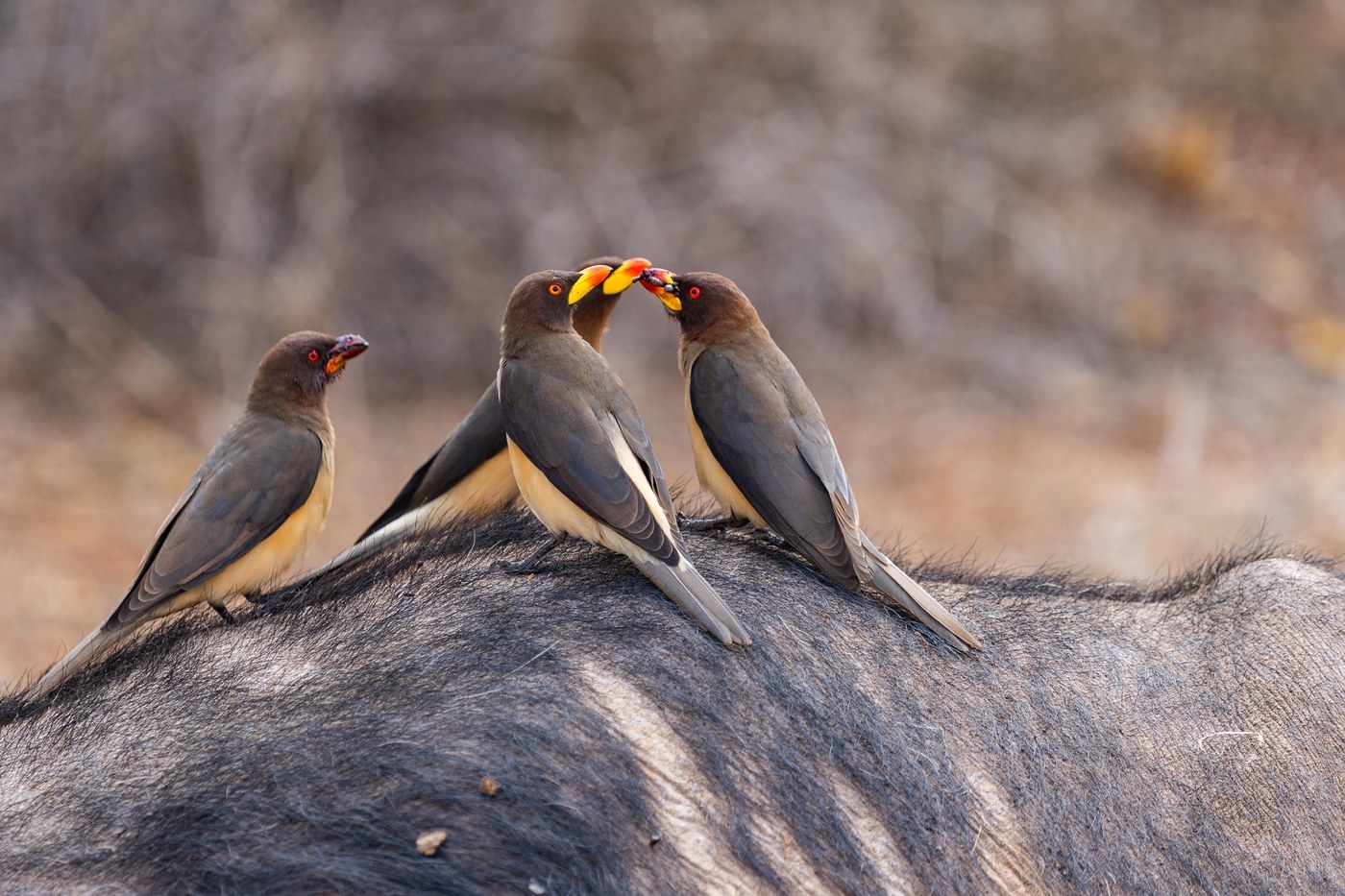
Yellow-billed Oxpecker
Buphagus africanus
A stocky African bird closely related to the Red-billed Oxpecker, identified by its yellow-based, red-tipped bill and lack of a bright eye-ring.
- Size
- About 20–22 cm long
- Habitat
- Savanna and woodland with large wild mammal populations
- Type
- songbird
Spotted a bird like this?
Identify any bird from a photo, free.
Overview
The Yellow-billed Oxpecker shares the same specialized lifestyle as its close relative the Red-billed Oxpecker, living almost entirely on the bodies of large African mammals. It has the same stocky build, strong clawed feet, and stiff bracing tail adapted for clinging to a host's hide.
Plumage is duller and plainer than the Red-billed Oxpecker, brownish above with a paler, less contrasting rump, and buffy underparts.
How to identify it
Key field marks
- Bill is yellow at the base and red at the tip, distinct from the all-red bill of the Red-billed Oxpecker
- No bright yellow eye-ring; the eye appears plain and dark-surrounded
- Duller, more uniform brown plumage with a less contrasting pale rump
- Sturdy body with strong claws for gripping host animals
Similar species
The Red-billed Oxpecker is the main confusion species, distinguished by its entirely red bill and conspicuous yellow eye-ring. In areas where both species occur together, bill color is the most reliable field mark.
Habitat & range
Habitat and range
The Yellow-billed Oxpecker is found across a broad band of sub-Saharan Africa, from Senegal and West Africa east to parts of East Africa and locally into southern Africa where it has been reintroduced or has recolonized areas, generally in savanna and woodland with abundant large mammals.
Migration
It is resident, with movements dictated by the local presence of host animals such as buffalo, hippopotamus, and antelope rather than true migration.
Behavior & voice
Behavior
Like the Red-billed Oxpecker, this species spends nearly all its time perched on large mammals, moving over the body in search of ticks. It forms small groups, sometimes joining mixed flocks with Red-billed Oxpeckers where ranges overlap.
Voice
Calls are hissing and churring notes similar to those of the Red-billed Oxpecker, given while foraging on a host or in flight between animals.
Feeding
It feeds on ticks and other ectoparasites gleaned from the skin of large mammals, along with blood from wounds and some insects disturbed by grazing animals.
Nesting and breeding
Nests are built in tree cavities, lined with hair from host mammals. Clutch size is typically 2–3 eggs.
Frequently asked questions
How is the Yellow-billed Oxpecker different from the Red-billed Oxpecker?
It has a yellow-based bill with a red tip rather than an all-red bill, and it lacks the Red-billed Oxpecker's bright yellow eye-ring.
What do Yellow-billed Oxpeckers eat?
They primarily eat ticks and other external parasites found on large mammals, along with some blood from wounds.
Where do Yellow-billed Oxpeckers live?
They range across parts of West, Central, East, and southern Africa, wherever large wild mammal herds are present.
Do Yellow-billed Oxpeckers only live on animals?
They spend the vast majority of their time on host mammals but do fly between animals and roost or nest in nearby trees.
Yellow-billed Oxpecker guides
In-depth guides for identifying, finding, and understanding Yellow-billed Oxpecker.
Other birds you may enjoy

Black Redstart
13-14.5 cm (5.1-5.7 in) long, 23-26 cm wingspan

Black-throated Sparrow
12-14 cm (4.7-5.5 in) long, about 19-20 cm (7.5-8 in) wingspan

Greater Bird-of-paradise
Body about 43 cm; males with additional flank plumes up to 50 cm and long tail wires

Blue Tit
11-12 cm (4.3-4.7 in) long, 17-20 cm wingspan

Red-billed Quelea
11.5–13 cm long, wingspan about 20–22 cm
White-plumed Antbird
13-14 cm (5-5.5 in) long

Pyrrhuloxia
19-22 cm (7.5-8.7 in) long, 30 cm wingspan

Blue-gray Tanager
16-18 cm (6-7 in) long

Blackburnian Warbler
11-13 cm (4.3-5.1 in) long, 20-22 cm wingspan

Bluethroat
13-14 cm (5.1-5.5 in) long, 20-22 cm wingspan

Eurasian Nuthatch
12-14.5 cm (4.7-5.7 in) long, 22.5-27 cm wingspan

Wood Thrush
19-21 cm (7.5-8.3 in) long, about 33 cm (13 in) wingspan