
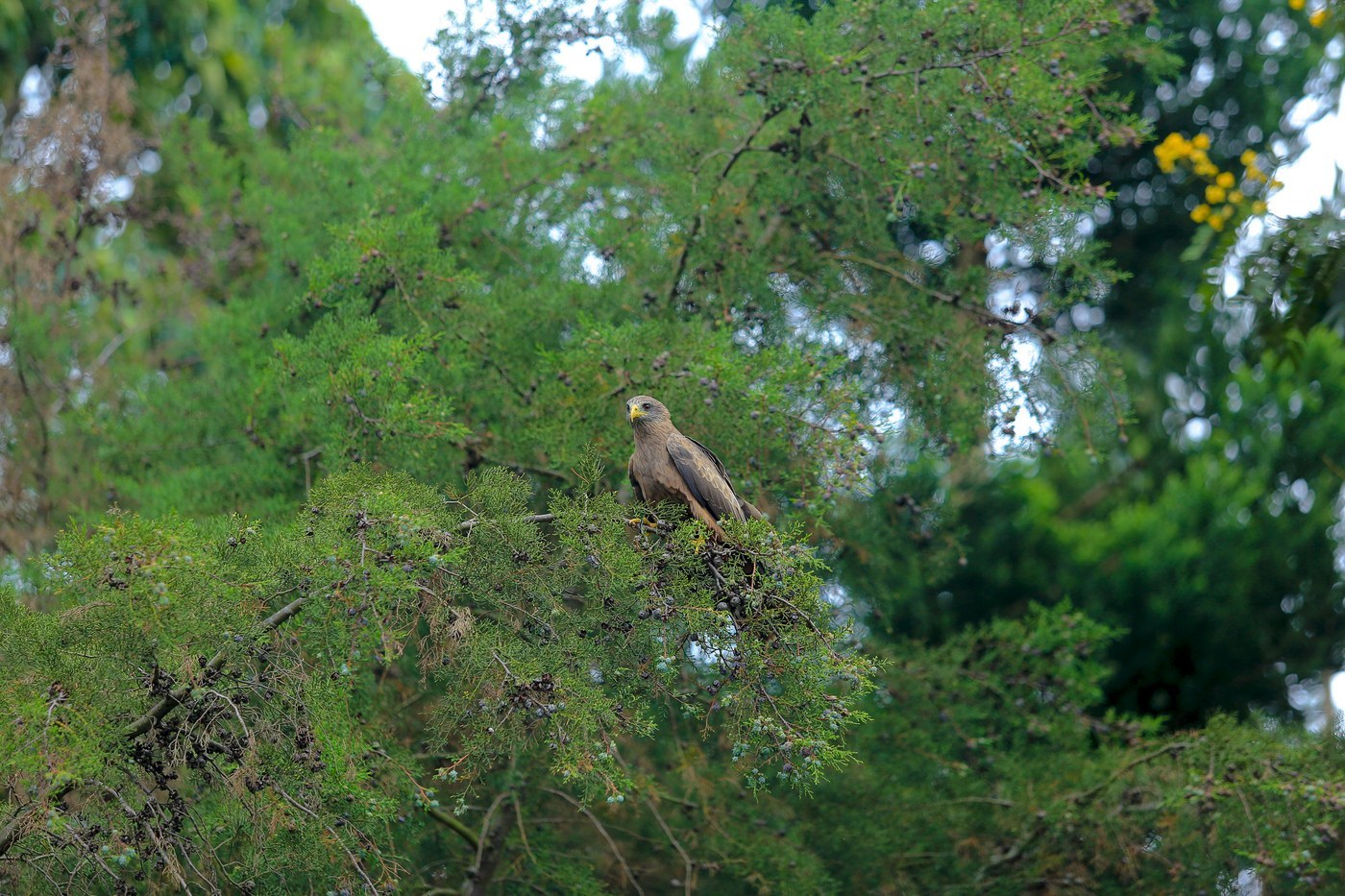
Yellow-billed Kite
Milvus aegyptius
A common, adaptable African raptor with a bright yellow bill and forked tail, often seen soaring over towns and open country.
- Size
- 55-60 cm long; wingspan 130-155 cm
- Habitat
- Open savanna, grassland, farmland, and urban areas across sub-Saharan Africa
- Type
- raptor
Spotted a bird like this?
Identify any bird from a photo, free.
Overview
The Yellow-billed Kite is a medium-sized, dark raptor of sub-Saharan Africa, closely related to the Black Kite and often treated as its African representative. It is one of the most familiar birds of prey across much of the continent.
Appearance
Plumage is a fairly uniform dark brown overall, slightly paler on the head, with a distinctly notched or shallow-forked tail visible in flight. As its name suggests, the adult's bill is bright yellow, contrasting with the dark plumage; the cere is also yellow. Juveniles have a dark, dusky bill that yellows with age, along with paler streaking on the underparts.
How to identify it
Key field marks
- Uniform dark brown plumage with a shallowly forked tail
- Bright yellow bill and cere in adults (dusky in juveniles)
- Buoyant, agile flight with frequent tail twisting for steering
Similar species
Black Kite (where ranges or subspecies overlap) has a dark bill rather than yellow. Yellow-billed Kites are often confused with other brown raptors such as buzzards, but the forked tail and habitual soaring/gliding flight with wings held slightly angled distinguish it. Its frequent association with human settlements, roads, and grass fires also aids identification.
Habitat & range
Habitat
Highly adaptable, occupying open savanna, farmland, wetland edges, and readily using urban and suburban areas, including towns and cities where it scavenges.
Range
Widespread across sub-Saharan Africa, from the Sahel south to South Africa, and also found in Madagascar and parts of the southern Arabian Peninsula.
Migration
Many southern African populations are intra-African migrants, arriving in the austral spring and departing after breeding, while other populations are largely resident; movements are also linked to rainfall and food availability.
Behavior & voice
Behavior
Yellow-billed Kites are opportunistic and highly social outside the breeding season, often gathering in numbers at grass fires, rubbish dumps, and abattoirs to catch fleeing prey or scavenge. They are agile fliers, constantly adjusting their forked tails while soaring and gliding.
Voice
Gives a thin, whinnying or mewing call, often a series of high-pitched notes descending in pitch, typically heard in flight or near nests.
Feeding
Feeds on a wide range of prey including rodents, reptiles, insects, and small birds, and readily takes carrion and food scraps; it is a frequent kleptoparasite, stealing food from other birds.
Nesting and breeding
Builds an untidy stick nest in a tall tree, sometimes reusing nests over multiple seasons. Typically lays two to three eggs, incubated mainly by the female while the male provisions her; both parents feed the chicks.
Frequently asked questions
How do you tell a Yellow-billed Kite from a Black Kite?
The Yellow-billed Kite has an all-yellow bill and cere in adults, whereas the Black Kite has a dark bill; their ranges also differ, with Yellow-billed Kite largely confined to Africa.
Why are Yellow-billed Kites often seen in towns?
They are opportunistic scavengers that readily exploit human settlements for food scraps, rubbish, and prey flushed by human activity.
Are Yellow-billed Kites migratory?
Many southern African populations migrate north into tropical Africa outside the breeding season, while other populations are resident.
What does a Yellow-billed Kite eat?
A varied diet of small mammals, insects, reptiles, birds, carrion, and human food scraps.
Yellow-billed Kite guides
In-depth guides for identifying, finding, and understanding Yellow-billed Kite.
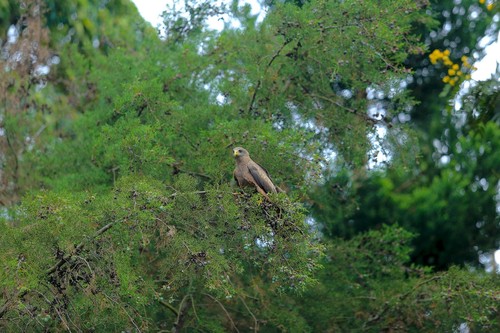
Yellow-billed Kite identified by the community
Real birds identified with Bird Identifier.
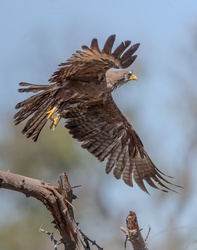
Other birds you may enjoy
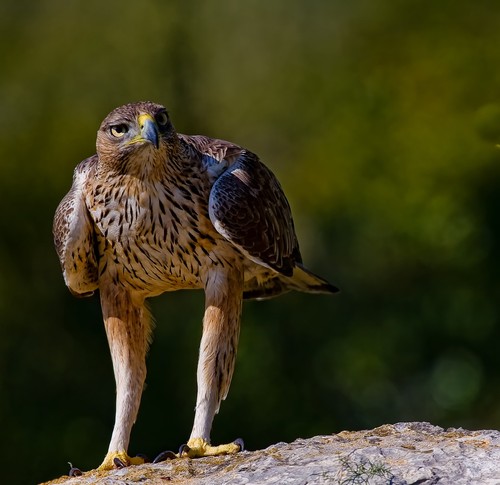
Bonelli's Eagle
Body 65–72 cm (26–28 in); wingspan 150–180 cm (59–71 in)
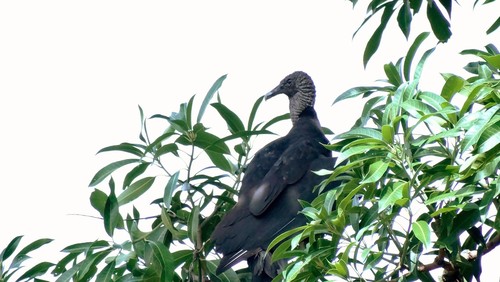
Black Vulture
56-68 cm (22-27 in) long, 137-165 cm wingspan
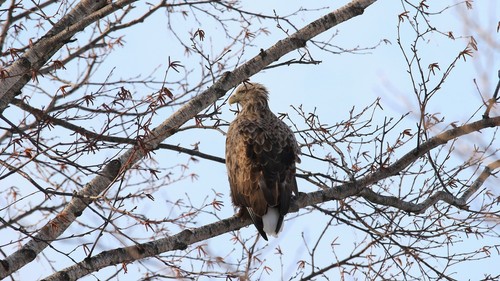
White-tailed Eagle
66-94 cm body length; wingspan 178-245 cm, among the largest eagles in the world
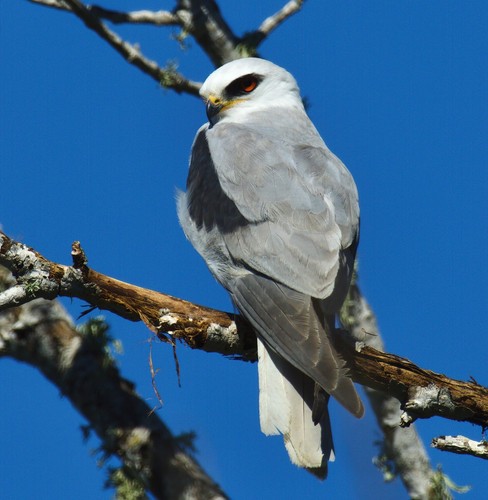
White-tailed Kite
35-43 cm (14-17 in) long, 88-102 cm (35-40 in) wingspan
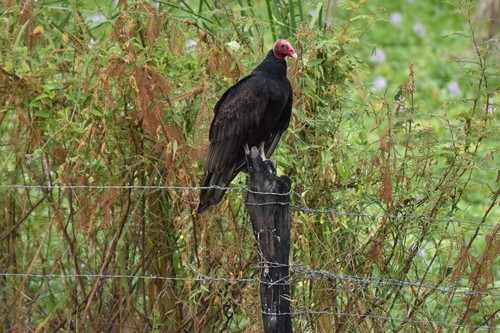
Turkey Vulture
64-81 cm (25-32 in) long, 160-183 cm wingspan
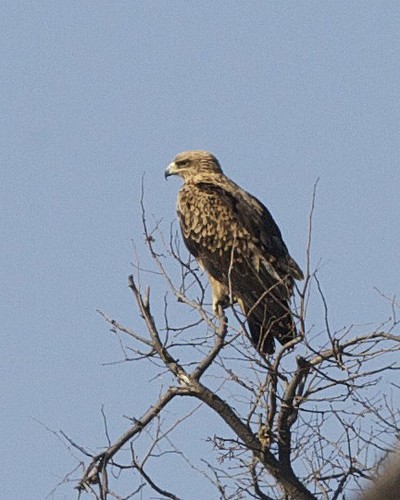
Tawny Eagle
62–75 cm long; wingspan 1.65–2.0 m
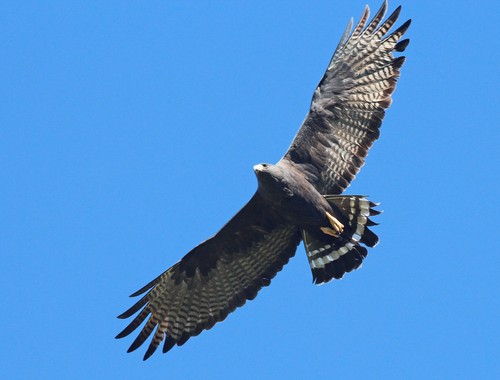
Zone-tailed Hawk
46-56 cm (18-22 in) long, 118-140 cm (46-55 in) wingspan
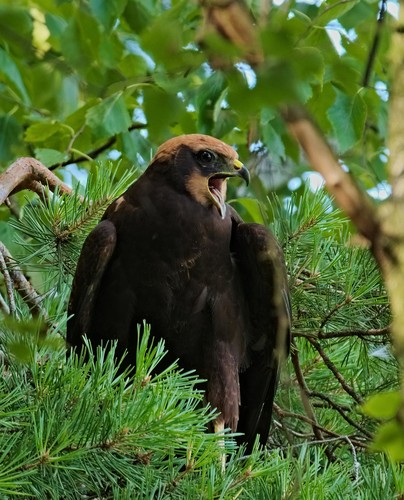
Western Marsh Harrier
Body 43-56 cm; wingspan 115-140 cm
Swallow-tailed Kite
48-68 cm (19-27 in) long including tail streamers, 112-136 cm (44-54 in) wingspan
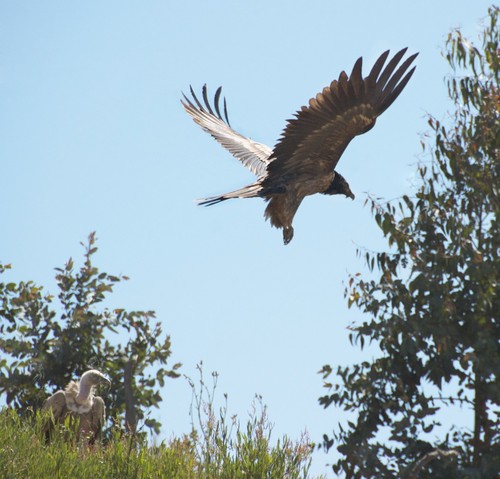
White-backed Vulture
78-98 cm long, wingspan 1.96-2.25 m
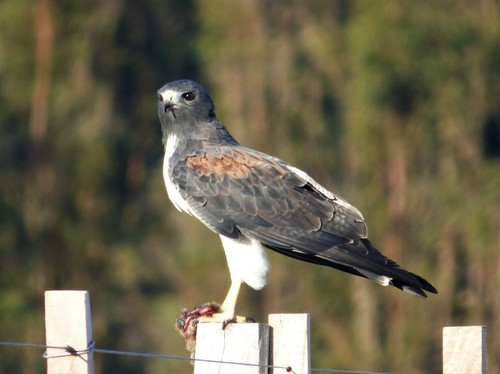
White-tailed Hawk
46-59 cm (18-23 in) long, 122-142 cm (48-56 in) wingspan
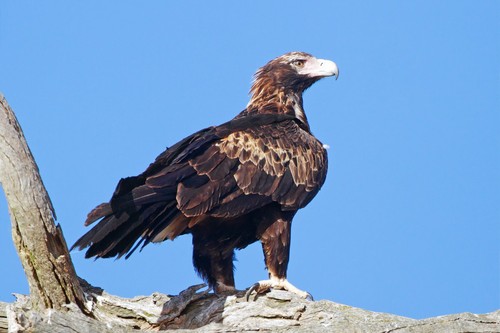
Wedge-tailed Eagle
Body 85–106 cm (33–42 in); wingspan up to 232 cm (7.6 ft); Australia's largest bird of prey